Those Were the Days, My Friend!

Somewhere in the night the “good old days” moved.  They turned 40 going on 50 and died.  History does that.  It telescopes out, maximizing its view, and then when it gets just beyond most human memory, it disappears.  I tend to think of it as the vanishing point, that point in time that we can’t actually remember anymore but which radiates all the well defined lines of our contemporary world.  We know it’s back there, and without it, we have no perspective, but we have no idea what it looks like.  It’s the point in every generation when living memory is replaced by historical record.

Despite what Mad Men and Pan Am try to tell you, we have no more in common with the early 60s than we do the Vikings.  Their world was a time of barbarians.  Their morality was close to home — family first.  They distrusted anyone over the horizon and stuck to their own clan.  The weakest among them either kept up or went under.  They drank and wenched and flung themselves at each other in fits and starts of passion.  Honour was satisfied with blood.   Thought required action.  They lived in a desperate, suspicious time.

I’ll bet for a minute there you thought I was talking about the Vikings; I wasn’t.

Nostalgia has a way of creeping up on us.  As John Knowles said in A Separate Peace (or was it Herman Raucher in Summer of ’42) we all have our own time and we never leave it.  However, after a while, our time becomes blurry with everyone else’s.  Today, it’s hard to imagine that somewhere Astronaut Neil Armstrong, the Ohio boy who left the first footprint on the moon, was a contemporary of Astronaut Anthony Nelson who finally married Jeannie the Genie in I Dream of Jeannie.  It’s difficult to reconcile that, in those days, we had the intelligence to go to the moon but not the sophistication to show a woman’s bellybutton on TV.  So we slide events around in our memory, and even people who were there have to Google things to get the time line right.  There’s no such thing as documented memory.

Today, the 80s are the “good old days” and the 60s are ancient history.  It was a time when Reagan and Thatcher ruled the earth and Presidents went riding with Queens.  The Soviet Union was in its last dying convulsions with four Premiers in five years and Mao was already dead.  There was a truce in the Cold War, and although total nuclear annihilation was still a possibility (a lot closer than we knew) we were much more afraid of AIDS.  Terrorist attacks were isolated, always somewhere else (places like Lockerbie and Beirut) and the killing was manageable.  A lot of people learned how to spell Chernobyl and Bhopal.

Cocaine replaced marijuana as the substance abuse of choice among the well-to do, and we still thought we could win the war on drugs.  Madonna was more-or less like a virgin, or so we thought and we didn’t know half as much as we needed to know about Michael Jackson.  Lucas and Spielberg hadn’t yet sold their collective souls and the franchise movie demons were still babies.  Mick Jagger and the Stones replaced Buddy Holly and the Crickets on Golden Oldies radio.

IBM and Commodore controlled the personal computer industry until Steve Jobs and Steve Wozniak changed the rules with Apple and a hardwired mouse.  People (they weren’t called gamers yet) had a choice between Pac Man and Donkey Kong.

Mexican debt exceeded its ability to pay, but everybody else was making the mortgage, and for the first time in history, trans-Pacific trade eclipsed trans Atlantic.  Most people thought Wall Street and Donald Trump were the good guys.

Someday, rather soon actually (more than half the kids born after the Fall of the Berlin Wall don’t know who Gorbachev is) these new “good old days” will become history.  People will wonder whether Seinfeld was before or after Miami Vice.  They’ll look at photographic film cameras in a museum and wonder how people took videos of the riots.  They’ll laugh at the size of the telephones and the computers and the internal combustion cars.   Generation-i will roll their eyes at the primitive world their parents grew up in.  And — heaven help us! — this world around us, called 2011, will be the “good old days.”

Hawkeye Pierce and the Rise of the Smart Ass

I blame MASH; not the book or the movie: the television series.  If it hadn’t been for it overstaying its welcome, we wouldn’t be fighting for our lives against the pandemic of pompous asses that have plagued us ever since.

Most people don’t know that MASH the entertainment franchise is based on MASH: A Novel about Three Doctors written by Richard Hooker (H. Richard Hornberger.)  It was a cute little comic novel based on the real-life mayhem at a Mobile Army Surgical Hospital during the Korean War and originally published in 1968.  This was right around the time that Mobile Army Surgical Hospitals in the Vietnam War were up to their elbows in real casualties – almost literally.  Therefore, even though it wasn’t a New York Times bestseller (at the time) it enjoyed a certain success; enough to attract the attention of Hollywood.  Within a year, a mediocre industrial film director named Robert Altman got hold of a screenplay from the book and filmed M*A*S*H with Donald Sutherland and Elliott Gould.  It came out in 1970.  Altman absolutely lucked out with a combination of nouveau cinema camera techniques and worldwide anti-war enthusiasm.  It also didn’t hurt that the movie was black dog hilarious for the time.  It won the Palme d’Or at the Cannes Film Festival and a handful of Oscar nominations.  Interestingly, it’s only Oscar was for Best Screenplay, written by Ring Lardner Jr.  Television executives have never been accused of not cashing in on a good thing, so MASH, the television series, premiered on CBS two years later — on September 17th, 1972.  Nobody paid much attention to it at first, but then it was rescheduled behind Norman Lear’s All in the Family (the Amos and Andy of the 70s) and a star was born.  His name was Alan Alda.

Before 1972, Alan Alda was a permanent TV guest star and a recurring panellist on I’ve Got a Secret and What’s My Line? – two TV programs that are difficult to explain to a 21st century audience.  His only starring role was as George Plimpton in Paper Tiger (a movie I’m sure has only been seen by me and nobody else I know.)  However, Alda is a good actor and when he landed the role of Hawkeye Pierce (Donald Sutherland in the movie) he must have thought he’d died and gone to celebrity heaven.

He probably didn’t realize how long heaven was going to last.  MASH was on television for eleven years — nearly four times as long as the Korean War itself and about twice as long as it should have been.  I’m sure that more wounded soldiers came through the fictional 4077 MASH unit than actually fought the war – on both sides.  In the end, only Hawkeye and Hotlips (although nobody called her Hotlips anymore) remained out of the original cast, and they were treating industrial accidents from the local Hydunai factory.  Most importantly though, Alan Alda singlehandedly not only destroyed a perfectly good bit of television comic relief but made it socially acceptable to be an utter know-it-all jerk.

Here’s a bit of background.  The book and the movie make clear that Benjamin Franklin Pierce is a good doctor.  He finds himself trapped in a hell-hatched netherworld where doctoring is fast-tracked into something called “meatball surgery” — a lot of blood, stress you could hit with a hammer, and no end in sight.  Pierce and his buddies, however (like young people everywhere) think they can make the best of a bad situation by adding large quantities of alcohol and an active libido.  They believe this will somehow balance the absurdity of war.  The result is a bunch of antics about the Korean War that we’re never going to read in the history books but that probably happened, all the same.  (I’ve heard similar tales out of Vietnam.)  The important point is, never, at any time — in neither the book nor the movie — does Hawkeye Pierce start shooting his mouth off about macro-vision moral values.  He’s just trying to get himself out of the war in one piece, with his sanity still intact.

Back to 1972!  In the beginning, Alan Alda’s Hawkeye was recognizably the same guy from the movie, if not the book.  For example he never delivered Pierce’s signature “Finest kind” line with any believability.  But somewhere after the second season, it all went to his head and he started playing Pierce like a morally superior Groucho Marx with a knife in his hand.  He became a wiseass, and a mean one at that.  Not only that, but he was always right.  The guy ran around like he was the smartest person in the Korean theatre of war, and he was always willing to tell you about it.  There was no problem — medical or otherwise — that he didn’t have the inside scoop on, and it became increasingly apparent that he thought he was surrounded by idiots.  It got so bad that Trapper John got fed up and cleared off without even a “See ya later.”  (FYI Trapper was killed by Adam Cartwright’s grandson, who assumed his identity and took over his medical practice in San Francisco.)  He was replaced by B.J. Hunnicutt, a perfectly bland second banana, who oozed smarm so thick you could cut it with a scalpel.  Pierce may not have chased everybody off the show, but there were more casualties among the actors than there were in the operating room.  The only supporting cast left at the end were Klinger — a TV invention — and Father Mulcahy
— who had to forgive him.

That wasn’t the worse of it, though.  For at least the last six seasons and maybe more, Hawkeye Pierce acted as if his superior understanding trumped all other ideas and observations.  The show was written so that every week Pierce showed up the blaring inadequacies of everyone around him and made fun of them while he was doing it.  There was no moral question he didn’t have an answer for and no social injustice he couldn’t mend; meanwhile solving serious medical emergencies as an afterthought.  And all of this was delivered with a smart ass insult!  The guy didn’t just take the moral high ground: he landscaped it, built a house and settled in for the duration.

Before Alan Alda, Hawkeye Pierce was the type of guy you wanted to be around.  He was good at what he did and fun in the off hours.  After Alda, Pierce became the quintessential pompous ass, and since he was beamed into millions of living rooms every week (and still is) it’s now socially acceptable.  We’ve all met them.  He’s the guy (and they’re usually guys) who shows up with this whole “Bite me!  I’m smarter than you are.” attitude.  He always has all the answers even though you didn’t ask any of the questions.

Poor Benjamin Franklin Pierce became the prototype of our contemporary oh-so-superior man and unfortunately, since then, they’ve been mass produced.

Millionaires, Billionaires and the NBA

After last week, many among us started queuing up to buy tickets for an extended cruise to the not-so-tropic islands of Gloom and Doom.  It’s an understatement to say the news from around the world hasn’t been that good.  The first of the vulnerable European banks, Dexia SA, is folding up like a cheap lawn chair with a couple more waiting for the next stiff financial breeze to follow suit.  Merkel, Cameron and Sarkozy are once again scrambling around, trying to convince European taxpayers that if they just dump enough gold into the Aegean Sea, it will eventually float.  (It won’t, by the way.)  Meanwhile, Madame Lagarde, who already warned us that we’ve got somewhere between four and six weeks to get our financial house in order, has figuratively thrown up her hands and gone home.  I’m not even including Barack Obama in this litany because most of his economic crew have already jumped ship.  The ones who are left are shaking their heads and (you guessed it!) rearranging the deck chairs — to invoke a familiar analogy.  Then, to top it all off, The Canadian Council on Learning released some astonishing news yesterday.  Cloaked in long and boring bureaucratese, their report basically says that the killer whales at Sea World are getting a better education than Canadian children, and if we don’t watch out, in ten years we’re going to be the dumbest country on the planet.  Our present situation sucks, and the only thing we can say about the future is, “Thar she blows!”

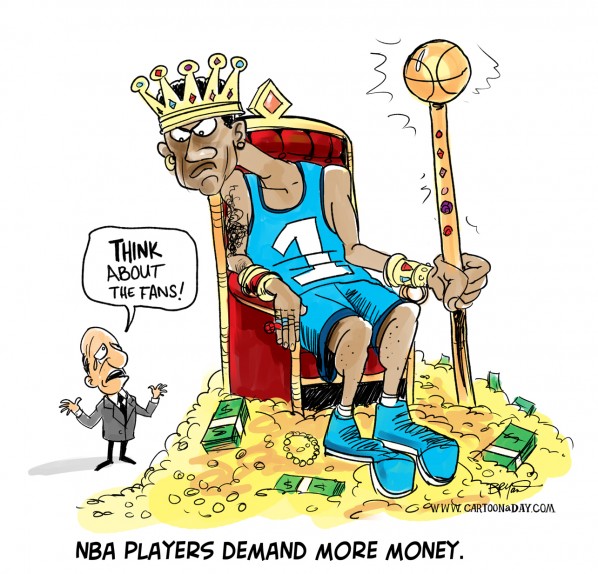
However, before you give up hope entirely and start looking for an inside cabin on the S.S. Pessimistic, there is one group of people in this world who do understand economics: NBA basketball players!  These multimillionaires are putting their livelihood on the line to school their billionaire bosses in the rudiments of supply and demand.  And here’s the punch line: I’m only half kidding.

If you live outside the large urban areas of North America, you may not have heard that last July the NBA (National Basketball League) locked out its players and spent the summer trying to negotiate a new CBA (Collective Bargaining Agreement.)  Negotiations have not gone well, and a couple of days ago the Commissioner of the NBA, David Stern, cancelled the first two weeks of the season with probably more cancelations to follow.

Despite tons of rhetoric on both sides, everybody knows that this is an internal squabble about how the NBA will divide up the spoils they’re going to fleece out of the general public (and various levels of government) over the next five years.  The billionaire owners want 53%; however, the millionaire players also want 53%.  Since even basketball players can do math, there’s a problem.  But that isn’t the real problem because chances are good that like gangsters everywhere, they’ll likely settle on a 50/50 split.  The real problem is something called a salary cap.  What this means is the billionaire owners want an imposed limit on what they can pay players – kinda like a household budget with a whole bunch of zeros at the end.  The millionaire players, however, don’t want any part of that because it limits their potential earning power.  The billionaires said, “We can’t function without it.”  The millionaires said, “You lying dogs! You can so!”  They went back and forth for a while, and then both sides reached for their lawyers.  This is where we stand.

What’s actually happened, though, is for the past several years, the NBA owners have been throwing money at their players like a bunch of drunken bridesmaids at an Afterhours party at Chippendales.  As a consequence, despite soaring arena and television revenues, the owners’ wastrel ways have severely cut into their profit margins.  (Once again, there are arguments on both sides, but in real terms, if you’re giving Kobe 20 million, that’s 20 million you’re not putting in your own pocket.  It doesn’t matter if you’ve already got a couple of billion in there.)  So, now, the owners want a serious salary cap – to prevent them from spending themselves into the poorhouse.  Not only that, but they also want the players to bite the bullet and give up a lot of future earnings to make up for their (the owners’) financial idiocy.  One would think billionaires would be better money managers than this, but what can you do?

Meanwhile, on the other side of the bargaining table the players (mere millionaires, mind you) seem to have a better grip on financial reality.  They understand that slam dunks and free throws, no matter how well done, have no intrinsic value; they are only worth what the market will bear.  This goes all the way from the playground (“I’ll bet you five bucks you can’t make that shot.”) to cars and cheerleaders in college and million-dollar signing bonuses on draft day.  In simple economic terms, the players want to maximize their earnings over the short playing career of a professional athlete.  For example, if billionaire A (in, let’s say, Ohio) offers you ten million dollars to dribble in your shorts and Billionaire B (in … oh, I don’t know… let’s say Florida) offers you seventeen, your best bet is to take your basketballs and head south for the winter.  Anyone who didn’t make that choice would be a flaming fool.  It’s straight dollars and good sense.

So there you have it.  I have the feeling the NBA lockout is going to last for a while, and I’ll bet you Michael Jordan would give you odds that Kobe and the boys will be playing in Italy before it’s all over.  Personally, I gave up on the NBA back when Latrell Sprewell turned it into a bush-league joke, but blaming greedy players for ruining the NBA is nonsense – despite their childish antics.  It’s obvious the billionaire owners are the ones spending more money than their bottom lines can absorb — if only on paper.  It’s equally obvious the owners will eventually get their salary cap and then overspend it as fast as they can find the loopholes — and the beat goes on.

However, in these troubled times of financial confusion, it’s nice to know that somebody still believes in the power of market economics — even if it is only overpaid basketball players.