I’m Scared of the Mob

mobOne of the problems with observing our modern world is you spend half your life in fear and the other half with no friends.  Technically, I suppose, these are actually two problems, but they come from the same place: having an opinion and voicing it outside the comfy confines of your own head.  It’s a truism in the 21st century, that whenever you say anything about anything, you’re going to piss somebody off.  Most people get all free speech macho about this, but when push comes to shove, everybody knows that our society is unforgiving when it comes to unguarded opinion.  More importantly, when the mob turns against you, we punish it severely.  This is why we will never produce a contemporary Mark Twain or Stephen Leacock – the consequences of unedited thoughts, in today’s world, are just too dangerous.  Far better to be momentarily safe than monumentally sorry, so people with pens tend to stick to the road most travelled.  Unfortunately, that road is crowded with dumb-ass clichés.  Future anthropologists who attempt to piece together our social structure from the mountain of evidence we’re going to leave behind will naturally conclude we had an unholy obsession with lawyers, rednecks and upper middle class men.  They are the nominated villains for most of our commentators, so the record of our times will read like a bad John Grisham novel.   It’s a sorry state, but it beats the hell out of the world according to Suzanne Collins and E. L. James.

There’s no real problem with history recording our time as the shallow end of the intellectual swimming pool.  None of us is going to be around to be embarrassed by it anyway.  Nor do we have to worry about future chroniclers calling us cultural cowards.  They won’t be the slightest bit interested in our existence.  After all, you get historical ink from speaking up, not lying down.

The thing that burns my beans is that having set the table for a vigorous and dynamic dialogue, we’re now scared skinny of the food fight it might create.  Just look: we have a mostly educated public with the information of the ages at their fingertips (literally.)  We’ve cracked opened the old boys club and now have instant access to all manner of ideas from everywhere and everybody.  Furthermore, we live in a free society, where (for the most part) the rule of law gives free range to these ideas.  Plus our leaders (such as they are) fear public opinion and follow it relentlessly.  Life is good, right?  Wrong!  The first thing we did with this intellectual banquet was set dietary restrictions.  Not to beat the metaphor to death, we have populated our world with so many sacred cows that, in the land of intellectual plenty, we’re starving to death.

It used to be that the only thing that governed public discourse was civility.  There was decorum in our discussion.  For example, we didn’t call each other names – offensive or not.  Perhaps certain subjects were handled delicately, but there was never any thought that they should be avoided.  In fact, it was a matter of honour to shine light into the darker parts of our society – distasteful or not.
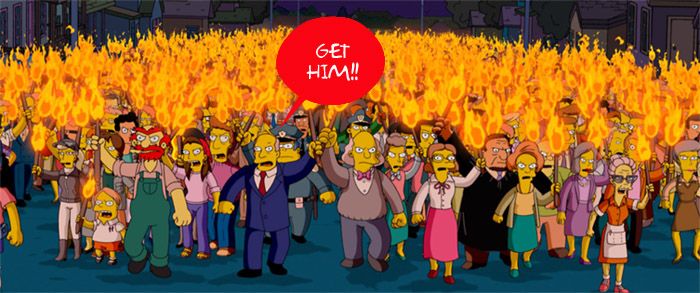
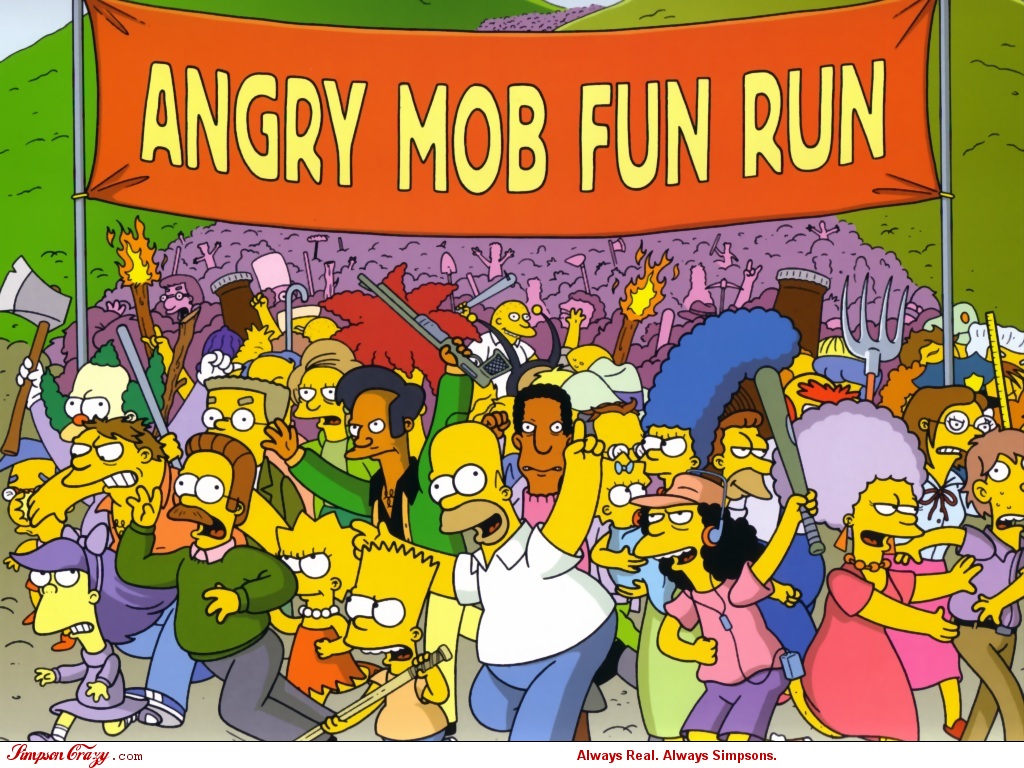
mob1These days, those days are over.  We have more social taboos than a tribe of Borneo headhunters.  A plethora of subjects in our world are no longer open for discussion.  Some of them I can’t even name in these pages without hollering up a verbal lynch mob.  In the past few years, this list has expanded exponentially.  Soon the only subjects anyone will feel comfortable commenting on will be the Kardashians’ breasts and the zombie apocalypse.

People like me, who know enough history to understand what the mob is capable of, are cowards at heart.  It’s one thing to go Vaclav Havel on the powers that be and strike out against censorship and oppression, for history shows us that eventually the pen is mightier than the sword.  However, it’s quite another to stand alone in front of a self-righteous mob of your neighbours and colleagues, demanding to be heard while they’re grabbing the torches and pitchforks.  In these troubled times, I do not fear the endless apparatus of the omnipotent state.  It’s the eagerly offended citizen, who created this mess that scares the crap out of me.

TV is Dead: Long Live TV!

tv ad2For a decade or so when I was young, I didn’t have a television machine.  It wasn’t because I have a philosophical argument with mass media – I don’t.  In fact, I’ve always been one of the cheerleaders – even back then.  Nor was it merely a sign of the times; despite popular mythology, even the most dedicated hippies of the Stoned Age watched television.  My situation was simple economics.  I couldn’t afford one in university, and it just got to be a habit.  As a result, I have no burning nostalgia for the days of Everybody Loves Friends TV.  To me, network television was just another brick in the media’s mind-numbing wall.  So, it’s with no emotion whatsoever that I can report the imminent death of television, and unlike Mark Twain’s premature demise, this is no exaggeration.

Let me clarify.  I’m not saying that those shiny screens we’ve got all over the place are going to follow the dinosaurs into extinction. Absolutely not.  Actually; I think we’re going to accumulate even more.  They’re going to get bigger.  They’re going to get smaller.  They’re going to be everywhere; and soon it’ll be impossible to escape their reflected glow.  But they’re not going to be the kind of television anybody born in the 20th century remembers.  Those times are gone and soon to be forgotten.

Way back in the day, when Milton Berle and Lucille Ball ruled the airwaves like media admirals, television was structured the same way as radio.  There were local programs of regional interest, but the national news and hardcore entertainment was provided by the networks.  We lived in a one-size-fits-all culture back then, and the whole family watched TV – together.  So when Lucy had “some ‘splaining to do” on Monday night, literally millions of people saw her do it and got the joke.  Network television built its power from those numbers and the massive advertising revenue they generated.  It was a lucrative arrangement, and TV to you and me was free.

Then along came cable.  Suddenly, media moguls discovered that the public would pay for television. What a novel idea!  Cable TV became the value-added medium that radio never had been.  People were willing to shell out substantial bucks for a few extra beyond-the-rabbit-ears channels and consistent sound and picture quality.  Within a couple of years, North America was wired up and life was good in media land.

Then along came Ted Turner, a guy who made a billion dollar career out of thinking outside the box.  In the early 70s, he figured out that the huge advertising dollars the big three networks were generating was simply a numbers game.  He knew that if he could broadcast his local station, WTCG, nationally, like the networks did through their affiliates, he could produce those numbers also and the ad revenue they generated.  Unfortunately, Ted didn’t have a network, or any affiliates or even very much money.  However, Ted realized he didn’t need any of those things because he could use the TV cables that local media companies had been stringing up all over the continent.  Those cables were hardwired into Ted’s potential national audience.  In 1976, the FCC approved Ted’s plan to broadcast WTCG nationally through hundreds of local cable networks, and the first Superstation was born.

From there, the floodgates were open.  Soon there were other superstations—notably, WGN Chicago and, of course, CNN.  By tv ad3the time Bill Clinton was in the White House, everybody and his friend had a specialty channel.  At the turn of the century, the 500 channel universe was alive and thriving and, ironically enough, already dying, as technology began to outrun the simple bit of coaxial cable that spawned it.  The Internet, once hardwired into your home or office was going wireless and when Stephen Jobs introduced the iPhone the revolution was on.

Today, as wireless communication grows, televisions are becoming empty receptacles – mere screens that host video games, iTunes, YouTube, Netflix etc. etc.  More and more people are choosing what they watch– and when they watch it– without reference to what television stations or networks are broadcasting.  Soon, that 60-inch big screen will be a slave to your smartphone, networks will produce pay as you play content only, and local stations, if they’re smart, will return to what they do best– local news and information.

By the time Lucy and Desi celebrate their 70th anniversary of reruns, nobody’s going to remember how we used to watch them, and television, as our generation knew it, will be dead as disco.

I Regret Nothing

regretI’ve missed a lot of things in my life: Elvis, a ballgame at the old Yankee Stadium, Heather McTavish (not her real name) and probably the Pyramids — if they don’t quit screwing around in North Africa.  These things are in no particular order and … oh, well! you win some, you lose some.  Life is, at best, a coin toss, and 50% or better is success.  After all, I’ve done a few other things that are going to surprise the hell out of the student volunteers when life finally lands me in the nursing home.  They’ll probably think I’m lying.

Personally, I don’t regret the things I haven’t done.  Chasing retroactive rainbows is not my style.  However, if Heather showed up tomorrow, I’d probably give it a shot, and who wouldn’t want to see a resurrected Elvis?  My point is, on the expressway of life, you might miss an off ramp every once in awhile, but so what?  There’s always a different one down the road.

However, there are certain things that I have actively pursued that simply haven’t worked out.  I used to think I needed to try harder or prioritize or some other such nonsense, but I learned early on that this was not the case.  For example, when I was a kid, there was a seawall which was the double-dog-dare-you macho challenge of my teenage years.  The object was to walk a concrete wall that separated the Pacific Ocean from a milder tidal pool – there and back again.  At high tide, the water swept back and forth over the top of the wall; at low tide, there was a 12 foot drop to the rocks below — and in between, the ocean battered and sprayed itself relentlessly across the concrete.  However, even though I’m scared of heights, bone-crunching surf and a number of other things that cause bodily injury, I desperately wanted to “walk the wall,” as we used to say.  I never did.  At the time, every time I went past the wall or joined the crowd to watch somebody else try to break their neck, my young man self esteem took a kicking.  This was especially true one after-school afternoon when good old what’s-her-name (I think Carolyn?) did it.  At fourteen, skulking is not the better part of valour.

Then an odd thing happened.  Semesters changed, somebody discovered that Paul McCartney had died; somebody else discovered Let It Bleed and everybody forgot about “walking the wall.”  I realized then that the gods had been protecting me from myself.  If I had put one pinky toe on that wall, I’d have crashed head first into Valhalla, and any macho points I might have gained would have been wasted at the funeral.

So what have we learned, boys and girls?regret2

Sometimes in life, we miss things, but rather than waste a bunch of time on regret, the best thing to do is keep on moving.  Maybe it wasn’t meant to be.  I don’t believe in fate or destiny or any of that other hocus-pocus, but I’m old enough to realize that if you’re instincts tell you no, don’t tempt the gods or you’re going to have to live with the consequences.

So, as far as I’m concerned, I’m never going to own the motorcycle that poverty denied me when I was young.  One hint of two-wheeled transportation and there wouldn’t be enough left of me to be an organ donor.  Nor am I ever going to play football again.  I still have 202 never broken bones and I’d like to take that stat to the grave.  And the gods don’t merely punish you with physical harm, either.  I’ve tried a million times to read Moby Dick, but since it never worked out, now, I plan to just keep it that way.  In fact, for years, I tried to watch a complete production of Othello: television, movies, live theatre, even puppets (if I could have got hold of some) but, strangely, it has never worked out.  I believe the gods are trying to tell me something.  So for the last few decades and from here on in, Iago, Desdemona and the mighty Moor – you’re on your own.