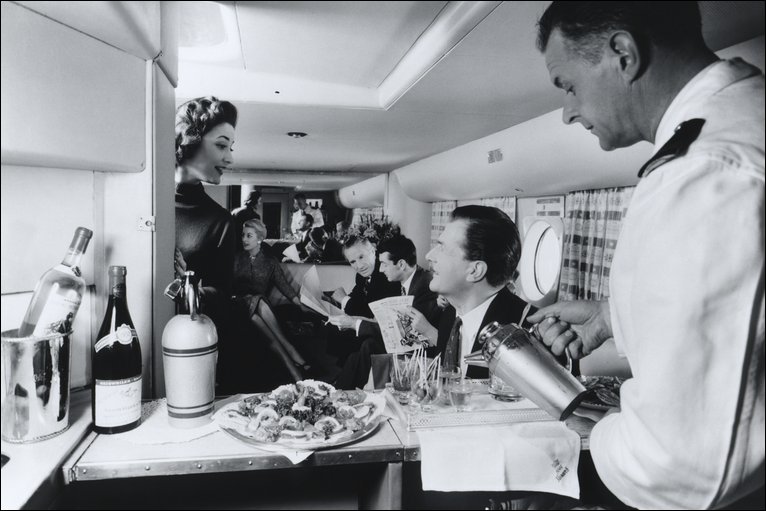
 I’m definitely dating myself, but I remember when air travel was elegant. Not the kind of Spy the Friendly Skies eyewash that ABC tried to promote with Pan Am but really a rather pleasant experience. People used to dress up for it and mind their manners. There was a style to it. It was an integral part of travel, not just a delivery system. Unfortunately, those days are gone and, like the rotary phone, they ain’t coming back.
I understand that the airline industry has grown up a lot since high-heeled stewardesses clicked up and down the aisles, handing out peppermints before take-off. Back in those days (at least in my neighbourhood) if you were travelling by plane, you’d either been saving your money since birth or somebody had just died. Air travel was expensive back in the day, and exceptional service was expected. Now, since the asking price of a ticket to London is cheaper than dinner and dancing anywhere but Burger King™, service has naturally deteriorated. Sheer numbers have overwhelmed most airlines’ ability to cope. Processing even one 747 full of sweaty tourists and their over-packed luggage has got to be a nightmare, and the airline industry is doing it thousands of times a day – all over the world. Obviously, the lines are going to be long, and the guy checking your bags won’t have time for a lot of idle chatter. After all, he’s looking at two or three hundred other people who need extra leg room and a window, too.
Then, of course, contemporary times have given us the extra added attraction that anybody with a boarding pass is now a target for every homicidal malcontent with a chemistry set. I’m not going to go into the whole WTF revelation that airline security is still looking for bombs and not bombers, but I’m not the only one who thinks that this misdirection is part of the problem. Honestly, measuring everybody’s lip balm and eye shadow as if they were Abu Nadel’s murderous grandchild certainly ramps up the grumpy and cuts down on the courtesy. But let me be the first to say that the security people in every airport I’ve ever been in have done a tremendous job against incredible odds. Think about it: they have to be right every time; the terrorist only has to get lucky once.
I don’t mind any of this really. It’s all part of the art of travel. One learns to hurry up and wait, amuse oneself with eavesdropped conversation and partial undress while holding a passport in one hand and a clear plastic bag with a toothbrush in the other. (It’s kinda like county jail with postcards.) Nor do I mind playing hide and seek with my departure gate, fending off imminent dehydration with overpriced bottled water or getting the disinterested plastic glove treatment. (I guess those guys really can’t smile.)
The thing I object to is the harshness and the impending chaos. Every time I walk into an airport, I get this vision that it’s sheep shearing time in the Australian Outback and, someplace out of sight, Bluey and the boys are sharpening the shears. People are flocking themselves back and forth in lamb-eyed confusion as if their best option might be the line marked souvlaki. Nobody, except maybe the folks who built the airport, actually knows where they’re going. They all just stumble around until they accidently find their baggage or the connecting flight. And ID tags don’t mean a damn thing either; every one of them has a different story. Once, at CDG in Paris, I got all the way out to the street without a passport stamp or my luggage on the advice of uniformed personnel behind a desk. Try explaining that to a couple of tres curious security guards – in fractured Franglais.
 Yes, I know, millions of people make it through thousands of airports every year with only tired and sweaty to bitch about, but really it could be so much better. I’m not suggesting we return to the days of yesteryear when pilots were all greying at the temples and stewardesses were harnessed into their underwear. However, getting from here to there should be more than running a guilty-until-proven innocent gauntlet, followed by a six to eight hour nose to knees dinner and a movie. As Lewis CK says, sitting in a chair in the sky is a fantastic experience. It could and should be tons more enjoyable.





 WD Fyfe