The Retort: A Fading Art Form

Even though I spend most of my time running a losing race with technology, I love it.  I look at kids phone-thumbing their way across the virtual universe and think “What a wonderful time to be alive!”  However, like most people my age, I’m already nostalgic for some of the finer points of the old world that technology is destroying.  First among equals on that list is the retort, that verbal slap that says: “Throw down!  ‘Cause this conversation just got serious.”  It’s impossible to retort electronically.  First of all, there’s too much lag time.  The retort has to be on the fly, swift, offhanded and sharp as a rapier’s thrust.  Secondly, there’s way too much nicey-nice in the digital world; too many LOLs and those sucky little emoticons.  The best you’ve got to be demonstrative with is the cap lock key, and that’s just sorry.  Finally, the retort has to be face to face; half of its power is delivery, half is tone and the other half is the nanosecond of recognition in the other person’s eyes that says “Gotcha!”

It’s really too bad the retort is fading from our world; however, I’ve collected a few to save them for posterity (like memorized books a la Fahrenheit 451) in the hope that, one day, the retort will be resurrected for general use.

I’d agree with you if you were right.

We can’t have a battle of wits; you’re an unarmed man.

If you’re so smart, why aren’t you rich?

That argument is an encyclopedia of misinformation.

If you’re trying to be a smart ass you only got the second half right.

Obviously, the only thing on your mind is a hat.

I could drive a truck through that argument and never hit the truth.

You’re not the village idiot; you’re his apprentice.

There are only three things wrong with that argument: the beginning, the middle and the end.

If thought were a symphony orchestra, you’d be playing the bagpipes.

I could make a better argument out of Alphabet Soup.

What did you study in school?  Recess?

Ideas that are that stupid should be put in solitary confinement.

That isn’t a painting; it’s paint.

That idea is about as bright as Cassiopeia on a cloudy night.

If stupid was an Olympic event, you’d be in the medal round.

Election 2012: A Campaign of Ideas?

I love a good fight, and nothing spells “Smack Down” like pissing off a Scotsman.  The Scotsman in question is Niall Ferguson, and the fight is over nothing less than the most important American election in a generation.  Last week, Ferguson came out swinging in Newsweek, calling the Obama administration everything but nice.  There was immediate retaliation and the war of the words was on.  I’m not going to go into the wherefores and the why right now, but you can read about it here, and follow the links all over the place.  The interesting thing is that maybe, just maybe, the 2012 presidential race is going to be a real election with issues and ideas and all kinds of other good stuff.  It could happen!

Regardless of which side of the aisle you’re on, up until a couple of weeks ago, it was pretty well agreed that the American election was going to be an outrageously expensive snoozefest.  Sure, Barack Obama wasn’t high-flying adored anymore, but he still had enough Evita Peron leftover to dazzle the multitudes.  On the other hand, Romney wasn’t exactly tearing it up in the charisma department.  The Man from Bland was living up to the moniker.  Meanwhile, the media, still a little uncomfortable with the laissez-faire treatment they’d given Barack the first time around, had decided to sit this one out.  Their strategy was that the Republicans would probably be Sarah im-palin themselves again, long before the bicoastal opinionators had to take a hand.  So they were spending their days drinking lattes and waiting for the latest Republican gaffe to Twitter by.  Enter Paul Ryan.

Ryan’s selection as the Republican vice-presidential nominee was a game changer.  Suddenly, the Republicans had something more to do with their time than get all defensive about things like gay rights and abortion.  Ryan made his bones babysitting the Budget in Congress.  He is a man with a plan and, like it or not, his economic theses are going to get nailed up on Obama’s cathedral door.  Basically, that’s what Niall Ferguson (a former advisor to John McCain) was doing — in 10,000 words or less — in Newsweek.

The Republicans know that they haven’t got a snowball’s chance in hell of beating Obama in a popularity contest – the guy’s just too ubercool.  For example, he won a Nobel Peace Prize a couple days after he signed orders to seriously escalate the war in Afghanistan.  When you think about that objectively, the only thing you can say is “Wow!”  Actually, I’m surprised the Nobel people didn’t just throw in the Literature Prize as well.  After all, somebody wrote The Audacity of Hope.  My point is there isn’t a Republican alive with that kind of star power.  Mano a mano, the GOP’s best shot would be to resurrect Lincoln.  Even then, there wouldn’t be any guarantees.  So what to do to get to 1600 Pennsylvania Avenue?

It not very complicated, really.  For any number of reasons, Obama has not delivered on his promises of change.   It’s obvious he’s made some terrible decisions, but, I think he didn’t have a hope, given the expectations put on the poor guy.  However, regardless of how he got here, even the apologists admit that the last four years have not been kind to him or America.  Now, with unemployment reaching double digits in some places, entitlement programs eating the budget faster than the Treasury can print money, a national debt that’s soaring into the stratosphere and an economy that’s hit rock bottom and started to dig, Obama’s vision of America is on trial.  Mitt has to offer a clear alternative.  He needs to stay away from the culture wars the Democrats love so much and match Obama — ideology for ideology.  Turning this campaign into a contest of ideas isn’t going to be easy, but, if he does, the White House could be well within his grasp.

Ever since John Kennedy took centre stage at the Kennedy/Nixon debates in 1960, American politics have leaned heavily on personality.  It would be totally refreshing if a candidate as unlikely as Mitt Romney could change all that.

Neil Armstrong 1930 – 2012

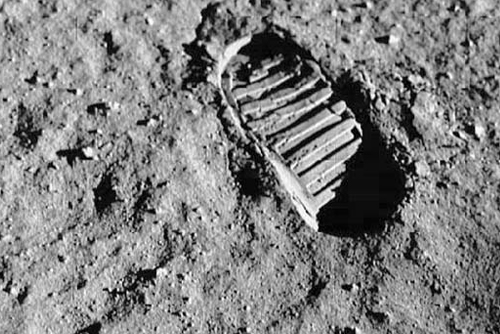
Some 40+ years ago, American knowhow and emerging technology sent an ordinary guy from Ohio, Neil Armstrong, to walk on the Moon.  It was an act of boots on the ground audacity that has since never been equaled.  “One small step for a man: one giant leap for mankind” was the culmination of the Big Idea, that magical mystical moment when people believe, tuck their egos away and apply all their energy, ambition and ability to reach for the stars.  When people do that, even the sky isn’t the limit.  Neil Armstrong was (and still is) the symbol of that selflessness.  Even as America changed its royal family from the Kennedys to the Kardashians Armstrong remained the reluctant hero – America’s last Gary Cooper.  He realized, better than anyone else on this planet, that, in fact, walking on the moon was not his accomplishment.

Neil Armstrong’s boot on the Moon changed history, but not simply because he put it there.  America’s Space Program and Moon landings produced much more than just an indelible footprint on an extraterrestrial body.  The innovation and technology alone changed our society.  Without Armstrong’s size 12s, our world would look very different from what we see around us today.  Let me demonstrate.

One of the first problems NASA encountered when it began flinging men out of our atmosphere is that pens (ordinary ballpoint pens) would not write in the weightlessness of space.  It was a small thing but critical to humanity’s conquest of the heavens.  Immediately, NASA set about solving the problem.  They hired a team of engineers, equipped labs and technical facilities, spent literally millions of dollars on the study of hydraulics in a vacuum and came up with the Zero Gravity Pen.  The Soviets, who had discovered the same problem some months earlier, thought about it thoroughly and gave their cosmonauts pencils.

Make no mistake: this story is absolute fiction (the Fisher Space Pen was developed independently in 1965.)  However, for decades, it has roamed our planet, masquerading as fact.  The important thing to note, is that even as most people believe this tale to be true, they are missing the significance of its allegorical message.

The pen-and-pencil myth is meant to show the narrow-minded American approach to problem solving.  Unable to think outside the box, they invariably ignore the simple solution and just throw money around promiscuously in a virtual orgy of waste.  This may be true to the casual observer, but look a little closer.  Yes, the pencil is an ingenious solution in the short term, but in the long term, it’s a dead end.  It doesn’t further the scope of innovation or engineering or scientific discovery or anything.  In actual fact, it stops the clock.

Fact or fiction, the residual value of the Zero Gravity Pen is enormous.  The American race for the moon provided the world with one of the greatest scientific leaps forward in human history.  They beat the Soviets by some years, and the seeds NASA planted doing it, grew into the technological wonders of our age – everything from miniaturization to massive personal computing power.  Almost at the exact moment the American-developed Internet was beginning to stride across the world like a new Colossus, the Soviet Union was imploding under the weight of its own stagnation.  Metaphorically, the Soviets were still using pencils.

So what does this have to do with the death of an American hero?  Not much, except that, at the very epicentre of NASA’s scientific and technological revolution, Neil Armstrong understood both the significance and the insignificance of his contribution.  He was the public face of the Space Race.  It was a man on the moon that galvanized the energies of a nation. Yet, for every footprint Armstrong left on the lunar surface, there had been literally thousands of nameless engineers and technicians whose job it was to put them there.  They were the ones who changed our world from pencils to Touch Screen Smartphones.

Neil Armstrong is an American hero — a man bold enough to go where no man had gone before.  But he also understood how he got there, was humbled by it, and, for the rest of his life, acted accordingly.