We’ve Run Out Of Villains

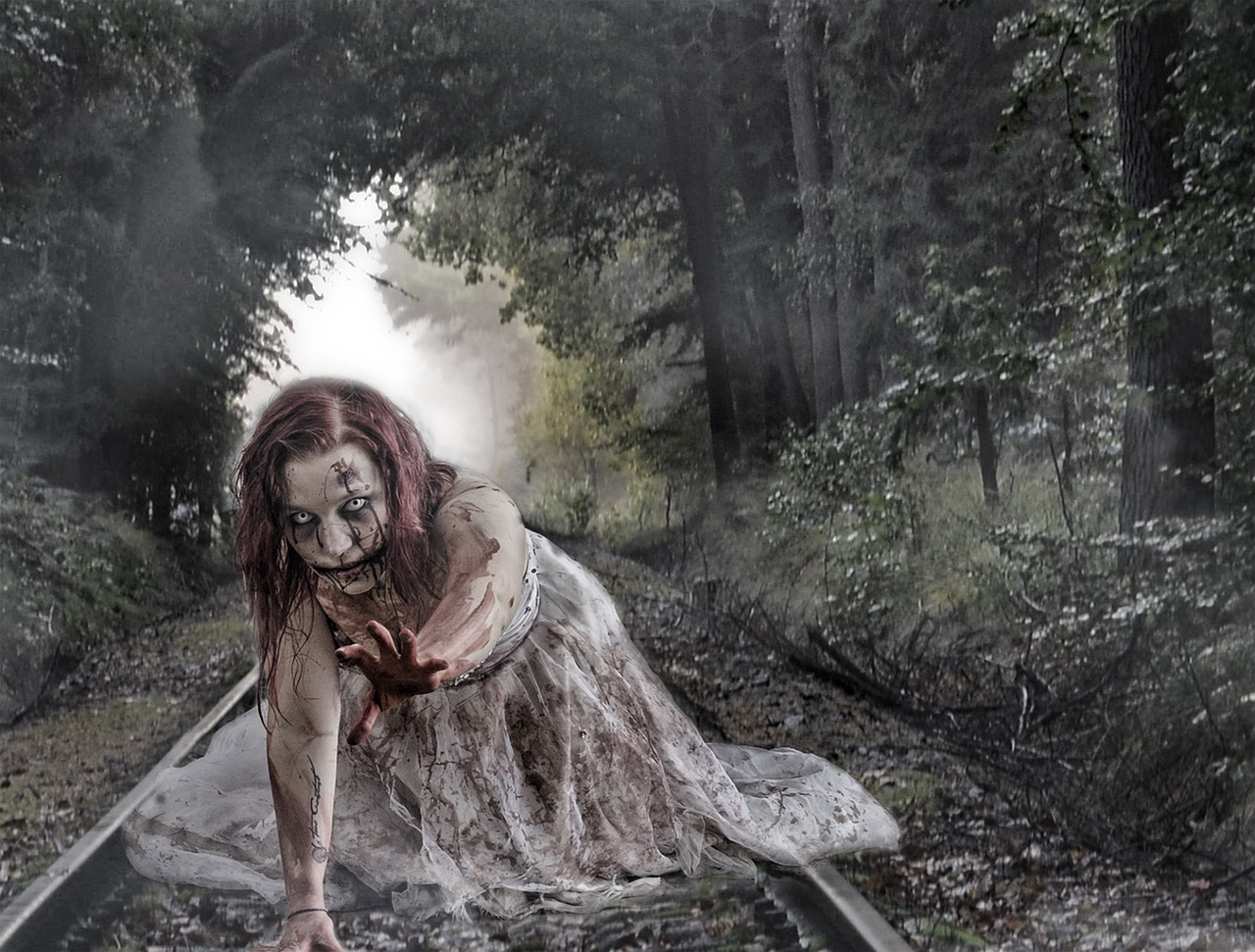
zombieA couple of years ago, I thought one more season of The Walking Dead was finally going to finish all this zombie crap — for good.  Wrong!  In a couple of weeks, AMC is going to be back at it again with Season 6.  (Not only that, but word around the campfire is, the production team has plans for a Season 7, and an 8, 9 and 10.)  It’s like Route 66 with butcher knives.  Plus, now they’ve come up with some nonsense spinoff, “let-me-explain-the-apocalypse prequel: Fear The Walking Dead.  What’s the deal?  The original Night of the Living Dead lasted 96 minutes.  Rick and his minions have been killing zombies for 5 years!  How many different ways can you blow somebody’s head off?  And more importantly, why is any audience still interested?

I’ve figured it out.

As a society, we’re starved for villains, and zombies are the last ones available to us.

Check it out.

1) Hollywood has clichéd Evil Corporate America out of existence.  When a movie has a white guy in an expensive suit in it — he’s the bad guy.  D’uh!  Audiences have been there/done that so many times even Disney has quit trying to sell that lame old story line.

2) No film maker is ever going to risk making the ethnic guy the villain.  That’s like throwing gasoline on the Eagerly Offended fire.  Every self-appointed activist this side of Mars would be on his ass faster than you can say “Don’t you ever show your face at Sundance, again!”

3) Point #2 goes double for all other identifiable groups.  Try making a gay guy evil, or a single mom, or a paraplegic and the Social Media would go berserk.  They’d threaten to blow up your car, burn down your house, slap your face, kick your dog and pee in your porridge — you insensitive bastard.  The last time a guy in a wheelchair was the villain of a movie, it was Kenneth Branagh in Wild, Wild West and even Salma Hayek’s boobs couldn’t pull that dog out of the fire.

4) The entertainment industry has made bad guys look good.  Tony Soprano was a Mafia Boss.  He was a criminal.  He stole things.  He cheated.  He lied.  He killed people.  WE SAW HIM DO IT!  But who cares?  We were still cheering for the guy when family night got cut short by the blackout series finale.  Dexter?  Totally psycho!  Walter White in Breaking Bad was a meth dealer.  A METH DEALER!  There are no redeeming qualities to that profession.  Yet there are people in this world who think the moral of that story is we should pay teachers higher wages!

So who’s left?  British accents and pretty girls.  And even that doesn’t always work.  I cheered for Rosamund Pike in Gone Girl just because she knocked the snot out of Ben Affleck.

No, folks.  We’re stuck with zombies for the foreseeable future.  In a society where vampires are cozy, crime is a career choice and everybody’s entitled to a rainbow, zombies are the last bastion of evil.

And to demonstrate just how far our world has descended into Cloud-Cuckoo-Land, never once — in the entire Walking Dead series — does anyone ever say the word “zombie.”  I think the producers are scared skinny that Z.A.C (the Zombie Awareness Coalition) is lurking in the shadows somewhere.

Art: What You See Is What You Get

shane2Art is like sex.  It’s always better to jump in and do it than just sit around and talk about it.  However, that’s exactly what I intend to do right now.  The thing is, after a lifetime of working in words I still have no idea how visual artists do what they do.  One minute, there’s a blank canvas; somebody adds some paint and suddenly I have tears in my eyes.  That’s the nature of visual art though — the Weeping Willows are supposed to make you weep.  But why?

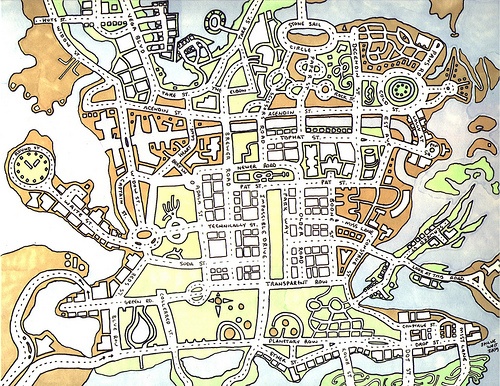
The closest I’ve ever come to understanding the process of turning blank space into emotion is talking to Montreal artist Shane Watt.  Shane does MAPS: semi-fictional, intriguing records of our time, that he maintains all exist in an autonomous universe called Loyala.  He’s created public murals in North America and Europe, and has exhibited in Montreal, New York, Barcelona, etc.  Many of his original works are in private collections.  He sells prints, creates book covers, paints doors, has a kick-ass coffee mug collection and has been known to design protest signs when the cause is right.  And he does tons of other cool stuff.  You can get the whole blurb here.

Shane is one of the few artists I know who doesn’t spend a lot of time explaining what he’s “trying'” to do.  There isn’t a whole lot of buildup to his art.  It just kinda exists.  However, on a few occasions we’ve talked about the nature of art and the artistic process.  According to Shane (I’m paraphrasing, BTW) all art is anarchy, structure and magic.  The anarchy is the artist’s concept — however complete or chaotic.  The structure is the artist’s creation — that tangible piece that exists separate from the artist.  And the magic is what the audience perceives — how individual memory and experience interprets what the artist has done.  Shane says these things must all exist simultaneously.  And the work itself is simply a visual record of the artist’s attempt to structure personal chaos in such a way that strangers can understand it.

“Okay, I get that part, buddy,”  I said, “But it still blows me away that Caravaggio and Rubens can reach across the centuries and speak so personally to me.”
“That’s why it’s called art,” Shane replied.  “It’s been waiting for you to complete the Trinity.”

shane3

shane4

shane

WHY ARE THERE HIPSTERS — PART 2

hipster 1My fascination with Hipsters has resulted in a stunning tour de force of binge-watching Hipster movies (you can read about it here) and I ended up with a Pepsi hangover and an amazing conclusion.  Unlike every other social trend in human history, the Hipster phenom is driven, almost exclusively, by women.

First, some background.

Every era has had its own fiction.  Contemporary fiction (of whatever age) is always that exaggerated funhouse mirror the reflects the time in which it was written.  For example, Shakespeare can’t escape Elizabethan England, and it appears in every one of his plays.  F. Scott Fitzgerald showed us The Jazz Age; Ginsburg and Kerouac, The Beats; and Tom Wolfe and Hunter S. Thompson took so many liberties with nonfiction that people still don’t know where the truth of the 60s ends and the fiction begins.  Our contemporary society, however, is rapidly moving beyond the book and becoming Post Literate.  Therefore. to understand GenerationText, we must look at its visual literature — the movies.

Like any archetypical fiction, Hipster movies are basically all the same.  (Believe me, after 48 hours, I was accurately writing the dialogue for some scenes as they were happening.)

Anyway, all Hipster movies are based on The Useless Boob.  This boob is always male.  He’s always drowning in his own sensitivity.  He’s normally consumed by angst and he’s always awkward and ineffectual.  This is supposed to indicate there’s a deep ennui-ed soul down there somewhere.  Unfortunately, it just comes off as too many emotional steroids.  The unique thing about the useless boob, though, is that, unlike every other stereotype in literature (hero, lover, rebel, villain, etc.) the useless boob is actually useless.  His function is to provide an empty venue for the female to fill.  That’s it!  Harry the Penguin could do it if a director could teach him how to talk and look constipated.

The real story in any Hipster movie is always about The Quirky Female.

Juno – Juno (Ellen Page) is a quirky, intelligent, uncertain female, trying to find her adolescent place in an adult world.  Paulie (Michael Cera) is the sperm donor.

Garden State – Maybe it’s the meds, but Andrew (Zach Braff) spends 99% of the movie swimming in emotional treacle.  On the other hand, Sam (Natalie Portman) and her attempts to redefine herself are way more interesting.

Her – Does Theodore (Joaquin Phoenix) do anything in this movie?  No.  The guy’s so emotionally stagnant even his computer leaves him.  It’s Sam (Scarlett Johansson) the quirkiest of all female Hipsters, who’s searching for emotional and intellectual growth.

Francis Ha – Some would say the quintessential Hipster movie and the main character Francis (Greta Gerwig) doesn’t even have a male counterpart — unless you count Benji (Michael Zegen) who’s inconsequential even at the very end.

500 Days of Summer – Tom (Joseph Gordon-Levitt) is depressed — big surprise.  He’s emotionally and physically stuck with a life he doesn’t like — another big surprise.  He decides that Summer (Zooey Deschanel) can fix it for him but doesn’t lift an emotional finger to help himself.  Summer leaves his sorry ass and gets on with her life.

And it goes on and on.
Inside Llewyn Davis
Frank
Eternal Sunshine of the Spotless Mind
Submarine

So, what have we learned — two things.  Even though a person can actually live on Doritos and Pepsi it’s not healthy to go nuts with Netflix.  And, hipsters are indeed just pompous asses in plaid shirts, but the girls are fascinating.