Christmas: Setting the Record Straight

Concerning Reindeer

Any Laplander will tell you that all reindeer have antlers.  This is a fact.  It is also a fact that male reindeer lose their antlers in late November or early December, whereas female reindeer do not lose their antlers until spring.  Ergo, the reindeer that pull Santa’s sleigh are all female – including Rudolph.  There were originally eight reindeer pulling the sleigh: Dasher, Dancer, Prancer and Vixen, Comet, Cupid, Donner and Blitzen.  Rudolph was added in 1939 when Robert L May created a colouring book for retailer Montgomery Ward to give away at Christmas.  The book told the now familiar story of Rudolph and how he came to guide Santa’s sleigh.  Ten years later, in 1949, Gene Autry had finished colouring all the pictures, so he decided to record a song based on the Rudolph story.  It was an instant hit, and Rudolph has been around ever since.  Many years ago, there was another reindeer pulling the sleigh.  Unfortunately became bitter and belligerent, so Santa had to take appropriate disciplinary action.  His name was Dinner.

Canada and Christmas

Canada was the first country to issue Christmas stamps — in 1898.

Nova Scotia exports more Christmas trees than anywhere else in the world.

Santa Claus lives in Canada.  He has his own address and postal code.  It’s Santa Claus, North Pole, Canada, H0H 0H0.  If you write to him he will reply in whatever language your letter is written in.  Try it!

Odd Facts

The reason that relentless movie, It’s a Wonderful Life, is on TV so much is that television stations don’t have to pay for it.  Apparently, when it was made, there was a mix-up in the contracts, so nobody who worked on the film — including the actors — ever gets residuals.

“Frosty the Snowman” was written by Jack Rollins and Steve Nelson in 1950, for Gene Autry, who wanted to follow up the success of “Rudolph, the Red-nosed Reindeer” from the previous year.

The True Story of Santa Claus
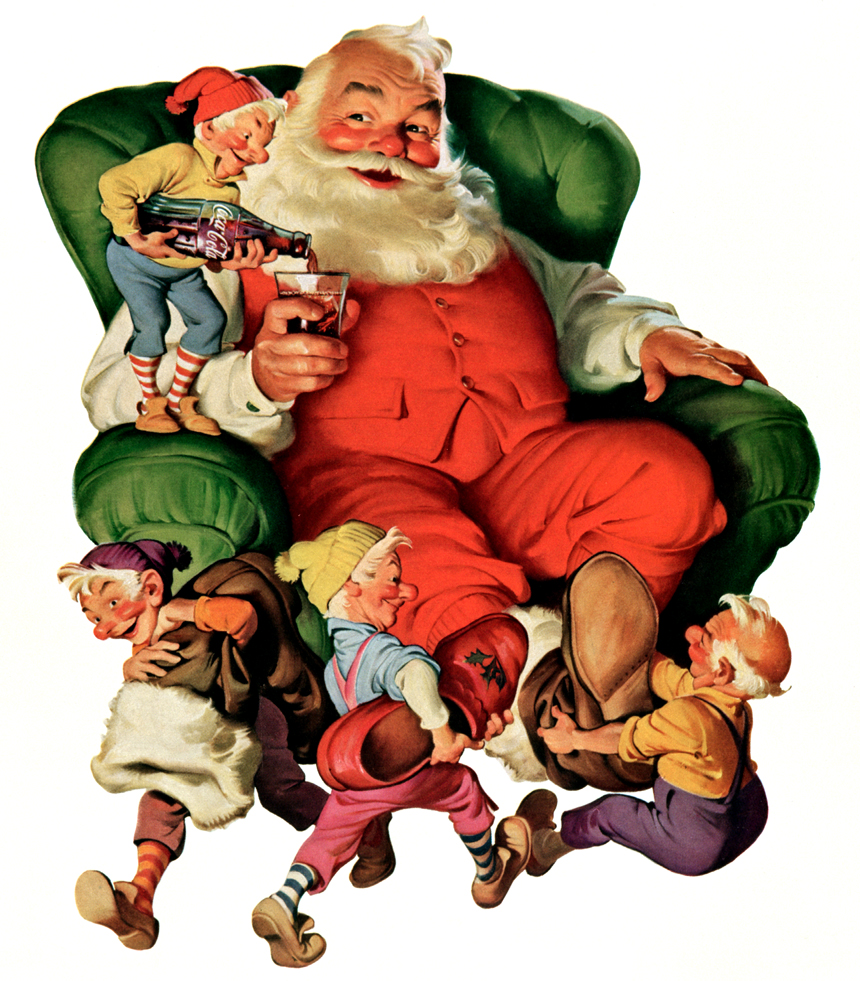
In every Christmas book ever written, the story of Santa Claus starts out in some godforsaken town in Turkey.  Presumably, there was a guy there named Nicholas, who was a priest or something.  He was so generous the Church made him a saint.  Fine!  Then there’s a whole boring bit about saints in general and around 8 different stories about Nicholas in particular.  None of them jive.  Then the next thing you know, he shows up in Holland.  He’s changed his name to Sinterklaas and he’s bought himself a horse.  Then he’s Father Christmas; then he’s Kris Kringle (who doesn’t even have a Wikipedia entry), then he’s Pere Noel.  Yeah, right!  That’s the story we tell kids who are too young to understand.

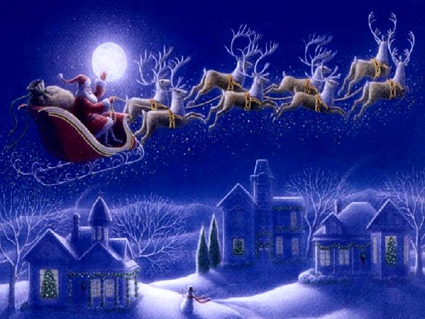
Here’s the real story.  Santa Claus has been around forever.  He lives at the North Pole with Mrs. Claus, a ton of elves and the reindeer.  Once a year, he gets into his magic sleigh and flies around the world, delivering toys to good girls and boys.  How do I know this?  Documented proof!  Santa Claus has actually been seen – twice — once by Clement Moore in 1823, and then again by Haddon Sundblom sometime in the late 1920s.  Clement Moore wrote a poem about his experience called, ‘Twas the Night before Christmas.  In that poem, Moore describes Santa quite accurately, but because Moore suffered from an undiagnosed eye ailment, which messed up his depth perception, he didn’t realize Santa Claus was so big and called him “a right jolly old elf.”  Santa Claus is actually quite a large gentleman.  How do I know this?  Again, documented proof.  In 1931, Haddon Sundblom painted a picture of Santa as an advertisement for the Coca Cola Company.  It appeared in the Saturday Evening Post.  Sundblom’s image was universally recognized as Santa Claus; there were no complaints or any suggestions of inaccuracy.  Therefore, we can conclude that Sundblom must have seen Santa relatively recently to depict his likeness so exactly.  This is the true story of Santa Claus.  That other bunch of nonsense is a fable.

The Little Drummer Boy
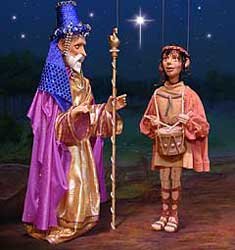
It is a well known fact that the stupid “Little Drummer Boy” (who was put on this earth to annoy me) has absolutely nothing to do with Christmas.  The real little drummer boy was a pickpocket and sneak thief who fell in with the Three Wise Men in order to gain their confidence and eventually rob them.  He was already a hardened criminal by that time and had a list of previous offences as long as the Ohio River.  He was caught with his hand in the frankincense jar and sentenced to 10 years’ hard labour — which is exactly what the treacherous little bugger deserved.

Did you know?

If you’re frightened of Santa, you have Claustrophobia.

There was once a dyslexic devil worshipper who sold his soul to Santa.

Christmas Quotes

“There’s nothing sadder in this world than to awake Christmas morning and not be a child.” – Erma Bombeck

“All Christmas trees are perfect.” – Charles N Barnard

“Bah! Humbug!” — Ebenezer Scrooge

“Merry Christmas, Nearly Everybody!” – Ogden Nash
How the Victorians Invented Christmas

Obviously, Christmas, as we know it, started quite literally in the year dot.  Like it or don’t, the birth of Christ is the single most important event in the history of Western civilization.  Here in the 21st century, we continue to celebrate the day as a religious, secular or “hell of a good time” holiday.  It’s a tradition.  However, it’s a relatively new one.  Our celebration at Christmas started accidently, in the1840s, when these two events coincided.  First of all, an English author published a novel; secondly, Queen Victoria married a German.  Without these two isolated events happening at just the right time, we’d all be sitting around December 25th burping up turkey and looking for batteries — for no apparent reason.

When Queen Victoria ascended the throne in 1837, there was a feeling that this was the beginning of a new age in Britain.  The Napoleonic Wars were long over and mostly forgotten, and the world was enjoying a time of relative peace.  The industrial revolution was producing not only a new prosperity but also a new middle class who had both money and leisure.  They could enjoy things like travel, family life, and even hobbies such as reading for pleasure.  Also in 1837, a relatively unknown author named Charles Dickens published a newspaper serial called The Pickwick Papers.  Within about 5 chapters, he had suddenly become the J.K. Rowling of the 19th century.  The new English middle class fell in love with Pickwick.  Soon, people on both sides of the Atlantic were lining up to get the latest instalment of his adventures.  One of the most enchanting episodes in The Pickwick Papers was a fanciful description of a Christmas festival.  Christmas was undergoing a bit of a revival at the time, and Dickens’ highly fictional description gave people something to emulate.  It was very much the same as when people today talk and act like their electronic friends on TV.

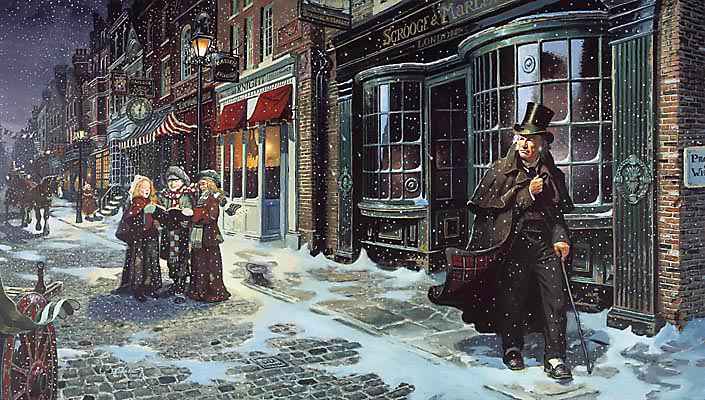
For the next couple of years, Charles Dickens kept himself busy.  He published some very successful novels — Oliver Twist and Nicholas Nickleby among others.  Then, like most successful authors, he decided to shoot his mouth off.  He run afoul of his American audience by advocating some rather radical ideas like universal copyright (so those damn Yankees couldn’t steal his stuff) and the abolition of that quaint American custom of slavery.  Suddenly, he was losing some pretty valuable customers on the other side of the Atlantic.   He wanted to get them back, so he began writing a series of books he described as, “… a whimsical sort of masque intended to awaken loving and forbearing thoughts.”  He succeeded.  In 1843, he published A Christmas Carol and the world changed dramatically.  Once again, both sides of the Atlantic went crazy for Charles Dickens.  Scrooge, Cratchit and Tiny Tim were more popular then, than Mikael Blomkvist and Lisbeth Salander are today.

Everybody wanted to celebrate a traditional Christmas the way Dickens described it because — before Dickens wrote it — nobody actually kept Christmas that way.  He made it all up.  He took several traditions that were already there and put them together in a stylized setting.  It was fiction.  Plus, Dickens didn’t just write A Christmas Carol; there were 5 books in the series.  Every time our Victorian ancestors turned around, there was Charles with another feel-good Christmas story.  It must have been like getting beaten over the head with a rainbow.  By the time Dickens was done, Christmas was everywhere.  You couldn’t get away from it.

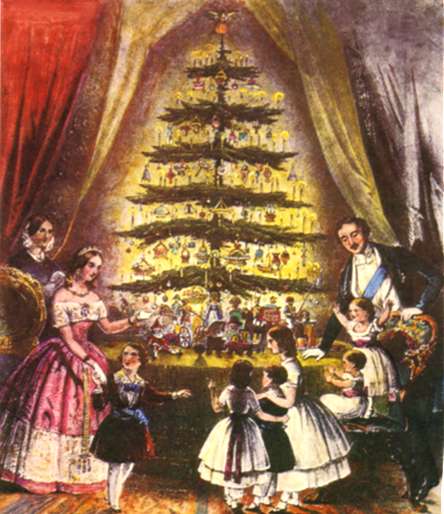
Meanwhile, in 1840, Queen Victoria married Prince Albert of Saxe-Coburg and Gotha, her German first cousin.  Albert showed up at Buckingham Palace with all his German sensibilities intact, including some very noticeable Christmas traditions — like decorations and the tannenbaum or Christmas tree.  Christmas trees had been around for some time, but it wasn’t a common practice in England to cut down a tree and haul it into your house.  Any trees that did get cut down around Christmas were normally thrown into the fire as Yule Logs.  However, the popularity of the young, good-looking monarchs was such that, when Victoria and Albert appeared with their children in front of a Christmas tree, in The London Illustrated News, Christmas celebrations became uber-fashionable.

The social ladder now had a new rung, and people all over England and America began decorating their houses at Christmas, just like they assumed their aristocratic betters were doing.  Thus, the height, breadth and weight of the Christmas table one set became society news and reason for gossip.  Everybody wanted to know what Jenny Churchill was wearing or what the Astors served for dinner — so they could do it, too.  It was Entertainment Tonight – only with bonnets and bustles.  Christmas was not only everywhere; it was trendy.  The result was that Christmas became the #1 holiday of the year — and has been, ever since.

Today, our Christmas celebration is surprisingly similar to that of our Victorian ancestors.  Of course, there have been a bunch of refinements along the way.  In 1843, Horsley and Cole, a couple of bored Englishmen, invented Christmas cards.  Saint Nicholas was turned into Santa Claus by Thomas Nast and Coca Cola.  At some point, religious hymns became I’m Dreaming of a White Christmas and Jingle Bell Rock.  And we’ve added Rudolph the extra reindeer and that stupid Little Drummer Boy (who was put on this earth just to annoy me.)  However, it’s basically the same Christmas they would have had a century and a half ago.  So, when you push your chair back from the table and look at the beauty of your own personal Christmas, take a nanosecond and thank Charles, Victoria and Albert, who invented it for you.

Christmas and the Annual Idiot

I love Christmas.  I love everything about it.  I love Santa and the reindeer, jingle bells, mistletoe, the baby Jesus and the Wise Men – everything.  I like the crowds and the bitchin’ and the music in the malls.  I even tolerate that stupid little drummer boy – the first 500 times, anyway.  It’s all too cool but I’m an old-fashioned guy, so I like the older traditions best.  That’s why, every year, I wait, in uncontrollable anticipation, for one of our society’s oldest and dearest traditions — the arrival of the Annual Idiot.  For me, the arrival of the Annual Idiot actually kicks off the Christmas season.  When I was younger, the Annual Idiot was usually a school teacher with a full beard or the woman who didn’t shave her legs.  However, like most traditions, the Annual Idiot has changed over the years.  Today, the Annual Idiot could be anyone — a friend, a colleague, the guy you meet in the mall, even a family member.  Like Christmas itself, the Annual Idiot has become somewhat universal.

For those of you who haven’t figured it out yet, the Annual Idiot is that person, who, filled with the spirit of “I’m Smarter than You Are” (and overcome with joy at the sound of their own voice) takes it upon themselves to explain just how screwed up Christmas really is.  This can be as simple as the politically correct guy who stops you in mid “Merry Christmas” to tell you to say “Happy Holidays” because it’s more inclusive.   Or it could be the holier-than-thou woman who tells you, “Christmas is becoming just too commercialized.”   Or it could be that pompous ass who explains, “According to the fragmentary records from the Augustan period of the Roman Era, tax collection was done in July of the Julian calendar; therefore, Christ could not possibly have been born in December.”  But the one I like the best is the cynical jerk who questions the holiday itself, asking, “How did we get from the birth of the ‘so-called’ Saviour to Santa Claus and elves?  All of the things we have for this ‘so-called’ Christian holiday are really just pagan symbols, you know.”   When I hear these dulcet voices singing, I know it’s finally Christmas.  I like to take a second or two to contemplate the infinite universe and its delights before I respond, in my best little kid voice, “Sorry, I forgot.”  What these neo-fascists don’t realize is that they’re engaging in a Christmas tradition that is one of our very oldest.  Christmas bashing actually pre-dates most of what we know to be a traditional Christmas.  In truth, these modern merry morons are merely acting like our most intolerant Christian ancestors – the Puritans.  They didn’t like Christmas, either – over 400 years ago.

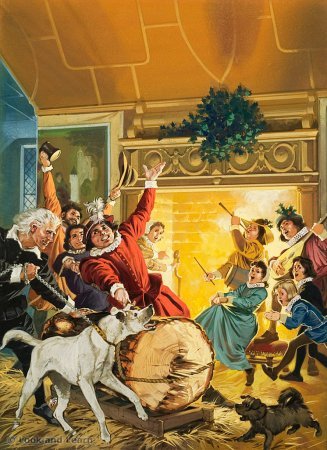
In Elizabethan England, Christmas was the main holiday of the year.  When good Queen Bess was on the throne, the locals really knew how to party.  First of all, Christmas lasted 12 days – the 12 days of Christmas, from the song.  Secondly, nobody went to work, so if you wanted your doublet fixed, you were out of luck until January.  What people did was roll out of bed and head for the nearest tavern.  They drank and gambled and chased women (who generally tried not to run that fast.)  They sang bawdy songs, ate, laughed, joked and then drank some more – and this went on every day.  They dressed up as supernatural creatures and animals and danced in the streets or watched the acrobats, the bear-baiting or one of Will Shakespeare’s new comedies.  It was called Topsy-Turvy time — when the servant became the master and the shepherd became the sheep.  The Elizabethans celebrated by honouring the Lord of Misrule, a local dimwit or barmaid who rode backwards on a donkey through the streets to the steps of a church or cathedral where he or she was crowned, in front of the cheering, jeering mob.  Basically, it was all one big, queen-sized debauch.  Obviously, our ancestors saw Christmas as a time to have fun, much as we do.  So it was only a matter of time before somebody tried to put a stop to it.

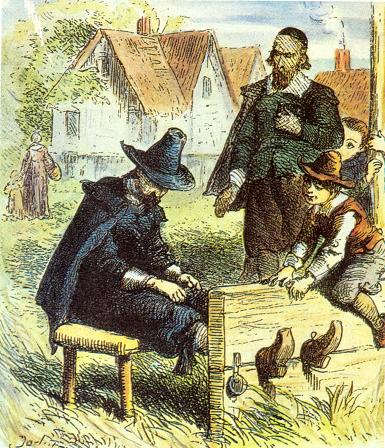
Enter the Puritans.  Without overstating it, the Puritans were a gang of uptight, intolerant fanatics who wanted the world to do as it was told, and they wanted to do the telling.  They were so narrow-minded they could look through a keyhole with both eyes.  They believed life was a serious business and anybody who wasn’t serious about it needed to be whipped into shape – literally.  They also believed they had all the answers, and were willing to provide them even when nobody was asking for their opinion.  Actually, they compare very well with our contemporary Christmas bashers — except the Puritans were better organized.  They looked at Christmas, circa 1570, and practically burst an internal organ.  One unnamed source wrote “There is nothing else [at Christmas] but cards, dice, tables, masking, mumming, bowling and such fooleries…”   It was clearly the work of the Devil.  As early as 1583, some churches were setting penance for “keeping the superstitious day called Yule,” and by the turn of the 16th century, the common folk were well-advised to stay off the streets after the middle of December.  The times were changing in Merrye Olde England: it was getting a lot less merry.  By the time Cromwell and his Puritan crowd actually came to power, anybody who wanted to celebrate Christmas did it at their peril, and in the privacy of their own hovel.  Within a couple of years, there was nothing much left of Christmas, and on December 24th, 1652, it was formally banned.  The proclamation read, “That no observation shall be had of the five and twentieth day of December, commonly called Christmas nor any solemnity used or exercised in churches.”  It would take Christmas just about 200 years to recover.

So you see, all those oh-so-enlightened Christmas bashing freaks who wander the earth, setting the world straight every December, are just following in the footsteps of their Puritan ancestors.  They’re actually celebrating their very own, very old Christmas tradition.  That’s why I wait for them so eagerly every year.  They’re as much a part of Christmas as Santa Claus himself.

 Wednesday: A Modern Christmas, or how Santa Claus finally came to town.