Why Are We All Angry?

anger

Here in the Western World, we live in the most benevolent civilization in all human history.  The irony is a lot of us seem pissed off about it.  Odd as it may seem, a ton of people spend a ton of time complaining about our world and the collective bounty of 3,000 years of economic and social success.  Why?  There are three reasons.  I like to call them the Killer Bs.

Bewildered — Like our medieval ancestors, we don’t understand anything about the world we live in.  Face it, folks!  We’re stupid.  These days, most people couldn’t tell you the difference between an aardvark and an antelope if you put burning coals between their toes.  And it’s not just zoology that stumps us.  Common knowledge simply isn’t common anymore.  We might be able to read and write, but we’re culturally, historically, economically, scientifically and mathematically illiterate — and proud of it.  For some weird reason, smart is not a currency we use or even value.  However, without these intellectual building blocks, it’s impossible to make sense out of the 1,001 complex systems that govern contemporary life or to understand our place in it.  At least a 12th century peasant could rely on God to justify his existence.  Unfortunately, since Nietzsche shot his mouth off, we don’t even have that option.  So, unable to figure out the simple how and why of what’s going on, many people boil over with frustration and say “Screw it!”

Bored — Intellectually divorced from reality, we have retreated behind our videos screens which filter out all the complexities of real life.  This is a mutant utopia, scripted with gratuitous drama and broad music-hall comedy.  The problem is it’s all relentlessly the same: kittens have achieved maximum cuteness, blockbuster movies bust tired old blocks, and the only shock left in those “shocking finales” is a shrug.  There’s no place to go in the cyber-verse that isn’t somebody else’s sequel, prequel or reboot.  All that’s left is hours and hours and hours of looping YouTube videos, everybody “liking” everything and bum-numbing binges of “must see TV.”  Face it, folks!  We’re bored — bored to the bone — and it’s making us bitchy.

Betrayed — We may ignore it or fail to understand it, but this is still the only reality we have — and sometimes it can be nasty.  Unfortunately, when that nasty comes calling (and it always will) it’s so alien to our everybody-gets-a-rainbow existence that we think something has gone horribly wrong — and we want to know why.  Flushed with excitement at the possibility of a “real” problem, but unable to comprehend any of the nuances of it, we demand an explanation for how our society failed.  We want a  reason, and we want it yesterday.  When we don’t get it — we get angry.  We begin to see evil where it doesn’t exist, impossible plots and conspiracies, tidy theories of nefarious secrets and blame — lots and lots of blame.  Face it, folks!  We truly believe we’re being betrayed by the very institutions we’re supposed to trust.

The Killer Bs aren’t killing the most benevolent civilization in history, but they’re certainly making it unpleasant. If we could get them under control, we’d all be a lot happier.
May 68 (plus 50)

may 68 1

Fifty years ago is a long time: it sits in that twilight zone between living memory and history.  Old people can conjure it up — if they have to — but young people can only see it on YouTube.  And every year, the shadows those images cast get a little greyer, a little thinner and a little harder to recognize.

Fifty years ago (March 22, 1968) Daniel Cohn-Bendit and seven of his friends walked into the administration offices at the University of Nanterre in Paris and refused to leave.  Six weeks later, all hell broke loose!

May 1st, 1968 was the high-water mark of the 60s.  Television and the Tet Offensive had turned the world against the Vietnam War.  In America, that popular opinion was chasing Lyndon Johnson out of the White House, and when Bobby Kennedy announced he wanted to live there, it looked like the second coming of Camelot.  In Europe, Alexander Dubcek’s communist reforms in Czechoslovakia were cleverly outmaneuvering the Soviet Union in a warm and glorious Prague Spring.  Che had become the infallible martyr of the revolution, and Mao’s Red Guards hadn’t gone crazy yet.  The world was young and arrogant and optimistic and excited and on the verge of … nobody knew what … but it was Dany le Rouge and his buddies who lit the fuse.

The events of May 68 in Paris are well-documented.  Here’s the quick and dirty version.

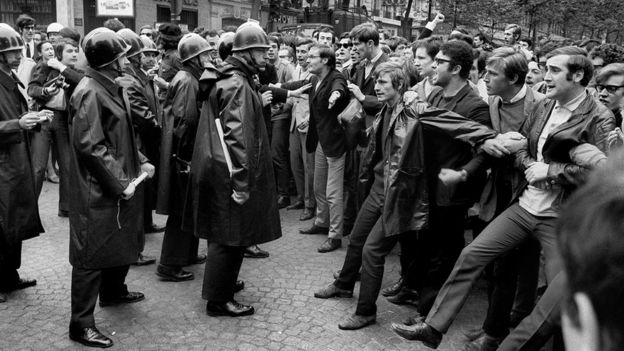
On May 2nd, after a series of running battles between students and police, the French authorities closed the University of Nanterre.  On May 3rd, the students at The Sorbonne organized a sympathetic protest.  Somebody called the cops (les flics) who showed up and took charge.  On May 6th, 20,000 students (or more) marched on the Sorbonne to take back their university.  The police were waiting for them.  Shouts and threats, a push, an arrest, a bottle thrown and suddenly it was “Aux barricades!” and the war was on!

The narrow avenues of the Quartier Latin are ideal for urban conflict (In 1944, General Leclerc’s tanks carefully avoided the area) and the students took full advantage.  They blocked the streets with burning mattresses, furniture, trashcans and overturned cars.  They taunted the feared CRS riot police into chasing them and pelted them with rocks, bottles, flaming bags of dog merde and Molotov cocktails.  The cops responded with water cannons, teargas and bone-cracking batons to the head and groin.  Who controlled the streets?  The students or the police?  Night after night, the two sides battled it out in the alleys of the Rive Gauche.

On May 14th, workers at Renault in Rouen went out on strike in solidarity with the students.  Within a week, 100 factories were closed or occupied, and 10 million workers were on strike.  The government offered huge wage increases (35%) but the workers pushed their own leaders aside and refused to go back to work.  Many of them joined the students in the streets.  Shops closed, banks closed, even the ubiquitous Parisian cafes locked their doors.  Transportation ground to a halt, and government services ceased to exist.  France was on the verge of collapse.  On May 29th, worried that the mob might storm the Elysee Palace (shades of The Bastille in 1789) De Gaulle flew to a French military base in Germany to negotiate the loyalty of the army.  On the morning of May 30th, half a million people marched in the streets of Paris, chanting “Adieu, De Gaulle!”  That afternoon, De Gaulle addressed the nation.  Defiant as ever, his only concession to the seething chaos was to call an election — but he refused to resign, threatened to declare a State of Emergency, and hinted that the army was ready to march on Paris.  That night, a million people (or more) poured down the Champs-Elysees in support of the government.  They chanted “Vive La France!” and sang La Marseillaise.  The city, the country and French society were all divided neatly in two.  The next stop was civil war.

Luckily, it was the Communist Party leaders who blinked.  Painfully aware of the bloodbath that erupted the last time French troops entered the capital (Paris Commune 1871) and eager to take a chance on gaining real power in the coming election, they pulled their people off the streets.  A couple of days later, the student unions followed suit.  The cops backed off.  The crisis was over.

May 68 has entered the mythology of history.  Most historians will tell you that May 68 tossed the old order (which we’ve lately been calling ‘the greatest generation’) under the bus and brought about a seismic change to European society that eventually spread around the world.  I agree.  However, change is not, by definition, always beneficial.  Look around you!  In the 21st century, university students are content to click their dissatisfaction on Facebook, throw Twitter tantrums over cartoon characters and call each other “brave” and “awesome” for demanding “trigger warnings” on disagreeable discussions.  They’ve become just another demographic in the consumer society their grandparents desperately wanted to dismantle, and their only power is purchasing power.

And what ever happened to Daniel Cohn-Bendit (Dany le Rouge?)  He’s a pro-market, pro-European Euro MP, living large in Brussels — a minor company man of the political establishment.

But one other thing happened in France in 1968.  A politician was born and, these days, she’s having a bigger influence on the world than any of the soixante-huitards are.  Her name is Marine Le Pen . . . .

9 Fun Facts About The Russian Revolution

russian-flag-1168929_1920It’s impossible for me to go through November, 2017 without saying a few words about the 100th anniversary of the Russian Revolution.  The problem is it’s so damn complicated and, quite frankly (aside from Che) dead communists are not all that fashionable anymore.  Plus, in a time when “history” means “last week,” it’s difficult to explain to people that our world wouldn’t be suckin’ up to Vladimir Putin and Xi Jinping in the 21st century if a 19th century university student named Aleksandr Ulyanov had stuck to zoology.  (So be it!)  However, rather than kick myself forever for missing the opportunity, here are some fun facts about the Russian Revolution that most history books, historians and political pundits ignore.

1 – The Russians call it the “October Revolution” even though it happened in November because, in 1917, Russia was still using the calendar Julius Caesar created in 45 B.C. — which shows you just how backward Russia was at the time!
2 – The word “Tsar” is the Russian equivalent of the Latin term “Caesar” — which came to Russia from the Eastern Roman (Byzantine) Empire in the 15th century.
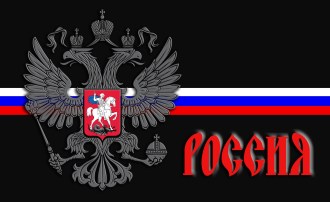
3 – From the time of Ivan III of Muscovy (who kicked out the Mongols) the Russian double-headed eagle hasn’t been able to decide whether it wants liberal enlightenment or reactionary despotism.  For example, Peter and Catherine — both ruthless, brutal rulers — are designated “the Great” in Russian history; whereas the most progressive of all the tsars, Alexander II, has been largely forgotten.  Ironically, despite his many reforms, Tsar Alexander was actually assassinated by socialist revolutionaries.
4 – The definition of “revolution” is “one complete rotation.”  That means that if you’re on a wheel and have a revolution, you end up in exactly the same place you started from.  In fact, you can have dozens of revolutions and you’ll always end up in the same place!
5 – What Marx wrote and what Lenin did are two different things.  Marx was a German philosopher in the mold of Schopenhauer, Kant and Nietzsche.  Lenin was a slick, silver-tongued lawyer, lookin’ for the main chance.
6 – Items #2 and #3 explain why, in 100 years, Russia has “progressed” from an empire ruled by an absolute autocrat, Tsar Nicholas II, to whatever-the-hell it is now — where President Vladimir Putin’s word is absolute law.
7 – Aside from Lenin, most of the Soviet leaders who came after the Russian Revolution weren’t actually Russian.  Stalin was a Georgian, Brezhnev was Ukrainian and all the others — up until Gorbachev — had mixed ancestry including Don Cossack and Finnish.
8 – Unlike capitalism and socialism, communism is such a dumbass, discredited political system that the only people who still even pretend to believe in it are college sophomores and their bearded professors.

And finally

9 – Aleksandr Ulyanov was a natural science student who, in 1887, was part of  conspiracy to assassinate Tsar Alexander III.  He was arrested, tried, convicted and executed.  He was also Lenin’s older brother!  This goes a long way in explaining why Lenin had such a hate on for the Romanov dynasty that he spend his entire life trying to destroy it.  In 1917 he succeeded and set up a regime whose ideology dominated political thought (for and against) for most of the 20th century.