
 Stuck between The Ides of March and St. Patrick’s Day, March 16th is probably the most neglected day on the calendar. It shouldn’t be: after all, The Ides of March was really just a minor Roman festival before Brutus and Cassius decided that power came out of the pointy end of a dagger. Frankly, if Julius Caesar had been feeling a bit frisky that morning and gone over to Cleopatra’s instead of to the Senate, we wouldn’t remember The Ides of March, at all. Plutarch wouldn’t have written about it, and Shakespeare wouldn’t have borrowed it to add a little spooky to his play Julius Caesar. As Katherine Hepburn once said, about an unrelated matter, “Such is the role of sex in history.”
This minor change (given the tenor of the times Caesar was going to get his one way or the other) would have made March 16th a bigger day: Saint Patrick’s Eve, perhaps; just as Hallowe’en is All Hallows’ Eve and December 24th is Christmas Eve. Unlike the Ides of March, which needed an assassination to put it on the map, St. Patrick’s Day is one of the big boy holidays. It is so connected to Ireland that even if Saint Patrick hadn’t become the kick-ass saint he was destined to be, the Irish would have made him up – which, for the most part, they probably did.
There is no doubt in anybody’s mind that Saint Patrick was a real guy. His life is actually pretty well documented (for the time.) At least two letters he wrote are considered authentic, which doesn’t seem like much but when you consider most everybody in the 5th century was an illiterate peasant, it’s a lot. However, that’s where it ends. Most of the juicier details of his life are actually just high-end speculation. There are no snakes in Ireland and there are a lot of shamrocks but we have no documented proof that either had anything to do with Saint Patrick. In fact, there is actually no record in the Vatican of his ever even being canonized. He is the patron saint of Ireland by tradition alone. Likewise, the stories of his exploits were probably just good press for a church that was fighting tooth and nail against some long-established pagan gods.
The early Christians weren’t stupid. They knew that a single God was a hard sell to superstitious people who had always worshipped a pantheon of pagan deities. So they turned a bunch of ordinary people — who had led virtuous lives — into saints. These saints weren’t gods, but they were already in heaven. Thus, they were able to perform miracles in aid of the living and could be invoked in prayer, just like the old gods of the forest that the people were accustomed to. Then, the Christian church went one step further and made it all personal. They invented the patron saint, who had a personal interest in you. Whether through your occupation, your birthday, where you lived or some other circumstance, a number of saints were available just for you, to handle your earthly problems. The local river nymphs didn’t stand a chance against that kind of firepower, and Christianity came to dominate Europe. Interestingly enough, though, these days, even ahead of Saint Patrick, the universally accepted symbol of Ireland is the leprechaun.
For centuries, St. Patrick lounged around in the same secular/celestial neighbourhood as St. Andrew, St. David and St. George, first among equals in the regions they represented but not that well-known beyond the borders. (For example, most non Scots get St. Andrews Day and Robbie Burns Day hopelessly confused.) But then, in the 1840s, the potato crop failed and Ireland began to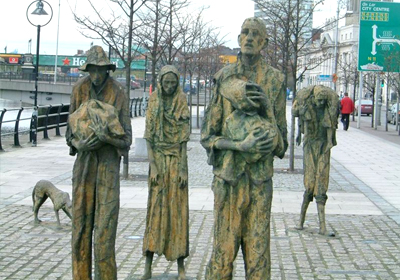 starve. First, the old people died and then the children. Mothers abandoned their babies rather the watch the inevitable. Whole villages turned their backs on their homes and roamed the countryside, looking for anything to eat — including the grass that grew in the ditches. Without hope and forsaken by the future, the Irish left Ireland by the thousands to go anywhere beyond this despair. In the 19th century the Irish Diaspora was huge: an army of homesick exiles, driven from their land. Isolated in their adopted countries, by their speech, their customs and their religion, they clung together, keeping their traditions alive. It was here — in the Irish ghettos of New York and Boston, Melbourne and Montreal — that St. Patrick’s Day was born. It had always been a religious holiday in the old country, but far from home, St. Patrick’s Day became a time to drink a toast, sing the old songs and try to remember that which had once been. A day of Irish pride far from the graves of their families, it was the slender thread that could take their hearts home.
 Today is March 16th, the most neglected day on the calendar, but tomorrow is St. Patrick’s Day, the party where everyone is Irish. So, at some point in the festivities, pause for a moment, and raise your glass to St. Patrick, a virtuous man, good enough to be turned into a legend by the early Christian spin doctors. Then, raise it once more to all those nameless Irish immigrants who carried him with them, around the world.
May yer neighbours respect ya
Troubles neglect ya
The angels protect ya
And heaven accept ya*
Happy St. Patrick’s Day!
*(Did you just read that in an Irish accent?)







 WD Fyfe