The End of the News of the World

I remember a time when journalism was an honourable profession.  I’m even old enough to remember Edward R. Murrow’s boys, albeit at the end of their careers.  These were the folks (Sevareid, Cronkite et al) who came home from World War II determined to change reporting from the William Randolph Hearst school of half truths and outright lies to something better.  I used to read the columnists who followed after them: Mike Royko, Buchwald and Safire.  They reported what they saw, what they investigated, what they could prove, what they knew to be true.  When Cronkite said it on the 6 o’clock news you could believe him.  In those days, journalists were an important part of our society.  They had one simple, extremely difficult job: cut through the spin and tell us the truth — and they did it, or at least tried their best.  Woodward and Bernstein were the last of their line.  So how the hell did we get from there to Rupert Murdoch’s News of the World?  The short answer is we didn’t.  Responsible journalism (as I remember it) was just a bump in the cycle; as Murrow’s boys culture died off, so did their brand of integrity and journalism.

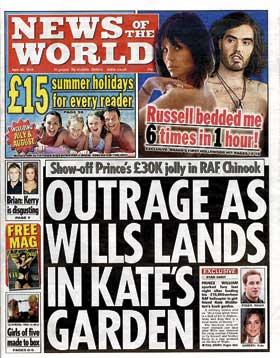
In case you’ve been in a tunnel for the last twenty years, News of the World is a despicable British newspaper.  You can read about it here. It is so sordid and tawdry that, in a land known for contemptible tabloid presses, it has no shoddy rival.  In an international sleaze-off contest, the News of the World would beat The National Enquirer without breaking a sweat.  And for those of you who think this is Rupert Murdoch’s doing, no, the News of the World has always been disreputable.  Here’s a quote from a book written in 1950 about an incident that took place in the 1890s.
“Frederick Greenwood, editor of the Pall Mall Gazette, met in his club one day Lord Riddell, who died a few years ago, and in the course of conversation Riddell said to him, `You know, I own a paper.’ `Oh, do you?’ said Greenwood, ‘what is it?’ `It’s called the News of the World—I’ll send you a copy,’ replied Riddell, and in due course did so. Next time they met Riddell said, ‘Well, Greenwood, what do you think of my paper?’ ‘I looked at it,’ replied Greenwood, ‘and then I put it in the waste-paper basket. And then I thought, “If I leave it there the cook may read it — so I burned it!’ ”(J. W. Robertson Scott, The Story of the Pall Mall Gazette (1950), 417—as cited in Wikipedia)

There is nothing good to say about the News of the World and when it announced its impending suicide nobody, except the dregs of humanity who worked there, shed a tear.  Are we clear?

What we call “yellow journalism” or sensationalism has its modern roots in the mid 19th century.  (Incidentally, the News of the World got its start in 1843.)  Believe it or don’t, the industrial revolution actually created leisure time for whole segments of our population.  Meanwhile, as we inched towards universal education, rudimentary literacy became the norm.  In other words, most ordinary people could read, and after about 1850, they had the time to do it.  It was the golden age of the penny dreadful and the dime novel.  It was also a time when the only news available came from newspapers.

As newspaper circulations began to increase, a few enterprising young media people — including William Randolph Hearst, a guy by the name of Joseph Pulitzer and a few others — discovered an interesting phenomenon. The newly literate social class much preferred exciting stories about fires, robberies, murders and corruption to ordinary daily news.  They learned that sensational stories and even more sensational headlines sold newspapers.  It was a no brainer; they gave the people what they wanted.  By the 1880s, sensationalism was firmly established in the print media – all it needed was a name.  In the 1890s, an all-out media war in New York between Hearst and Pulitzer provided that.  As the newspaper headlines got wilder and wilder, the result was the international expansion of “yellow journalism.”  The other side effects were the de facto death of truth in the news and, quite possibly, a media generated conflict — the Spanish American War in 1898.  Plus, the battle proved one thing that everybody already knew: the public was more interested in sordid details, true or not, than factual reporting.  To be fair, not all newspapers of the time were sensationalist rags, and even the sensationalist rags covered hard news stories sometimes, but, in general, murder usually got the front page in even the most respected papers.  For example, one of the biggest stories of the early 20th century was the titillating love triangle murder in 1906 of Stanford White, by jealous husband, Harry Thaw with ex-chorus girl Evelyn Nesbit coyly posing in the middle.  At the time it was called The Trial of the Century.  It was followed immediately by the murder trial of silent film comic Roscoe (Fatty) Arbuckle, and the murder convictions of two anarchists, Sacco and Vanzetti: both trials equally dubbed The Trial of the Century.  Soon after that there was the Lindbergh kidnapping and subsequent trial of Bruno Hauptmann which satirist H. L Mencken mockingly called “the biggest story since the resurrection.” It’s pretty plain that the O.J. Simpson Trial of the Century in 1995 doesn’t hold a candle to what the media was doing decades before.

In less than 48 hours the News of the World will cease to be, thank god.  Of course, its brand of journalism will still ooze out of the pages of a dozen other British tabloids.  Enquiring minds will still buy millions of National Enquirers every week.  Lindsay Lohan’s picture will still guarantee magazine sales and Casey Anthony will get enough ink to drown Cameron, Merkel and Sarkozy combined.  The world might not have changed that much since William Randolph Hearst took over the San Francisco Examiner from his dad in 1887 but for one brief, shining moment, after World War II, there was honour in journalism.  Mike Royko, clearly a man of his time, summed it up best when he wrote, “No self-respecting fish would want to be wrapped in a Murdoch paper.”

Wit and Wisdom

Believe it or not, there was a time before “awesome” was the only acceptable response in the English language; a time when conversation was an art form and wit was its paint brush.  People talked to each other in those days; they didn’t just have face time.  I don’t harken back to the good old days; today (right now) is way more awesome than they ever were (despite the claims of most people over 35.)  However, sometimes, I miss the quips and jabs of a good conversation. Here are some dead people (except Yogi) who used words like magical tools that could turn a phrase — and sometimes even bend it.

Wilson Mizner (1876 – 1933)
These days, very few people have heard of Wilson Mizner, mainly because many of his business practices were either disreputable or illegal.  Mizner tried his hand at nearly everything to make money — including writing, gambling, speculating on Florida real estate, and marrying one of the richest women in America.  It’s strange that Mizner’s underside look at life both gave him his scathing wit and keeps him largely ignored.

Those who welcome death have only tried it from the ears up.
Don’t talk about yourself; it will be done when you leave.
If you steal from one person, it’s plagiarism; if you steal from many, it’s research.
Life’s a tough proposition, and the 1st hundred years are the hardest.
A critic is a person who surprises the artist by informing him what he meant.
A fellow who is always declaring he’s no fool usually has his suspicions.
The gent who wakes up and finds himself a success hasn’t been asleep.
He’d steal a hot stove and come back for the smoke.

W.C. Fields (1879 – 1946)
On screen, William Claude Dukenfield portrayed a somewhat obnoxious drunk whose mean-spirited attitude generally got him into trouble.  In real life, he was exactly the same.  It’s been said that the only difference between W.C. Fields on screen and off was that off camera he drank less.  Yet he was very popular, both with his fans and his friends, because he was funny and had an acid wit that he plied, not like a rapier but a broadsword.

Start every day with a smile and get it over with.
A blonde drove me to drink, and my one regret is that I never thanked her.
If a thing’s worth having, it’s worth cheating for.
If, at first you don’t succeed, try, try, again.  Then quit.  There’s no use being a damn fool about it.
Mae West is a plumber’s idea of Cleopatra.
Anyone who hates dogs and children can’t be all bad.

Samuel Goldwyn (1882 – 1974)
In the Golden Age of Hollywood’s powerful studio moguls, Samuel Goldwyn was one of the most powerful.  He ruled MGM with an iron hand and produced such film classics as Wuthering Heights and Guys and Dolls.  Today, however, Goldwyn is most remembered for his ability to recognize what ordinary people wanted to see at the movies — that and his absolute butchery of the English language that resulted in such famous “Goldwynisms” as these:

Anyone who goes to see a psychiatrist should have his head examined.
Include me out.
A verbal contract isn’t worth the paper it’s written on.
All this criticism – it’s like ducks off my back.
Directors are always biting the hand that lays the golden egg.
So, how did you love the picture?
I am willing to admit I’m not always right, but I’m never wrong.
I don’t want yes-men.  I want you to disagree with me–even if it costs you your job.
The most important thing in acting is sincerity.  Once you’ve learned to fake that, you’re in.

Oscar Wilde (1854 – 1900)
In Britain, where eccentricity is considered normal, Oscar Wilde was considered eccentric.  His outrageous dress and behavior made him one of the most flamboyant figures of the Victorian Era, and his success as an author made him a public one, as well.  Unfortunately, a conviction on morals charges cut his career short.  Although much of his writing is ignored today, his gigantic, entertaining wit has made him immortal.

I am not young enough to know everything.
Experience is the name everyone gives to his mistakes.
Men always want to be a woman’s first love; women like to be a man’s last romance.
A cynic is a person who knows the price of everything and the value of nothing.
The only way to get rid of temptation is to yield to it.
Ambition is the last refuge of a failure.
Duty is what one expects from others.
I must decline your invitation owing to a subsequent engagement.

Mae West (1892 – 1980)
It has been said that Mae West out-Gaga-ed Lady Gaga fifty years before that child was even born.  In the days of movie censorship, West’s on-screen persona of a sexually avaricious female, bubbling over with double entendres, frequently got her into trouble.  She was sexy when it was still against the law and was once arrested for it.  Even though West was the original “blonde,” off screen she was intelligent and witty and wrote much of her own material.  Here are some of her wittier moments, both on and off screen.

He who hesitates is a damned fool.
It’s better to be looked over than overlooked.
To err is human — but it feels divine.
Whenever I’m caught between two evils, I take the one I’ve never tried before.
He’s the kind of man who picks his friends — to pieces.
Are you happy to see me or is that a gun in your pocket?
It ain’t no sin if you crack a few laws now and then, just so long as you don’t break any.
It’s not the men in my life but the life in my men that counts.

Yogi Berra (1925 – )
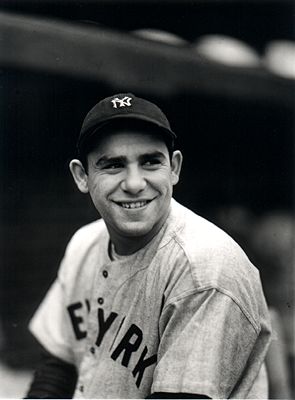
Lawrence (Yogi) Berra was part of the mighty New York Yankees team that dominated baseball in the early 50s.  He was named Most Valuable Player in the American League 3 times.  He hit 358 home runs (long before steroids) and anchored the Yankees behind the plate.  Yet Yogi Berra will be remembered for something more than his athletic accomplishments — his amazing use of the English language.  Yogi Berri could certainly turn a phrase.

It’s not over ’til it’s over.
If the people don’t want to come out to the park, nobody’s gonna stop them.
I want to thank all the people who made this night necessary.
Better make it four pieces.  I don’t think I can eat eight. (on being asked how he wanted his pizza cut)
No wonder nobody comes here — it’s too crowded
You can observe a lot just by watching.

Yeah, Yogi!  You sure can!

Perfume: The Smell of Extinction

The human race is heading for extinction.  No, guess again: it’s not climate change – not yet anyway.  It’s much more basic than that.  We stink.  We absolutely reek of chemicals.  Every day, we pour, spray and smear huge amounts of artificial smells on our bodies.  If that isn’t bad enough, we fill the air around us with a chemical cocktail, as well.  We’ve become obsessed with odor, and we attack it like it’s Satan’s grandson.  However, in our zeal to defeat aroma, we’re cloaking ourselves in a chemical cloud capable of defoliating Denmark.  Our noses haven’t worked properly in decades, and our poor lungs can’t even gasp for help anymore.  Most importantly, we’re losing our original human scent, and this will be our demise.

I know it’s hard to believe in a world filled with Driven, Hidden Fantasy and Hugo Boss, but we humans have our own smell – individually — just like cats, dogs or elephants.  It’s a perfectly agreeable odor that is simply Mother Nature’s way of recognizing her kids with the lights off.  We don’t smell it consciously anymore because we’re a gillion generations out of the caves.  Basically, we haven’t needed to distinguish our buddy Cro-Magnon Carl from the local sabre tooth man-eater for many millennia — so we don’t.  But it’s still there, all the same.  Ask any couple who’ve been together for any length of time and they will tell you their partner/husband/wife/lover has a distinct smell.  It’s recognizable on the pillow, on their clothes or in a room.  It’s identifiable.  This smell is extremely important.   It’s how animals find and keep sexual partners.

In our oh-so-sophisticated contemporary society, we don’t want to believe we’re still just really smart animals.  We think we’re halfway to the gods or something, and ordinary human activity is dirty, dangerous and offensive.  Just take a look at how we go after bacteria.  We’re willing to flush tons of life destroying chemicals into our water supply and massacre whole species of fish just so our children don’t touch anything that isn’t double-dipped in Lysol.  We treat smell the same way (worse, actually.)  We’ve convinced ourselves we smell bad, and not just occasionally – all the time.

Take a walk through any shopping mall and count the number of places that sell fragrance of one kind or another and not just perfume — any fragrance.  The only places that don’t are A & W, the bank and the guy selling lottery tickets.  There are entire stores devoted to smell and that’s just human smell.  Other stores have departments for kitchen, bathroom and household odors.  Still others have a whole aisle for air fresheners, and some have little mini-sections strictly for pets.  This is outrageous.  Clothing stores have tables for celebrity perfumes, hardware stores sell AXE and gas stations sell travel size deodorant  – just in case.  In case of what?  It’s a gas station!  It smells like gas!

We don’t generally notice the amount of retail space given over to the war on smell — simply because it’s everywhere.  However, the real problem is, it’s chemical warfare!  Most of the perfumes, deodorants, soaps, body sprays etc sold, are not naturally derived from the lavender plants of Provence lovingly crushed by the local peasants.   Trust me: 99% of the stuff we use every day is concocted by scientists in a laboratory.  And get this — it’s a secret laboratory — because the makers of all those perfumes, deodorants, soaps, body sprays etc. are not obligated by law to list their ingredients on the label.  These are unknown chemicals folks, in strange and unique combinations, and we’re putting them on our skin — which, by the way, is porous.  Unless you’re Robert Downey Jr. from Iron Man II your body is absorbing those chemicals like a brand-new loofah.

The other side of the coin is that some of those chemicals remain on our skin and attack the sensory organs of the people around us.  Try walking through the perfume department of The Bay (no offence, it was the only name I could come up with) and you can taste the fumes in the air.  Or ride in an elevator with a Radioactive AXE Man, and somewhere around the 25th floor, you’re going to need oxygen.  I have no fear of industrial air pollution because we are breathing the chemical waste of Obsession, Heat, Glow, Unforgiven and a thousand more – up-close-and-personal — every moment of the day.  No wonder there’s a pandemic of asthma and respiratory illness in our society.  Our lungs simply weren’t made to absorb this amount of crap.  These days, people who quit smoking just come out about even.

Eventually, between the amount of fragrances we use to disguise our natural scent and the damage we’ve already done to our noses, lips and tongues, we’re not going to be able to smell each other anymore.  We’ll all smell the same.  This is not a good thing.  Any anthropologist, biologist or zoologist will tell you that animals, including humans, depend on smell.  It’s the most intimate of the senses, and it’s essential — not only for reproduction but also for natural selection within the species.  If we’re not careful, we’re going to become a-scentual.  After that, it’s a straight slide to extinction.