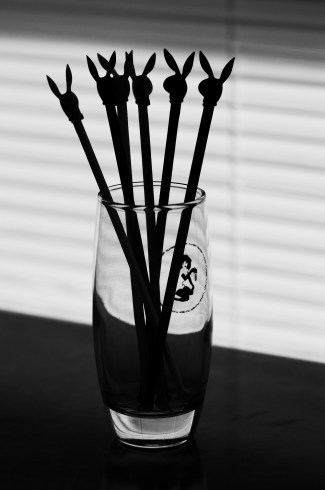
 Hugh Hefner is dead, and I’m not feeling that well myself. It’s too bad the old boy turned himself into such a caricature because, now, blinded by the neo-Victorian morality of the 21st century, all we can see is boobs. However, I’m certain history will absolve him.
Hugh Hefner was a uniquely American phenom who, like Joseph Pulitzer and William S. Paley, saw an empty space in the media marketplace and filled it.
In the early American 1950s, World War II was still fresh, but the soldiers were home. They’d gotten the girl next door, a couple of kids, a corporate job, and a GI Bill of Rights house in the suburbs. Life was ordinary again, and these aging ex-warriors found themselves losing their hair and their testosterone, sitting on the sofa night after night with Milton Berle and I Love Lucy. Then came Playboy. It was a full colour glossy, foldout fantasy of all the things a 30-something family man thought he shoulda/coulda/woulda done with his life. It was urban cool — sweet jazz, dry martinis, deep-throated stereos, street muscle cars and beautiful women. It set the standard for hip because anybody who was anybody appeared in the pages of Playboy.
There’s no doubt our world thinks Hugh Hefner belongs to a different time and his creation Playboy is a misogynist relic. However, here’s something I wrote two years ago that shows just how large an impact Playboy had on our society.
——————
October 16th, 2015
Now that Playboy Magazine has renounced nudity, it’s become an easy target — a misogynist relic of the 20th century — more silicone than substance. Perhaps — I don’t know — like most people, I don’t actually read Playboy anymore, so I’m in no position to judge. However, I do know this. If you’re over 35 and not dead, you’re part of the massive impact Playboy has had on our society.
Take a look:
The Playboy Interviews read like a history book of our times:
Malcolm X, Jimmy Hoffa, Federico Fellini, Fidel Castro, Orson Welles, Ralph Nader, Marshall McLuhan, Ray Charles, Germaine Greer, Tennessee Williams, Jimmy Carter, Barbara Streisand, David Frost, Marlon Brando, G. Gordon Liddy, Lech Walesa, Ansel Adams, Jesse Jackson, Carl Bernstein, Imelda and Ferdinand Marcos, Yasser Arafat, Donald Trump, Martin Scorsese, Michael Jordan, Salman Rushdie and on and on and on.
In one single year, 1964, Playboy interviewed Vladimir Nabokov, Ayn Rand, Jean Genet, Ingmar Bergman and Salvador Dali. And Playboy didn’t just follow what was trending; it tried to understand. It interviewed Martin Luther King Jr. at the height of the Civil Rights Movement in 1965; Timothy Leary, when mainstream drug use was a brand new phenom in ’66 and Steve Jobs, immediately after getting booted out of Apple in 1985. Plus, Playboy took some chances, like sending Alex Haley, the author of Roots, to interview George Lincoln Rockwell, the leader of the American Nazi Party.
Yes, Alex Haley wrote for Playboy and so did Norman Mailer, Gay Talese, Hunter S. Thompson and Gore Vidal. There were others too, but the list of fiction writers is even more overwhelming:
Joseph Heller, Roald Dahl, Ian Fleming, Margaret Atwood, Haruki Murakami, Ray Bradbury, Bharati Mukherjee, Jack Kerouac, Kurt Vonnegut, Joyce Carol Oates, Philip Roth, Ursula Le Guin, Martin Amis and, once again, on and on — including four Nobel Prize winners: Saul Bellow, Isaac Bashevis Singer, Gabriel Garcia Marquez and Doris Lessing. In fact, if it wasn’t for the boobs, Playboy would be considered a literary magazine — one of the best.
But what about those boobs?
Some of the most beautiful women in the world have voluntarily taken their clothes off for Playboy:
Farrah Fawcett, Olivia Munn, Robin Givens, Katarina Witt, Ursula Andress, Tia Carrere, Kim Basinger, Elle Macpherson, Kate Moss, Catherine Deneuve, Shari Belafonte and Raquel Welch among many, many others. The numbers alone take Playboy pictorials beyond sleazy. Besides, is there any great distance between Charlize Theron and Titian’s “Venus of Urbino” or Naomi Campbell and Goya’s “The Nude Maja?” Argue all you want about objectifying women, but if you want a lesson in that, go to the pages of Vogue or Fashion or Harper’s Bazaar. Rhetorically speaking, is a pouting, uber-skinny supermodel a more acceptable female image? Or is it just that she’s covered up the naughty bits?
At 62, Playboy Magazine is old and grey and nodding by the fire. In a one-click universe where the most outrageous porno is at your fingertips and few people are willing to wade through serious pages of unbroken prose, Playboy is passé. Eventually, it will dissolve into history — the history it helped shape. Like it or not, Playboy changed the world — no doubt. But, mostly, it let us be adults about sex and it single-handedly transformed sexuality from Downtown smut to Uptown sophistication. It made smart sexy, and that’s what made Playboy cool.

 People are wonderful creatures. They come in infinite varieties, and just when you think you’ve got them figured out, they come up with something completely different and surprise you. It’s no wonder so many psychiatrists need therapy. I’ve studied people (informally) most of my life, and I’ve arrived at a few interesting conclusions.
 WD Fyfe