Eagerly Offended: Our Brave New World

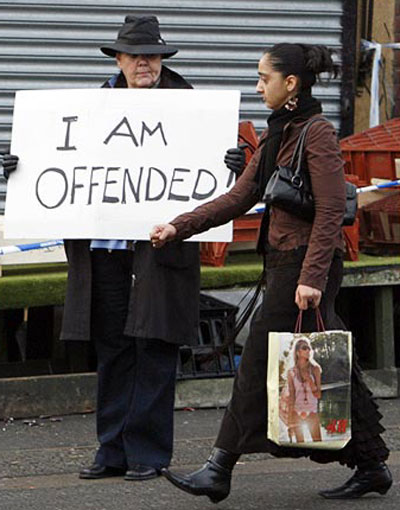
offendedI doubt that congratulations are in order, but as of this week, our world finally hit critical mass on the “I am offended” scale.  In less than a day and a half we went from a society that was merely easily offended — by pretty much anything — to one that is now eagerly offended by it.  Therefore, as of close of business, January 30th, 2013, we are currently self sustaining in the injured feelings department and will remain constantly offended by one thing or another for the rest of all time.  My, but we do live in a curious age!

The Malcolm Gladwell Tipping Point, that threw us into this abyss of indignation, came during this week’s hype-up to the Super Bowl.  No, it wasn’t Ray Lewis mouthing off about the devil.  Quite frankly nobody’s on his side (the devil’s that is, not Lewis’.)  Nor was it Taco Bell getting its ass kicked by a bunch of militant vegetarians.  They were the ones who were so offended by Taco Bell’s “attack ad” on healthy eating that they made the faux Mexican fast food chain withdraw its Super Bowl mega-mercial in abject shame.  (Frankly, I never realized vegetarians were an identifiable activist group.  I thought they were just people who didn’t eat meat.)   No, the straw that proverbially pushed us from “easily” to “eagerly” was an innocuous player interview from the three-ring media circus.

The radio interview of Frisco 49er cornerback Chris Culliver (BTW, I’m a Raven’s fan so I have no self interest in defending Mr. Culliver.) was probably cliché-ing along quite nicely when interviewer Artie Lange asked if there were any gay players on the 49ers.  Culliver’s murky, meandering answer amounted to assurances that he was a heterosexual, his team mates were heterosexuals and nobody in the 49ers’ locker room was interested in exploring any alternative sexual orientation for at least a decade.  The loud and proud crowd jumped on the guy faster that you can say leisure-class activist.  They hauled out their own battalion of clichés – homophobia, intolerance, discrimination etc. and made their usual demands – a personal apology, a corporate retraction and some force fed re-education for the offending member.  The 49ers’ organization reacted immediately, tremblingly obeyed, and all was right with the world again.

Unfortunately, as per usual, people were offended by the wrong thing.  It’s offended1beyond my comprehension why nobody was pissed off by the question itself.  Rhetorically speaking, why did Lange even ask it in the first place?  What the hell does homosexuality have to do with football?  I doubt very much if Raven’s Coach Harbaugh (John) called his players together and said, “Listen up!  My brother, over in San Fran, has got himself a couple of homosexuals on defence, so we’re going to overload the strong side on 3rd and long situations.”  Sexual orientation just isn’t part of a winning football strategy.  It would have made just about as much sense for Lange to ask how many Norwegians were on the team; more, actually, since Norway is not what you’d call an American football powerhouse (no offence, Norway.)  Yet, Artie got off scot free (no offence, Scotland, or Dred Scott or whoever — My God, there’s no end to it!)

My point is somebody is always going to be offended by something.  This is as natural as homosexuality itself.  However, bringing up contentious issues at every possible inappropriate opportunity is actively seeking to be offended.  There’s no second choice on this.  Lange didn’t ask the question because he genuinely thought the world needed to know the straight-to-gay ratio on the 49ers.  He askeoffended2d it to see if he would get a stir-the-pot response.  He did.  The usual suspects were shocked and appalled, and our society gasped in some kind of sicko socio-emotional masochistic satisfaction (no offence, masochists.)

It comes down to this: go ahead and be offended if that’s what makes you happy.  However, don’t go striding around as if you’ve just been confronted by the antiChrist.  As of a couple of days ago, it’s pretty obvious that getting offended in our society is something we’re doing on purpose, and it’s now just as institutionalized as the Super Bowl!

I Love Urban Legends

urban legendI love Urban Legends.  The first time the stupid gringo couple bought that rat in Tijuana and tried to import it as a Chihuahua, I laughed myself stupid.   I always look for the dead mouse in the soda pop.  And even though I’ve never seen the Ghost Hitchhiker, I know a woman whose cousin worked with her neighbour.  The neat thing about urban legends is, like Rembrandts, it’s so easy to spot a fake.  Street gangs do not have the patience nor the elaborate forethought to drive around town with their headlights off, looking for victims.  Petty little sneak thieves don’t take the time and trouble to do unmentionable things with your toothbrush.  And regardless of how many people have declared they are Jedi on the census form, the federal government does not recognize it as an official religion.  (I checked.)  That’s why it’s so cool that the latest urban legend has surfaced as a legitimate news story.

If you missed it, too bad, but here’s the Peanut Gallery version.  Apparently, this six-figure American computer programmer, who conveniently works out of his house, decided that rather than working for a living he would pull a General Motors and outsource his job to China.  Basically, he hired a Chinese national to do his work for him — at a fifth the price.  The Chinese technician is living large in some place called Shenyang, and our boy is fat, smart and happy, getting 80% of his salary for doing nothing.  According to all reports, he spends his days watching cat videos on YouTube.  Pretty sweet, huh?

Of course, when you think about it, a bunch of WTF questions come to mind.  Like how did our American programmer find this Chinese guy in the first place?  A want ad in Wired?  Or how come the company didn’t notice when there was a daily log-on from China?  These are little things, but they raise some serious red flags (no pun intended.)  But the telling moment in the whole “news’ story is there’s no who, when or where!  The programmer, the company, the timeframe and the city are not named.  The only hard “fact,” in any of it, is Shenyang, China, and go ahead and try finding a particular programmer in that town.  There’s absolutely no way, from the information given, to check just how true this “news” story really is.

That’s the thing about Urban Legends; they seem plausible.  They could be true.urban-legend1  A maniacal killer could, on occasion, lurk in the back seat of a car.  Dead people could wander rainy midnight roads.  And American workers could outsource their jobs.  These things are all entirely possible; they’re just not probable.

Yet urban legends are more than simply the lies the Internet tells us.  (BTW, Dream Whip™ and ping pong balls do not have the same molecular structure, and Coca-Cola™ was never laced with cocaine.) They are contemporary fables; teaching stories and cautionary tales.  They remind us that, as Hamlet once said, “There are more things in heaven and earth, Horatio, than are dreamt of in your philosophy” and tell us to be wary of our world.  For example, there’s an urban legend that Kentucky Fried Chicken changed their name to KFC because the USDA discovered that the company had genetically modified their product to such an extent that it could no longer legally be called chicken.  Apparently, Kentucky Fried Mutant would have been a marketing disaster, so they went with KFC.  This is 100% false (again, I checked.).  However, it does demonstrate that there is widespread concern about GMOs and just exactly what is happening to the food we eat.  Similarly, our enterprising computer programmer shows us that people are worried that North American jobs are, like the elves of Middle Earth, leaving these shores.

Urban legends are genuine folk tales.  Like Aesop’s fables,they give us an allegorical insight into our world and reflect contemporary concerns and attitudes.  As sophisticated as we may believe ourselves to be, we still fear the unknown.  This is why so many urban legends have a supernatural or demonic element to them.

urban legend2Unfortunately, as our society gets more complex, so do our urban legends.  Real stories get mixed in with the fakes.  We might laugh at our computer programmer outsourcing his own job, but what about my sister’s gardener’s brother, who had his identity stolen when terrorists used Face-recognition software on his Facebook profile picture? Then, when he went to collect his lottery jackpot, he was arrested for terrorism…. You can never be too careful in this world.

Children of the Net

facebook3There’s a funny little thing happening right now that is going to change our society forever.  However, unlike most changes history has encountered, this one is not the deliberate result of layers and layers of knowledge.  This new phenomenon is merely an unintended by-product of what was once called the Information Superhighway.

If you are of an age, you remember the family photo albums.  These were where the hard copies of your family’s memories were warehoused.  They had pictures of aunts and cousins you’d never heard of, a bunch of black and white faces with no names, Christmas trees, birthdays and even the vacation from hell.  They were a permanent record of you standing there like a bow-tied midget at some wedding, or flashing your baby bum.  All of the good shots and geek shots of the life that was yours.  The photo albums were the repository of you and your family’s consciousness, collected and bound and hidden, as if they were precious, in a closet somewhere.  And precious they were.   There is more than one story of parents braving natural disasters to save the photographs or divorcing couples arguing over baby pictures.  As sentiments go, pretty much everybody prizes photographs above all else.  They were yours.  They belonged to you.  In essence, you owned your own memories and could distribute them (share, if you will) as you saw fit.  But that was then, and this is now.

Siblings using laptopsSince the time of the photo album, our society has gone through some radical changes: the Internet, digital cameras, email, texting, smartphones, Facebook and Twitter.  As the children of the Internet were exploring these new Apps and devices they were recreating themselves as public personae – picking and choosing the best and the brightest for their public faces.  Straddled across generational lines (their earliest pictures might still be in the photo albums) they could maintain a semblance of privacy in a tsunami of social networking.  Bad hair days were deleted, not uploaded; shoes were shined and despite the ubiquitous “duck face,” everyone put their best foot forward.  However, even as they were shaping their newfound publicity they were also growing up and starting to have children of their own.

The children of the children of the Internet are being documented as no other generation.  Even before they were born, they swarmed through cyberspace as baby bumps.  (God, I hate that term!)  Now, as they teeth, talk and waddle around the coffee table, smartphones are snapping every move they make, and with a few finger stokes, uploading their antics across the planet.

facebook1This is the Facebook Generation.  They are the first generation to be born in the Internet fishbowl and raised in the public domain.  Nothing is sacred.  They can neither run nor hide.  Every developmental step and stutter is being recorded, and the results are available to anyone with a Web connection.  As of right now, their individual collective memories, so guarded and cherished by past generations, are no longer their own.  For the first time in history, an entire generation will not have the option of deciding for themselves how they want the world to see them.  They’re already on permanent display.  This will have a profound effect on their future.  To them, privacy will no longer be a question open to debate; it simply will not exist.

Without thinking, we have sacrificed our children’s privacy on the altar of Social Networking.  This is not necessarily a bad thing.  The situation is what it is, and there’s no turning back the clock.  However, by denying our kids the right to stumble and make mistakes in private, we have condemned them to live their lives in the public eye.  At this point, there’s no way of knowing how well they’re going to handle this relentless public scrutiny.  However, I, for one, am glad my teenage friends couldn’t download the details of my potty training and Elizabeth McTavish never saw me looking like a toad in that stupid sailor suit.