
Christmas Trivia

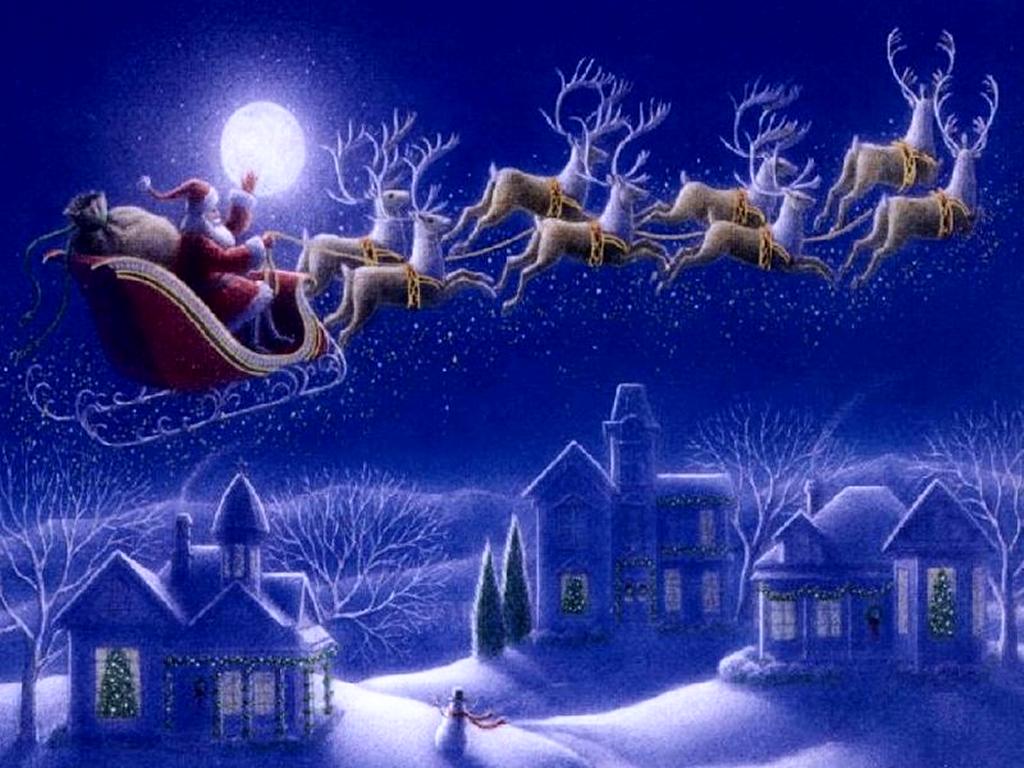
Any Laplander will tell you that all reindeer have antlers.  However, they will also tell you that male reindeer lose their antlers in late November or early December, whereas female reindeer do not lose their antlers until spring.  Therefore, the reindeer that pull Santa’s sleigh are all female – including Rudolph.  There were originally eight reindeer: Dasher, Dancer, Prancer and Vixen, Comet, Cupid, Donner and Blitzen.  Rudolph was added in 1939 when Robert L May created a colouring book for retailer Montgomery Ward to give away at Christmas.  The book told the now familiar story of Rudolph and how he came to guide Santa’s sleigh.  Ten years later, in 1949, Gene Autry had finished colouring all the pictures, so he decided to record a song based on the Rudolph story.  “Rudolph the Red-Nosed Reindeer” was an instant hit, and Rudolph has been around ever since.

“Frosty the Snowman” was written by Jack Rollins and Steve Nelson in 1950, for Gene Autry, who wanted to follow up the success of “Rudolph, the Red-nosed Reindeer” from the previous year.

Originally, there was one other reindeer in Santa’s team pulling the sleigh on Christmas Eve.  Unfortunately he became bitter and belligerent, so Santa had to take appropriate disciplinary action.  His name was Dinner.

The names of The Three Wise Men are Gaspar, Melchoir and Balthasar not Manny, Moe and Jack as some TV ads would lead you to believe.  However, if you want to astound your friends with your Christmas knowledge or win drinks at any pub in the world just ask the question; Which Wise Man brought which gift?  The answer is Melchoir brought gold, Balthasar brought frankincense and Gaspar, who, like most of us left his Christmas shopping to the last minute, brought myrrh (whatever that is.)

The traditional Christmas poinsettia originally came from Mexico.  It was first brought to the United States by Joel Poinsett in the 1820s.  Even after all these years, the name is still almost universally mispronounced.

Santa Claus actually lives in Canada.  He has his own address and postal code.  It’s Santa Claus, North Pole, Canada, H0H 0H0.  If you write to him he will reply in whatever language your letter is written in.  Try it!

Although, under various aliases, Santa Claus is claimed by a number of countries he is, in fact, a Canadian citizen.  On December 23rd, 2008, the Canadian government’s Minister of Citizenship, Jason Kenney, declared, “The Government of Canada wishes Santa the very best in his Christmas Eve duties and wants to let him know that, as a Canadian Citizen, he has the automatic right to re-enter Canada once his trip around the world is complete.”

Like most of the cool Christmas traditions, candy canes come from Germany.  They started out, in the late 17th century, as white sticks of candy given to children to keep them quiet during the long and infinitely boring Christmas church services.  Many people believe candy canes are bent so they could hang on the Christmas tree.  Originally, however, the canes were bent to resemble a shepherd’s crook and so calm the objections of stodgy old churchmen who didn’t want kids having candy in church.

If you’re trapped in Dublin at Christmas, “Merry Christmas” in Irish is “Nollaig Shona Dhuit” but I have no idea how to pronounce it.

Oddly enough, Mrs. Claus does not have a first name; nor, for that matter does any of the elves.

Canada was the first country to issue Christmas stamps — in 1898.

Nova Scotia exports more Christmas trees than anywhere else in the world.

The reason that relentless movie, It’s a Wonderful Life, is on TV so much is that television stations don’t have to pay for it.  Apparently, when it was made, there was a mix-up in the contracts, so nobody who worked on the film — including the actors — ever gets residuals.
It is a well known fact that the stupid “Little Drummer Boy” (who was put on this earth to annoy me) has absolutely nothing to do with Christmas.  The real little drummer boy was a pickpocket and sneak thief who fell in with the Three Wise Men in order to gain their confidence and eventually rob them.  He was already a hardened criminal by that time and had a list of previous offences as long as the Ohio River.  He was caught with his hand in the frankincense jar and sentenced to 10 years’ hard labour — which is exactly what the treacherous little bugger deserved.

Did you know?  There was once a dyslexic devil worshipper who sold his soul to Santa.

Christmas Quotes

“There’s nothing sadder in this world than to awake Christmas morning and not be a child.” – Erma Bombeck
“All Christmas trees are perfect.” – Charles N Barnard
“It’s not the gift, but the thought that counts.” – Henry Van Dyke (Dick and Jerry’s other brother?)
“Christmas is a whispered conspiracy of love.” – Anon
“Nothing is as mean as giving a child something useful for Christmas.” – Kin Hubbard
“Santa is very jolly ‘cause he knows where all the naughty girls live.” – Dennis Miller
“Bah! Humbug!” — Ebenezer Scrooge
“Merry Christmas, Nearly Everybody!” – Ogden Nash

Christmas: A Victorian Invention

Obviously, Christmas, as we know it, started quite literally in the year dot.  Like it or don’t, the birth of Christ is the single most important event in the history of Western civilization.  Here in the 21st century, we continue to celebrate the day as a religious, secular or “hell of a good time” holiday.  It’s a tradition.  However, it’s a relatively new one.  Our celebration at Christmas started accidently, in the1840s, when these two events coincided.  First of all, an English author published a novel; secondly, Queen Victoria married a German.  Without these two isolated events happening at just the right time, we’d all be sitting around December 25th burping up turkey and looking for batteries — for no apparent reason.

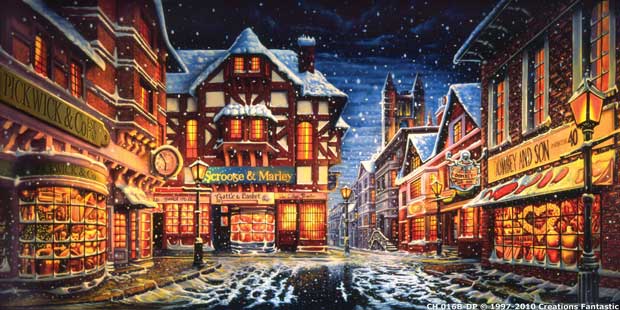
When Queen Victoria ascended the throne in 1837, there was a feeling that this was the beginning of a new age in Britain.  The Napoleonic Wars were long over and mostly forgotten, and the world was enjoying a time of relative peace.  The industrial revolution was producing not only a new prosperity but also a new middle class who had both money and leisure.  They could enjoy things like travel, family life, and even hobbies such as reading for pleasure.  Also in 1837, a relatively unknown author named Charles Dickens published a newspaper serial called The Pickwick Papers.  Within about 5 chapters, he had suddenly become the J.K. Rowling of the 19th century.  The new English middle class fell in love with Pickwick.  Soon, people on both sides of the Atlantic were lining up to get the latest instalment of his adventures.  One of the most enchanting episodes in The Pickwick Papers was a fanciful description of a Christmas festival.  Christmas was undergoing a bit of a revival at the time, and Dickens’ highly fictional description gave people something to emulate.  It was very much the same as when people today talk and act like their electronic friends on TV.

For the next couple of years, Charles Dickens kept himself busy.  He published some very successful novels — Oliver Twist and Nicholas Nickleby, among others.  Then, like most successful authors, he decided to shoot his mouth off.  He ran afoul of his American audience by advocating some rather radical ideas like universal copyright (so those damn Yankees couldn’t steal his stuff) and the abolition of that quaint American custom of slavery.  Suddenly, he was losing some pretty valuable customers on the other side of the Atlantic.   He wanted to get them back, so he began writing a series of books he described as, “… a whimsical sort of masque intended to awaken loving and forbearing thoughts.”  He succeeded.  In 1843, he published A Christmas Carol and the world changed dramatically.  Once again, both sides of the Atlantic went crazy for Charles Dickens.  Scrooge, Cratchit and Tiny Tim were more popular then, than Edward, Bella and whatever the kid’s name is are today.

Everybody wanted to celebrate a traditional Christmas the way Dickens described it because — before Dickens wrote it — nobody actually kept Christmas that way.  He made it all up.  He took several traditions that were already there and put them together in a stylized setting.  It was fiction.  Plus, Dickens didn’t just write A Christmas Carol; there were five books in the series.  Every time our Victorian ancestors turned around, there was Charles with another feel-good Christmas story.  It must have been like getting beaten over the head with a rainbow.  By the time Dickens was done, Christmas was everywhere.  You couldn’t get away from it.

Meanwhile, in 1840, Queen Victoria married Prince Albert of Saxe-Coburg and Gotha, her German first cousin.  Albert showed up at Buckingham Palace with all his German sensibilities intact, including some very noticeable Christmas traditions — like decorations and the tannenbaum or Christmas tree.  Christmas trees had been around for some time, but it wasn’t a common practice in England to cut down a tree and haul it into your house.  Any trees that did get cut down around Christmas were normally thrown into the fire as Yule Logs.  However, the popularity of the young, good-looking monarchs was such that, when Victoria and Albert appeared with their children in front of a Christmas tree, in The London Illustrated News, Christmas celebrations became uber-fashionable.

The social ladder now had a new rung, and people all over England and America began decorating their houses at Christmas, just like they assumed their aristocratic betters were doing.  Thus, the height, breadth and weight of the Christmas table one set became society news and reason for gossip.  Everybody wanted to know what Jenny Churchill was wearing or what the Astors served for dinner — so they could do it, too.  It was Entertainment Tonight – only with bonnets and bustles.  Christmas was not only everywhere; it was trendy.  The result was that Christmas became the #1 holiday of the year — and has been, ever since.

Today, our Christmas celebration is surprisingly similar to that of our Victorian ancestors.  Of course, there have been refinements along the way.  In 1843, Horsley and Cole, a couple of bored Englishmen, invented Christmas cards.  Saint Nicholas was turned into Santa Claus by Thomas Nast and Coca Cola.  At some point, religious hymns became “I’m Dreaming of a White Christmas” and “Jingle Bell Rock.”  Add we’ve added Rudolph the extra reindeer and that stupid Little Drummer Boy (who was put on this earth just to annoy me.)  However, it’s basically the same Christmas they would have had a century and a half ago.  So, when you push your chair back from the table and look at the beauty of your own personal Christmas, take a nanosecond and thank Charles, Victoria and Albert, who invented it for you.

Santa Claus and Clausaphobia

Every December, the world is gripped in a pandemic of Clausaphobia – the irrational fear of Santa Claus.  Although this is a mental disorder, there is considerable evidence that it’s contagious.  First of all, it has a distinct season, roughly from American Thanksgiving until December 26th — when it suddenly disappears as if it was never there in the first place.  Secondly, people who get the condition are quite noticeably afflicted; they simply can’t shut up on the subject.  Finally, as fate would have it, it seems to be spread by word of mouth.  Over the years, there’s been a lot of claptrap written in defence of Clausaphobia — as though those who suffer from its debilitating effects are, in fact, quite normal.  These fables have been repeated, at concert pitch, for so long that many otherwise sane people are now in danger of contracting this condition.  However, a small group of learned men and women are fighting back.  Equipped with science and reason they are desperately holding this disease at bay.  In the interests of helping control a worldwide scourge, here is a brief synopsis of their findings.

First, the fables.  In almost every Christmas book ever written, the story of Santa Claus starts out in some godforsaken town in Turkey.  Apparently, there was a guy there named Nicholas.  He was a priest or something, and he was so generous the Church made him a saint.  Fine!  There are a few scraps of evidence that some of this might be true.  For example, this Nicholas could very well have been a real 4th century bishop named Nikolaos of Myra.  However, historians have never agreed on that or any other where, when or why of this little fairy tale.  In fact, there is no definitive evidence whatsoever that this (or any other) Nicholas has any historical connection to Santa Claus.  However, this hasn’t deterred the myth makers.  Invariably they go on to relate a number of tales about their various Nicholases (Nicholi?) to demonstrate a vague link to the common practices of our modern day Santa Claus.  Unfortunately, they are all different stories concerning shoes, stockings, children, lumps of coal and what-have-you (no two alike) and none of them is backed up with factual findings.  In place of hard evidence, anthropologists and social historians theorize that Santa Claus grew out of these improbable Nicholas legends. They maintain that quaint local folk traditions somehow not only survived the Dark Ages but actually thrived, spreading throughout Europe.  Again, without a lick of corroborating evidence!  What a crock!  This has led to modern confusion and frustration — the root cause of Clausaphobia.

Let’s set the record straight.  Here’s the real story of Santa Claus, based on historical fact.  Santa Claus has been around forever.  He’s known by a number of different names — Sinterklaas in Holland, Father Christmas in Britain, Pere Noel in France etc. etc. — but it’s all the same guy.  He lives at the North Pole with Mrs. Claus (who, oddly enough, doesn’t have a first name) a ton of elves and the reindeer.  All year long, the elves make toys in a gigantic workshop.  Then, once a year, Santa loads up his magic sleigh, hitches up the reindeer (who can fly, by the way) and goes around the world, delivering toys to good girls and boys.  How do I know this?  Documented proof!  Santa Claus has actually been seen – at least three times — once by Clement Moore in 1823, then again by Thomas Nast in the early 1860s and finally by Haddon Sundblom sometime in the late 1920s.  There are also a few secret contemporary photographs which haven’t been authenticated.  However let’s just stick to the facts.

In 1823, Clement Moore, a professor at Columbia College, woke up on Christmas Eve and witnessed Santa Claus delivering toys to his house.  He wrote a poem about his experience, called ‘Twas the Night before Christmas which was published in the Sentinel newspaper in Troy, New York.  In that poem, Moore describes Santa quite accurately.  He also describes the reindeer (miraculously remembering Santa’s names for them) and their ability to fly.  There is some controversy over Moore’s account, however, because he describes the scene as “a miniature sleigh, and eight tiny reindeer” and goes on to call Santa himself “a right jolly old elf.”  Since we know (from corroborating evidence) that Santa Claus is actually quite a large gentleman, we can only conclude that Clement either didn’t have his glasses on or suffered from an undiagnosed eye ailment.

Santa Claus was next seen by Thomas Nast, sometime in the 1860s.  Nast was a cartoonist and social commentator who gave us, among other things, Uncle Sam, the symbols of both the Republican and Democratic political parties and the term “nasty.”  Obviously, a witness to history like Nast would not let his encounter with Santa Claus go unrecorded.  In the January 3rd, 1863 issue of Harper’s Weekly, Nast drew an illustration of Santa Claus meeting Union troops and passing out gifts during the Civil War.  We know this portrayal to be accurate because Santa Claus appears exactly as Clement Moore described him!  Clearly, these two depictions are of the same person.  Nast seems to have developed a long-term relationship with Santa Claus, because, twenty years later, he drew him again in what looks like a seated portrait.

The next documented sighting of Santa Claus occurred sometime in the late 1920s.  Haddan Sundblom, an advertising artist, must have met Santa on several occasions or even convinced him to once again pose for a portrait.  In 1931, Sundblom painted a picture of Santa as an advertisement for the Coca Cola™ Company.  It appeared in the Saturday Evening Post.  Sundblom’s image was universally recognized as Santa Claus; there were no complaints, nor any suggestions of inaccuracy.  Not one single person in the entire world even hinted that this might not be Santa Claus.  In fact, Sundblom’s portrait was so accurate that over the last 80 years, it has been plagiarized unmercifully.

These are just three examples that document the truth about Santa Claus.  There are more.

This Christmas, as you celebrate the season of joy, remember that there are those among us who are frightened and confused.  And although education is our best defence against Clausaphobia, don’t confront those who suffer (clausaphobes get very agitated at the truth.)  Accept them.  They are poor unfortunates, and it’s not their fault.  Perhaps, you can make a difference if you just say in a kindly voice, “You don’t have to believe.  Just write to Santa.  He’ll answer.”
Santa Claus
North Pole
Canada
H0H 0H0