Gillette: Ya Screwed Up!

gillette

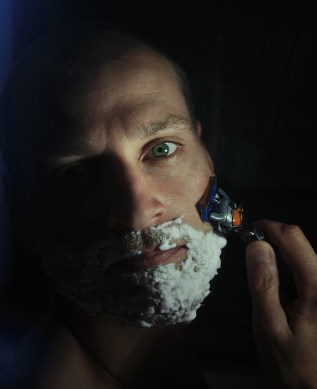
Gillette has just made a massive mistake that’s going to have consequences all over the world.  This is serious, folks — so you’re going to need a little background.  Gillette recently released an advertising video that, in no uncertain terms, calls their customers (men) a bunch of knuckle-dragging assholes who spend their leisure time teaching their male children to bully each other and harass women.  And then they take the virtuous stance that this has got to stop.  Applause!  Another multi-national corporation has found its soul.

Maybe.

Personally, I don’t think Gillette suddenly developed a social conscience last Tuesday and felt a moral obligation to join the #MeToo conversation.  I think their advertising department took one look at the gigantic numbers generated by the controversial Nike/Kaepernick collaboration last September and said, “Wow!  We need to get in on some of this social justice action!”  So, at a time when traditional advertising is dying, they decided to hitch their corporate brandwagon to the rising star of “toxic masculinity.”  Fair enough.  Unfortunately, there are a bunch of cynics in this world who believe Gillette is just newsjacking.  They think that the reality is Gillette doesn’t much care if its customers punch each other in the face or have pan-fried puppies for breakfast — as long as they buy razorblades.  Here’s the deal: if Gillette were actually serious about social justice, they’d be funding a string of Gillette Centres for Battered Women.  After all, the designated smoking areas in some German airports are sponsored by Camel.  Honestly, if a multi-billion dollar corporation is going to talk the talk, they should walk the walk — every once in a while.

But the real problem is there’s going to be an unintended consequence from Gillette’s global hypocrisy.  Millions of Gillette customers don’t like being told they’re the problem and then being asked to pay for the privilege.  They’re dumping their Gillette products in the trash and finding alternatives – alternatives that have a different chemical composition.  Thus, in the very near future, people all over the world are going to subconsciously discover that their sons, fathers, brothers, husbands, boyfriends and lovers all smell different.  Humans, like all animals, rely on their olfactory sense for any number of social and sexual cues, and when the people closest to us don’t “smell right,” that’s a major problem.

So, now we’re left with a bunch of pissed-off men, a lot of suspicious babies, wary relatives, cautious friends and an army of confused and slightly frustrated women — all because the folks down at Gillette wanted to cash in on the 24-hour Twitter news cycle.  Thanks, Gillette!  If that’s “the best men can be,” don’t do me any more favours.
May 68 (plus 50)

may 68 1

Fifty years ago is a long time: it sits in that twilight zone between living memory and history.  Old people can conjure it up — if they have to — but young people can only see it on YouTube.  And every year, the shadows those images cast get a little greyer, a little thinner and a little harder to recognize.

Fifty years ago (March 22, 1968) Daniel Cohn-Bendit and seven of his friends walked into the administration offices at the University of Nanterre in Paris and refused to leave.  Six weeks later, all hell broke loose!

May 1st, 1968 was the high-water mark of the 60s.  Television and the Tet Offensive had turned the world against the Vietnam War.  In America, that popular opinion was chasing Lyndon Johnson out of the White House, and when Bobby Kennedy announced he wanted to live there, it looked like the second coming of Camelot.  In Europe, Alexander Dubcek’s communist reforms in Czechoslovakia were cleverly outmaneuvering the Soviet Union in a warm and glorious Prague Spring.  Che had become the infallible martyr of the revolution, and Mao’s Red Guards hadn’t gone crazy yet.  The world was young and arrogant and optimistic and excited and on the verge of … nobody knew what … but it was Dany le Rouge and his buddies who lit the fuse.

The events of May 68 in Paris are well-documented.  Here’s the quick and dirty version.

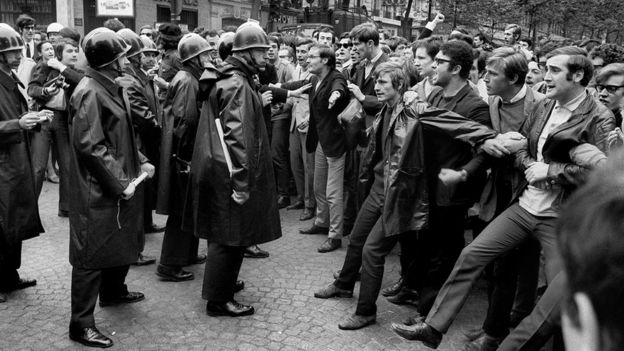
On May 2nd, after a series of running battles between students and police, the French authorities closed the University of Nanterre.  On May 3rd, the students at The Sorbonne organized a sympathetic protest.  Somebody called the cops (les flics) who showed up and took charge.  On May 6th, 20,000 students (or more) marched on the Sorbonne to take back their university.  The police were waiting for them.  Shouts and threats, a push, an arrest, a bottle thrown and suddenly it was “Aux barricades!” and the war was on!

The narrow avenues of the Quartier Latin are ideal for urban conflict (In 1944, General Leclerc’s tanks carefully avoided the area) and the students took full advantage.  They blocked the streets with burning mattresses, furniture, trashcans and overturned cars.  They taunted the feared CRS riot police into chasing them and pelted them with rocks, bottles, flaming bags of dog merde and Molotov cocktails.  The cops responded with water cannons, teargas and bone-cracking batons to the head and groin.  Who controlled the streets?  The students or the police?  Night after night, the two sides battled it out in the alleys of the Rive Gauche.

On May 14th, workers at Renault in Rouen went out on strike in solidarity with the students.  Within a week, 100 factories were closed or occupied, and 10 million workers were on strike.  The government offered huge wage increases (35%) but the workers pushed their own leaders aside and refused to go back to work.  Many of them joined the students in the streets.  Shops closed, banks closed, even the ubiquitous Parisian cafes locked their doors.  Transportation ground to a halt, and government services ceased to exist.  France was on the verge of collapse.  On May 29th, worried that the mob might storm the Elysee Palace (shades of The Bastille in 1789) De Gaulle flew to a French military base in Germany to negotiate the loyalty of the army.  On the morning of May 30th, half a million people marched in the streets of Paris, chanting “Adieu, De Gaulle!”  That afternoon, De Gaulle addressed the nation.  Defiant as ever, his only concession to the seething chaos was to call an election — but he refused to resign, threatened to declare a State of Emergency, and hinted that the army was ready to march on Paris.  That night, a million people (or more) poured down the Champs-Elysees in support of the government.  They chanted “Vive La France!” and sang La Marseillaise.  The city, the country and French society were all divided neatly in two.  The next stop was civil war.

Luckily, it was the Communist Party leaders who blinked.  Painfully aware of the bloodbath that erupted the last time French troops entered the capital (Paris Commune 1871) and eager to take a chance on gaining real power in the coming election, they pulled their people off the streets.  A couple of days later, the student unions followed suit.  The cops backed off.  The crisis was over.

May 68 has entered the mythology of history.  Most historians will tell you that May 68 tossed the old order (which we’ve lately been calling ‘the greatest generation’) under the bus and brought about a seismic change to European society that eventually spread around the world.  I agree.  However, change is not, by definition, always beneficial.  Look around you!  In the 21st century, university students are content to click their dissatisfaction on Facebook, throw Twitter tantrums over cartoon characters and call each other “brave” and “awesome” for demanding “trigger warnings” on disagreeable discussions.  They’ve become just another demographic in the consumer society their grandparents desperately wanted to dismantle, and their only power is purchasing power.

And what ever happened to Daniel Cohn-Bendit (Dany le Rouge?)  He’s a pro-market, pro-European Euro MP, living large in Brussels — a minor company man of the political establishment.

But one other thing happened in France in 1968.  A politician was born and, these days, she’s having a bigger influence on the world than any of the soixante-huitards are.  Her name is Marine Le Pen . . . .

Jerks & A**holes

jerksThere are three kinds of people in the world: regular folks, (that would be us) jerks and assholes.  We all recognize jerks and assholes.  They’re those people whose decision-making and social behaviour ruins the quality of life for everyone around them.  Yet they haven’t got a clue just how annoying they are.  They can be the girl on the bus, the guy behind the counter, a neighbour, even a friend — but these days, they’re everywhere.

At first glance, jerks and assholes might look and act in a similar manner; however, they are two different species.  Here’s a quick guide to help you sort them out.  (Although I have used the masculine pronoun throughout, there are an equal number of male and female jerks and assholes.  In fact, jerks and assholes practice 100% gender equality.)

At a restaurant, a jerk always leaves a miniscule tip.
An asshole always brags about the size of the tip he left, and then bitches about the service — after he’s left the restaurant.

A jerk will answer texts while he’s talking to you.
An asshole will stop you in mid sentence to show you the text.

A jerk doesn’t care what you think of him.
An asshole believes you think about him all the time.

A jerk will loudly explain why he’s an atheist to any Christian who crosses his path.
An asshole wants to discuss the Vatican’s position on pedophilia with your great aunt’s friend, retired Father Donnelly, aged 82.

At a coffee shop, a jerk asks any number of stupid questions but always ends up ordering a regular coffee.
An asshole will ask for some ingredient nobody’s ever heard of, be surprised that nobody’s ever heard of it, explain its significance to the  barista and end up ordering a regular coffee.  Then, after it’s poured he remembers he wanted decaf.

A jerk never cleans up after his dog.
An asshole scoops poop but leaves the bag under a tree.

At lunch, a jerk is constantly checking his phone.
An asshole has extended conversations.

A jerk laughs at his own jokes.
An asshole never laughs at anybody’s jokes.

A jerk is always late.
An asshole is always late.

You’re always nervous introducing your jerky friend to everybody.
You try to avoid introducing your asshole friend to anybody.