
St. Patrick’s Day: A Brief History

patrick3It’s only two sleeps ‘til St. Patrick’s Day, the #1 High Holiday on the ethnic calendar.  It’s a testament to the Irish that they could turn a minor religious observance into a worldwide cultural event – the only one of its kind.  Yes, I know, more people celebrate Chinese New Year, and I’m well aware that nobody’s tipping a Guinness in Riyadh, Islamabad or Baghdad this March 17th, but generally St. Paddy’s is celebrated around the world.  Frankly, all you need to get at it is more than one Irishman (or woman, or one of each, or just a couple of guys with beer money.)  My point is St. Paddy’s is not hard to find on this planet — especially if you’re looking for it.

There are two reasons we go looking to celebrate St. Patrick’s Day.  One, the Irish are cool.  Unlike, their Celtic cousins the Scots, who are cranky and belligerent, the Irish like to have fun.  They dance and drink, bet on the ponies and generally carouse.  Hell, they practically wake up singing — and not those dreary dirges the Welsh trot out when they’re finished digging coal, but happy songs about drinking moonshine and shooting at Englishmen, two notable leisure activities on The Emerald Isle.

The other reason is, unlike all the other Celts, the Irish didn’t go quietly.  They’re kinda the ethnic “Little Engine that Could” – and everybody loves an underdog.  The thing is (despite glacial devolution in Scotland) the Irish are the only Celtic nation that has survived the last two millennia of wanton European imperialism.  And it took them 900 years of ferocious biting back to do that.

Here’s the “Peanut Gallery” history lesson.

Way back in the day, a couple or three centuries before Christ, the Celts were the dominant people in Europe.  They pretty much called the shots north of the Po.  Meanwhile, down south, after a major smackdown beating of Hannibal and his Carthaginian elephants, the Romans discovered that you could get a lot more respect with a kind word and a sharp sword that you could with a kind word alone.  With Italy secure and prosperous, they pointed their legions north and came marching over the Alps, swinging their swords at anything that didn’t speak Latin.  (The kind words have been lost to history.)  The Celts, who were more into poetry and playing the pipes, didn’t stand a chance, and by the time Tony Soprano’s ancestors were done, there wasn’t much left of Celtic culture.  A few brave souls retreated back into the stony outcroppings of Northern Spain, Brittany, Cornwall, and Wales.patrick7  The Scots were living on crap land that the Romans didn’t want anyway (they built a wall to keep honest Romans from even going there – just sayin’) so, it was only the Irish, isolated on their island, who survived intact.

After the fall of the Roman Empire, Europe was thrown into nearly a thousand years of survival of the fittest: life was basically dog eat dog and don’t piss off the Vikings.  Nations rose and fell, on the strength of their leader’s arm, but, still devastated by the depth of the Roman conquest, none of them was Celtic.  Things settled down eventually, around the time of the Renaissance, but the Celts remained a digested people, swallowed whole by the individual European nation states that evolved.  Except the Irish, who, as I’ve said, didn’t go quietly.

Ireland, once protected by its island isolation from Roman occupation, was in for a shock.  One sunny day in the 12th century, a bunch of Normans (William the Conqueror’s boys) tired of kicking Saxons across the Thames, showed up on the Irish horizon, ready to do battle.  For the next 900 years, it was on-again-off-again warfare as the English laid claim to what was never lawfully theirs, and the Irish told them — in no uncertain terms — to go home.  Add to the mix, frequent famine, chronic poverty and, after Henry VIII, a religious schism between English Protestants and Irish Catholic that you could sail a Coffin Ship through, and “the luck of the Irish” becomes a bit of an oxymoron.  Essentially, Irish history is a litany of armed brawls where everybody shot first and nobody bothered to ask questions afterwards.  These conflicts were interspersed with times of relative peace when the various combatants rested up and/or passed the hatchet on to their children.  As my great uncle used to say, “Never give an Irishman a reason to hate you.”

patrick8Finally, in the first part of the 20th century, the English took the hint and went home — well, kind of – Northern Ireland is still part of the United Kingdom – and the Gaelic Celts of Ireland became a nation once again.

That’s it in a nutshell.

So on Sunday, forget about your troubles, crack out the Bushmills and go find the music.  The Irish have been doing it for centuries.  And thank God for it, because without them, we’d all be singing, “When Norwegian Eyes are Smiling” for no apparent reason.  Happy St. Patrick’s Day!
Solid Walls of JFK

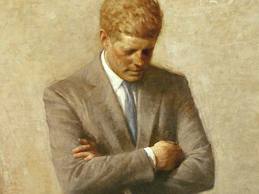
jfkMy generation has survived earthquakes, famine, Disco, AIDS, the End of the World (several times) and Richard Nixon.  For all our relentless whining, we’re actually a tough bunch of folks.  However, we are about to be tested as no generation before us has ever been.  Let me be the canary in the mineshaft and warn all humanity that, for the next nine months (about the same amount of time it took Rosemary to have that baby) we’re going to be up to our elbows in John Fitzgerald Kennedy – and it’s not going be pretty.  You might not have heard – but you will – that this is the 50th anniversary of his assassination.  From now until November 22nd, we’re going to be subjected to solid walls of JFK.

Before I get too deep into full-throated rhetoric, I want you to know that I believe John Kennedy was a good president.  He wasn’t necessarily Mount Rushmore great, but, as CEOs of the American Empire go, he’s definitely somewhere on the top end of the middle group.  The problem is it’s hard to judge.  We tend to credit him with initiating the good stuff (like civil rights) and to hand Lyndon Johnson the blame for mistakes (like Vietnam.)  What we forget is that Kennedy merely set the tone for both.  He didn’t have enough time to formulate policy.  It was Johnson who had to handle the follow-through and, alternatively, clean up the mess.  It’s this fundamental oversight that makes me wary of the approaching media tsunami.

We love JFK more for the idea of him than the man himself.  We want to believe that once there was a Camelot: a place where a bold young king gathered “the best and the brightest” around him, to spread peace and prosperity throughout the land.  An All-American America where daring New Frontier knights joined battle equally with the suits of things like corporate steel as well as the hard men of organized crime.  A place where lawyers used the honest tools of the law, not the loopholes; a place where journalists were honourable and money lenders trustworthy.  A place where smarts and the arts weren’t sins; where painters and poets rubbed shoulders with scientists and engineers; where university dons played metaphorical (and sometimes real) touch football with their political masters, each learning from each.  A place where race didn’t matter and our only adversaries were poverty and ignorance.  We want to believe that — for one brief, shining moment — the great tribes of America spoke with one voice; a voice that said we can do anything if we try.  We want to believe this because those of us who were there think we saw it happen.

Unfortunately, fifty-year-old memories have a way of clouding and fading and distorting the truth.

Fifty years ago, my generation was in the first bloom of immortal youth.  We see those years as a time of “sunshine, lollipops andjfk1 rainbows … brighter than a lucky penny.”  The Kennedy presidency is that tangible talisman that still tells us how young and unafraid we were.  We hold it dear to our hearts.  Yet it also holds the sum of all our regrets — all the shoulda, coulda things we woulda done if Lee Harvey Oswald had just called in sick that day.

For the last half century, day-late/dollar-short Cassandras have been turning history into legend, reworking JFK into the once and future king, soothsaying all the wonderful things he might have been.  Now, the Kennedy Camelot is about to get a modern-day makeover, courtesy of our ubiquitous media who can’t wait to cash in on an aging population, eager to squeeze in one last Look-At-Me.  They’re going to do it, too — and with all the spin that money can buy.  And Kennedy’s Camelot will take its place alongside Avalon, Shangri-La and Xanadu — unrecognizable to anybody but the myth makers.

International Women’s Day — 2013

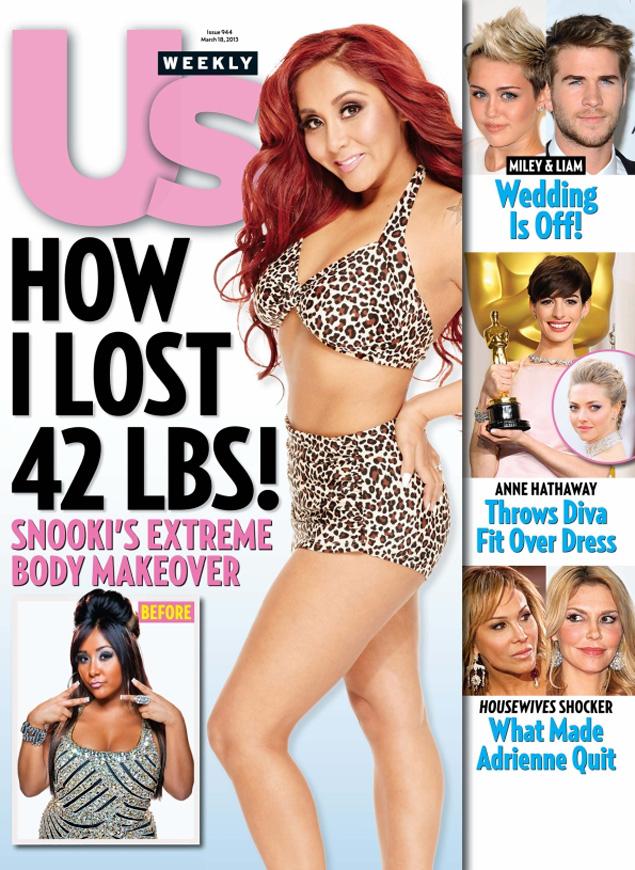
snooki3I wasn’t the least bit shocked to discover that Nicole Polizzi has lost 42 pounds; actually I hadn’t given it much thought.  I was a bit surprised, though, to find that it’s headline news.  Granted, she wasn’t “above the fold” as they say (that was reserved for Hugo and Stompin’ Tom) but she was still there, dressed in a bikini bottom smile to generate magazine sales and promote the 2nd season of her television show.  I’m not opposed to people using their bodies to make a living; after all, professional athletes do it every day.  Nor am I against self promotion, although I am wary of some of the stuff people get up to, to put their names in the public eye.  (Witness Dennis Rodman’s recent adventure.)  Weight loss, however, is nothing serious; Oprah Winfrey was using it as a marketing ploy (tool?) back when Ms. Polizzi was still in diapers.  (That’s a disturbing image, BTW)  No, Nicole can put herself out there all she wants.  Even her ensuing interview didn’t bother me that much.  I’m not sure my life is any fuller knowing that she’s not quite as horny as she used to be, but I suppose, in an abstract way, I’m glad she still makes time for sex when she can.  What I did wonder, however, was what would history’s serious women think about the antics of contemporary females like Ms Polizzi who have taken to whoring their privacy for so little gain and such limited fame.  What, for example, would Lillian Hellman have to say, or Tina Modotti or the tongue that launched a thousand quips, Dorothy Parker?

For those of you who don’t live on this planet, Nicole Polizzi is Snooki the sex gerbil from Jersey Shore, and Lillian, Tina and Dorothy are some of the great-grandmothers from the 1920s and 30s who cut a path for her to get there.

The last thing the world needs right now is a lesson in feminism.  However, I think that we should stop for a moment, take three deep ones and get some perspective.  Snooki and her cohorts are smart business people.  They know what sells, and they’ve packaged themselves as the product.  This is not a sin.  Their transgression is not what they do; it’s the way they do it.

Way back in the day, the women who first strolled through the Men Only door in the media arts were considered anomalies, at best.  They were there for the female perspective.   Men did the heavy intellectual lifting, and the girls softened the edges, normally on a separate page.  This all changed in the 1930s.  Unwilling to be segregated, women like Dorothy Parker and Lillian Hellman took centre stage, as accepted (if not equal) parts of the New York literary scene.  They did their share of crap (both wrote for Hollywood) but they also confronted some serious social and political issues.  Hellman’s The Children’s Hour (1934) dealt with lesbianism before most of America knew it even existed.  Meanwhile, the outspoken Parker was eventually blacklisted for her sharp and uncompromising political views.  At the same time, women like Martha Gellhorn and Msnookiargaret Bourke-White were making their bones as legitimate foreign correspondents.  Gelllhorn covered the Spanish Civil War for Collier’s and Bourke-White went to the Soviet Union for Fortune Magazine.  (She was the first Western journalist allowed in, by the way.)  Other photojournalists, like Dorothea Lange were picturing the Great Depression with a feminine eye, and Tina Modotti was putting a female face on the Mexican Revolution.

The one recurring theme throughout this entire period was that women were just as smart as their male counterparts, just as serious — but they were still women.  They didn’t just echo men.  Amelia Earhart might fly with the boys (and frequently did) but it was the typewriters and cameras of the age that gave the world a uniquely female intellectual voice.  People stopped, looked and listened.

Today, a lot of people are going to stop and look at Snooki in her faux leopard bathing costume.  They’re going to watch her TV program and listen to what she says.  At twenty-five, her claims to fame are being frequently drunk, getting punched in the face and losing 42 pounds after the birth of her first child.  As a businesswoman she’s obviously smart and clever enough to turn these minimal assets (?) into a million dollar industry.  However, I wonder what the girls* from the 30s would make of what their female voice has become.

Happy International Women’s Day

*Make no mistake: Hellman, Parker, Gellhorn and the rest were just girls at the time.  They drank and partied to excess.  They smoked Virginia tobacco and Mexican marijuana.  They listened to cool jazz and Cab Calloway’s hot jive.  They had sex with who they wanted to; when they wanted to.  They married, divorced and frequently took lovers.  They danced in the streets.  They were young and acted like it.