Older and (somewhat) Wiser?

There are tons of old people lists floating around the Internet.  They run all the way from old advertisements with doctors smoking cigarettes to lists of things that the world had never even heard of when grandma was a kid.  Some of them have this smug undercurrent of “things were so much better in my day,” but generally they’re all just harmless ways to play Remember When.   However, they all have a tendency to unlock the inner dinosaur in most of us and make us remember that we’ve been strolling around this earth for a long, long time.  Unfortunately, none of these lists makes any mention of what it takes to survive the rigors of life and actually arrive at an age when you can afford the luxury of nostalgia.  Nor do they offer a list of all those neat little goodies we all pick up along the way — the tricks of the trade, so to speak.  Things like white shirts attract spaghetti sauce and doctors are never on time.

It takes a lot to get old, and when you do, you need to stop every once in a while and congratulate yourself.  You finally made it, and now you’re old enough to know:

Puppies are a natural antidepressant

There’s no such thing as a free lunch.  Somebody, somewhere is going to have to pay for that Happy Meal™.  And if you eat it, chances are good it’ll be you.

If it sounds too good to be true, it probably is.

Lincoln was right.  You can fool some of the people all of the time.  The rest of it he just made up.

Integrity is what you do when nobody’s looking.

The meek may inherit the earth, but there’s always going to be at least one big, nasty bugger there who wants to contest the will.

There is justice in the world, but most people mistake it for fairness.  That’s why they get pissed off.

Nothing feels as good as warm on a cold day.

Everybody says they want the truth — until it actually shows up.

The shortest distance between two points is a straight line — no matter how many times you think you found a shortcut.

The major difference between smart and wise is a couple of bad decisions.

Most people simply don’t have enough money to get rich quick.

We’re all in the same boat; some of us just have a different captain.

And finally:

Like Polonius’ adv ice to Laertes, most of the feel good/words of wisdom homilies are just crap.
Hallowe’en: No Time for Horror Movies

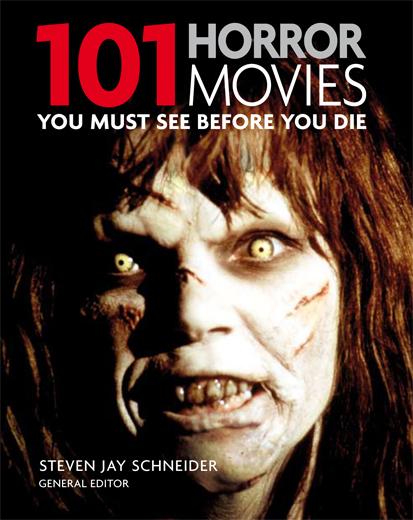
As of right now, it’s two weeks until Hallowe’en, but I don’t think I’m going to be able to take much more of this.  Make no mistake: I love Hallowe’en.  It’s my favourite occasion after Christmas, St Paddy’s Day and the Summer Solstice (I think I was a Druid in a past life.)  The problem is, like a lot of good things on this planet, idiots have got hold of Hallowe’en and they’re hell-bent on ruining it.  Every year it’s the same: one minute after Columbus Day, they trot out the Horror movies.  Then it’s wall-to-wall gore until the sugar shock wears off November 1st.  For the last nine days, our 500 channel universe has been turned into a butcher shop, and it doesn’t look like the carnage is going to let up any time soon.  So far, I’ve managed to avoid Friday the 13th in about 20 of its repetitious incarnations, Nightmare on Elm Street parts 1 through 35 and the entire Halloween franchise — except for about three minutes of Resurrection when I got the wrong Mike Myers.  If I don’t see a decent movie soon, I swear I’m going to buy Netflix.

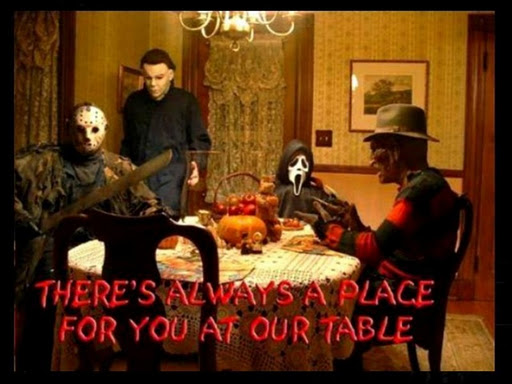
Let me put this into perspective so we’re all on the same page.  Michael Myers, Freddy Krueger, what’s-his-name with the hockey mask and anybody else with a chainsaw, pick axe or pointy stick have nothing to do with Hallowe’en.  These guys and their horrible movies were invented by Hollywood to cash in on the universal need for teenage boys to get close to teenage girls — who are looking for an excuse to let them.  (This little drop of human nature BTW, hasn’t changed since the Stone Age, but now it’s worth millions.)  That’s where horror movies came from — not from Hallowe’en.  Hallowe’en has never been about half-naked young women and dumbass young men getting their entrails splattered from here to Main Street.  Nor is it about the lunatics, maniacs, evil spirits and just plain nasty folks who stalk them.  These are all modern creations designed to separate unsuspecting youth from their money.

For the record, here’s the Twitter version of how Hallowe’en came about in the first place.  Despite all the ghosts and goblins, Hallowe’en actually started out as a quasi-religious holiday, back in the way back days.  This was at a time when Christians were battling Pagans for the collective souls of the European multitudes.  Religious marketing was at its cutthroat best.  As I’ve said before, the early Christians weren’t stupid and they incorporated a lot of pagan traditions into their rituals to ease the masses into accepting Jesus as their personal saviour.  In those days, pagans (and most Christians) believed that unsatisfied souls walked the night, and they could, on occasion, mete out some pretty mean-spirited (pun intended) retribution on the living — if they saw fit.  The church decided that November 1st, Hallowmas, a day that already honoured the saints would be a good opportunity for people to pray for the souls of the recently dead, thus, aiding their journey to heaven and getting them away from the God fearing living.   Since midnight masses were de rigueur in those days, the church services took place at night or on All Hallows’ Eve.  (Sound familiar?  We know it in its corrupted form as “Hallowe’en.”)  However, the nouveaux Christians of the day continued to hedge their bets.  On their way to church, they wore cloaks, masks and even costumes – all to disguise themselves from the assembled apparitions who were hanging around consecrated ground, awaiting prayers of deliverance.  In addition, some of the poorer members of the parish would accept coins or food from the wealthier patrons to add their prayers for the dear departed.  That’s it: the time, the place, the costumes, the tricks and the treats.  There’s a lot more to it, but for bare bones it serves our purpose.

If you notice, there were no chainsaws, axes, heavy mallets or ball peen hammers.  There were no knives, swords, machetes, garden forks, shovels or soup spoons.  Nobody got stabbed, jabbed, poked or prodded.  Nobody was torn limb from limb, dismembered, eviscerated or even bruised.   It wasn’t a bloodbath, nor even a slight rinse.  Originally, and for most of its history, Hallowe’en was spooky, creepy, perhaps even a little frightening, but murder and mayhem were never on the agenda.  It’s only recently that it’s been turned into a three-week multi-channel splatterfest.

Next Week:  How to Write a Horror Movie, and Whatever Happened to Spooky?

The Modern Myth Parade — Part 3

Despite our agnostic protests to the contrary, we contemporary North Americans are controlled by our mythologies.  Like our ancient Greek ancestors, we honour our gods and believe they rule our lives.  The problem is our myths don’t work.  In fact, they actually have an uncanny ability of getting in the way.  For example, because we believe in a benevolent planet where all reasonable people think and act just like we do, when that literally never happens, we feel our world is chaotic, disjointed, out of step and out of control.  This confuses us, but rather than questioning our myths, we reason that somehow we just haven’t been faithful to them and now the gods are angry.  So, like all primitive peoples, we try harder to please our gods, sacrificing our common sense on the altar of appeasement.  To butcher Shakespeare: “The fault, dear Brutus, is not in our stars/But in ourselves.”  Thus, when people act in ways contrary to the wishes of our myths, we look for something or someone to blame.

Here’s the deal.  When Eddie, the local villain, breaks into our house and steals the iPod, iPad, iPhone and every other iSomething that isn’t nailed down, we want an explanation.  We want to know why, in a benevolent world, this could happen to us; how Eddie, another reasonable human being, got thrown so far off the tracks?  We wonder why our society has failed us, Eddie and the prescriptions of our mythologies.  When we don’t get any answers, we feel angry and frustrated.

Unfortunately, the answers are exactly what we don’t want to hear.

First of all, we do not live in a benevolent world.  There are people out there who actively want to do us harm.  Open your eyes!  The evidence is all around us.  We can ignore it if we choose, but that doesn’t alter the facts.  Secondly, under normal circumstances, people are not reasonable.  It’s only the constraints of our society that make them so. You don’t have to be Charlie Marlow to understand that the tapestry of our world is woven of very thin yarn which breaks easily and unravels quickly.  Finally, there are people all around us who don’t give a damn about the high-minded expectations we have for ourselves.  They don’t care that we believe we’re good people.  And this brings us to our final and most dangerous myth.

We believe that our mythology itself makes us morally superior.  Now, before you relax and think, “Finally!  I knew it.  We’re all racist jerks!” think again.  I’m not talking about racism.  Actually, racism, in North America, is just a silly little word game we play with each other when the media gets bored.  Compared to the tribes of Europe, Asia and Africa, we can take the Pepsi Challenge on racism any time –and come off looking good.  No, our belief in our moral superiority has nothing to do with anyone else.  It rests solely on the mistaken idea that our society has transcended its savage past.  We believe so thoroughly in our inner goodness that any storm cloud in our Neverneverland world is cause for alarm.  And that is precisely why we refuse to question our mythologies.

The truth is that if we do not live in a benevolent world where everybody is reasonable, then we are not the good people we think we are.  We’re just techno-Visigoths, struggling to survive, and nobody wants to be a barbarian.  Thus, when bad things happen, we think we haven’t been compassionate enough, or empathic enough, or reasonable enough.  We go back to our false gods, pray for forgiveness and redouble our efforts to appease them. Thus, the dysfunctional cycle begins again.

It boils down to this.  Either we quit sacrificing the way of life that got us here to a bunch of mythologies– and try to solve the reality of our problems, face-to-face– or our mythologies are going to kill our society dead as disco.  It’s that simple.