Solid Walls of JFK

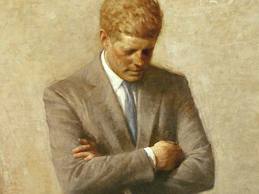
jfkMy generation has survived earthquakes, famine, Disco, AIDS, the End of the World (several times) and Richard Nixon.  For all our relentless whining, we’re actually a tough bunch of folks.  However, we are about to be tested as no generation before us has ever been.  Let me be the canary in the mineshaft and warn all humanity that, for the next nine months (about the same amount of time it took Rosemary to have that baby) we’re going to be up to our elbows in John Fitzgerald Kennedy – and it’s not going be pretty.  You might not have heard – but you will – that this is the 50th anniversary of his assassination.  From now until November 22nd, we’re going to be subjected to solid walls of JFK.

Before I get too deep into full-throated rhetoric, I want you to know that I believe John Kennedy was a good president.  He wasn’t necessarily Mount Rushmore great, but, as CEOs of the American Empire go, he’s definitely somewhere on the top end of the middle group.  The problem is it’s hard to judge.  We tend to credit him with initiating the good stuff (like civil rights) and to hand Lyndon Johnson the blame for mistakes (like Vietnam.)  What we forget is that Kennedy merely set the tone for both.  He didn’t have enough time to formulate policy.  It was Johnson who had to handle the follow-through and, alternatively, clean up the mess.  It’s this fundamental oversight that makes me wary of the approaching media tsunami.

We love JFK more for the idea of him than the man himself.  We want to believe that once there was a Camelot: a place where a bold young king gathered “the best and the brightest” around him, to spread peace and prosperity throughout the land.  An All-American America where daring New Frontier knights joined battle equally with the suits of things like corporate steel as well as the hard men of organized crime.  A place where lawyers used the honest tools of the law, not the loopholes; a place where journalists were honourable and money lenders trustworthy.  A place where smarts and the arts weren’t sins; where painters and poets rubbed shoulders with scientists and engineers; where university dons played metaphorical (and sometimes real) touch football with their political masters, each learning from each.  A place where race didn’t matter and our only adversaries were poverty and ignorance.  We want to believe that — for one brief, shining moment — the great tribes of America spoke with one voice; a voice that said we can do anything if we try.  We want to believe this because those of us who were there think we saw it happen.

Unfortunately, fifty-year-old memories have a way of clouding and fading and distorting the truth.

Fifty years ago, my generation was in the first bloom of immortal youth.  We see those years as a time of “sunshine, lollipops andjfk1 rainbows … brighter than a lucky penny.”  The Kennedy presidency is that tangible talisman that still tells us how young and unafraid we were.  We hold it dear to our hearts.  Yet it also holds the sum of all our regrets — all the shoulda, coulda things we woulda done if Lee Harvey Oswald had just called in sick that day.

For the last half century, day-late/dollar-short Cassandras have been turning history into legend, reworking JFK into the once and future king, soothsaying all the wonderful things he might have been.  Now, the Kennedy Camelot is about to get a modern-day makeover, courtesy of our ubiquitous media who can’t wait to cash in on an aging population, eager to squeeze in one last Look-At-Me.  They’re going to do it, too — and with all the spin that money can buy.  And Kennedy’s Camelot will take its place alongside Avalon, Shangri-La and Xanadu — unrecognizable to anybody but the myth makers.

International Women’s Day — 2013

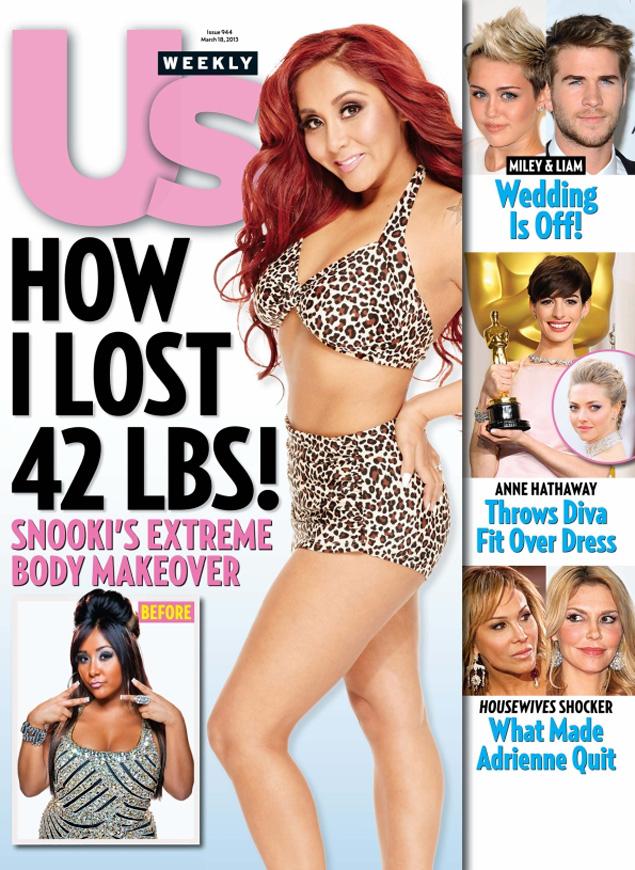
snooki3I wasn’t the least bit shocked to discover that Nicole Polizzi has lost 42 pounds; actually I hadn’t given it much thought.  I was a bit surprised, though, to find that it’s headline news.  Granted, she wasn’t “above the fold” as they say (that was reserved for Hugo and Stompin’ Tom) but she was still there, dressed in a bikini bottom smile to generate magazine sales and promote the 2nd season of her television show.  I’m not opposed to people using their bodies to make a living; after all, professional athletes do it every day.  Nor am I against self promotion, although I am wary of some of the stuff people get up to, to put their names in the public eye.  (Witness Dennis Rodman’s recent adventure.)  Weight loss, however, is nothing serious; Oprah Winfrey was using it as a marketing ploy (tool?) back when Ms. Polizzi was still in diapers.  (That’s a disturbing image, BTW)  No, Nicole can put herself out there all she wants.  Even her ensuing interview didn’t bother me that much.  I’m not sure my life is any fuller knowing that she’s not quite as horny as she used to be, but I suppose, in an abstract way, I’m glad she still makes time for sex when she can.  What I did wonder, however, was what would history’s serious women think about the antics of contemporary females like Ms Polizzi who have taken to whoring their privacy for so little gain and such limited fame.  What, for example, would Lillian Hellman have to say, or Tina Modotti or the tongue that launched a thousand quips, Dorothy Parker?

For those of you who don’t live on this planet, Nicole Polizzi is Snooki the sex gerbil from Jersey Shore, and Lillian, Tina and Dorothy are some of the great-grandmothers from the 1920s and 30s who cut a path for her to get there.

The last thing the world needs right now is a lesson in feminism.  However, I think that we should stop for a moment, take three deep ones and get some perspective.  Snooki and her cohorts are smart business people.  They know what sells, and they’ve packaged themselves as the product.  This is not a sin.  Their transgression is not what they do; it’s the way they do it.

Way back in the day, the women who first strolled through the Men Only door in the media arts were considered anomalies, at best.  They were there for the female perspective.   Men did the heavy intellectual lifting, and the girls softened the edges, normally on a separate page.  This all changed in the 1930s.  Unwilling to be segregated, women like Dorothy Parker and Lillian Hellman took centre stage, as accepted (if not equal) parts of the New York literary scene.  They did their share of crap (both wrote for Hollywood) but they also confronted some serious social and political issues.  Hellman’s The Children’s Hour (1934) dealt with lesbianism before most of America knew it even existed.  Meanwhile, the outspoken Parker was eventually blacklisted for her sharp and uncompromising political views.  At the same time, women like Martha Gellhorn and Msnookiargaret Bourke-White were making their bones as legitimate foreign correspondents.  Gelllhorn covered the Spanish Civil War for Collier’s and Bourke-White went to the Soviet Union for Fortune Magazine.  (She was the first Western journalist allowed in, by the way.)  Other photojournalists, like Dorothea Lange were picturing the Great Depression with a feminine eye, and Tina Modotti was putting a female face on the Mexican Revolution.

The one recurring theme throughout this entire period was that women were just as smart as their male counterparts, just as serious — but they were still women.  They didn’t just echo men.  Amelia Earhart might fly with the boys (and frequently did) but it was the typewriters and cameras of the age that gave the world a uniquely female intellectual voice.  People stopped, looked and listened.

Today, a lot of people are going to stop and look at Snooki in her faux leopard bathing costume.  They’re going to watch her TV program and listen to what she says.  At twenty-five, her claims to fame are being frequently drunk, getting punched in the face and losing 42 pounds after the birth of her first child.  As a businesswoman she’s obviously smart and clever enough to turn these minimal assets (?) into a million dollar industry.  However, I wonder what the girls* from the 30s would make of what their female voice has become.

Happy International Women’s Day

*Make no mistake: Hellman, Parker, Gellhorn and the rest were just girls at the time.  They drank and partied to excess.  They smoked Virginia tobacco and Mexican marijuana.  They listened to cool jazz and Cab Calloway’s hot jive.  They had sex with who they wanted to; when they wanted to.  They married, divorced and frequently took lovers.  They danced in the streets.  They were young and acted like it.

Hey, Boomers: Shut Up!

pie1Back in the Stoned Age, when I was growing up, there was an unwritten rulebook, which, like The Pirate’s Code, acted as a kinda running guide for the transition from primitive adolescent to responsible adult.  It covered pretty much everything — except sex (which was trial and error) and how to make a salad.  We didn’t so much live by the rules as reference them in times of crisis.  For example, when those pesky grandparents showed up with birthday money you moved the illegal agriculture off the “dining room” table and took down the more aggressive examples of bachelor art.  Here in the 21st century, that old way of life is more-or-less passé and we’ve discarded the rulebook.  After all, it’s usually grandma who’s hiding the drugs these days, and they’re dancing about boobs on the six o’clock news.   However, even though I say good riddance to most of the hypocrisy we practiced back then, it seems a shame that we threw the baby out with the bath water and no longer tolerate some of the niceties of civilized behaviour.

One of the cornerstones of life, as we used to live it, was that old people were stupid.  Every generation knew this.  Somewhere around menopause (male and female) the human IQ drops about twenty points and then continues to slowly decline on a straight shot to the grave.  People don’t actually die of old age; they simply become too stupid to live.  This is one of the tried and truisms, handed down from parent to child since Achmed the Unwashed decided to set up shop in the Euphrates valley – circa 40,000 years ago.

Of course, this utter stupidity never prevents the average old person from running off at the mouth.  They consider it a combination of their right to make noise and duty to be heard.  When I was a kid, most of the blather was irrelevant instructions on how to survive a world war – which hasn’t come in handy, yet.  (FYI, I don’t think my generation ever did convince the parents that the only thing walking away from World War III would be a cockroach.)

However, I digress.  The unwritten rule was that you listened to these old gasbags jawing away.  You shut your mouth, made all the right noises in all the right places (polite was another of the unwritten rules) and, then, after they’d cleared off, you did as you damn well pleased.  The sage advice from the grey hairs was not for you; it was for them.  It was a catalogued recollection of all the opportunities they missed, the risks they shouldn’t have taken and the places they screwed up.  Everybody knew this and acted accordingly.  Unfortunately, those days are gone, and our world is the lesser for it.

Since we threw out the old unwritten rulebook, the same people who scoffed at their parents are now demanding we take theirpie ancient wisdom seriously.  They want to keep running the show.  The problem is they’re retrending the ideas, solutions and institutions they’ve been yipping about since back when Bruce Willis still had hair.  The world has changed since then, and just FYI, that crap never worked in the first place.  And, here’s the kicker: people are listening to these fossils.  This is ridiculous.

I’m as clever as the next fellow — and smarter than most — but I have no clue what’s going on in 2013 and no right to make decisions about it.  I grew up in a time when baseball players swung for the fences, casual sex was important enough to keep private and the truth was protection against prosecution.  The world I see out my kitchen window is alien to me.  Hell, I have no idea what the 83 other buttons on the TV remote are there for – and neither does anyone else on the business end of 50.  We’re not supposed to.  We’re not supposed to be setting the agenda; we’re supposed to be complaining about it!

This is the first generation where the old folks are unwilling to go gentle into that good night.  They’re clinging to power like drunks hanging onto a lamppost.  Unable to go forward, unwilling to go back, they have no idea why they’re there in the first place.  The only thing they do know for certain is if they ever let go, they’re going to be lost in the gutter.

Me, I liked the olden days.  You knew where you stood.   And just like my parents and their parents and theirs — back a thousand generations – sometimes, I’m consumed with nostalgia and want to return to a more civilized time.  A time when young people were seen and not heard and old people were heard but never listened to.