St. Patrick’s Day Quiz

As you may have guessed, March 17th, is St. Patrick’s Day — when everyone in the world is Irish.  Unfortunately, due to the economic slowdown, Ireland can no longer afford to grant everybody temporary Irish citizenship.  Therefore, they have devised a series of questions to test your knowledge and commitment to Ireland heritage.  Please consider every question carefully and answer truthfully.
Lying will be severely punished.
When you have completed your quiz, e-mail the answers to Tourism Ireland — they will be pleased to hear from you.  On St. Patrick’s Day, regardless of your test scores, you may drink Irish beer (whiskey) sing Irish songs, dance Irish dances, read Irish poetry etc, etc, etc.  However, unless you passed the test and have been officially notified, you may not wear any goofy “Kiss me, I’m Irish” paraphernalia, including (but not limited to) hats, t-shirts, buttons and underwear.  Thank you for your cooperation, and good luck.

1 – The Shamrock is the symbol of Ireland because
a) The Scots already took the thistle
b) we’d look pretty stupid looking for a lucky leek
c) it beats the hell out of Sham Wow

2 – James Joyce wrote complicated stuff like Finnegan’s Wake because:
a) some idiot gave him a typewriter
b) He knew you can fool some of the people all of the time
c) he couldn’t actually see what he was doing
d) he lost a bet with Yeats

3 – Which of the following (be specific)
a) The Playboy of the Western World
b) County Cork
c) the foggy, foggy dew
d) Ryan’s Daughter
e) Bernadette Devlin’s cousin

4 – Which of the following does not have a prominent statue in Dublin?
a) Oscar Wilde
b) Molly Malone
c) James Joyce
d Barack O’Bama

5 – True or False?

6 – The phrase “Erin go bragh” means:
a) All girls must wear underwear
b)Let my people go, ya thievin’ English bastards
c)Who’s for another pint, then?
d) Like “aloha,” it doesn’t mean anything — until the tourists show up

7 – The Irish used to eat a lot of potatoes because:
a) They’d been on sale since the 4th century
b) Wouldn’t you, under similar circumstances?
c) They were involuntary vegetarians
d) the recipe called for them

8 – Fill in the blanks:
___________________________________
___________________________________
___________________________________

9 – Sinn Fein is:
a) a community group whose members just happen to carry automatic weapons
b) the political wing of the International Realtors’ Association
c)Bombs ‘R’ Us
d) The love child of Eamon de Valera and Connie Markiewicz

10 – If it weren’t for the Irish, we would all be:
a) up to our ass in leprechauns
b) nursing a hangover on March 18th — for no apparent reason
c) drinking Swedish whiskey and singing “When Norwegian Eyes are Smiling”
d) finally able to tell Bono his 15 minutes are up

11 – Compare the following:
George Bernard Shaw

12 – Ireland is:
a) 4 million alcoholics, clinging to a rock
b) a Celtic theme park off the coast of Europe
c) a minimum security prison for poets and folk singers
d) a large greenspace filled with a whole pile of people still pissed off about that Easter thing
13 – Saint Patrick drove the snakes out of Ireland because:
a) he wanted them all for himself, the greedy bugger
b)eco-diversity hadn’t been invented yet
c)he was giving them up for Lent
d) some Englishman told him not to

14 – “I’d rather rule in Ireland than spend the rest of my life in a stinking English prison.” – Liam, Prince of Donegal (1573-1604)
In a land of poets and storytellers, why did Liam take such great pains to state the bloody obvious?  Be specific.

Score:
If you answered yes to any of the questions, you’re a moron and don’t deserve to be Irish.
If you sang your answers – You’re Welsh!
If you’re still stuck on Question 4, you might very well be Irish.
If you re-programmed the quiz to make a video game called “Leprechaun Hunter,” you need to come out of the basement and ask your parents if you’re Irish — if they haven’t already moved.
If you answered the questions on YouTube and declared yourself the winner, Sheen is an Irish name.
If you answered – a – c – c – d – true – d – b – wtf – a – d – no – c – d,  congratulations!  The party starts at 6 and the poetry starts at 7.  See you there!

Of course, #14 is a trick question.  If we remember our Chronicles of Cork, what Liam, Prince of Donegal actually said was, “I’d rather go to school in Ireland than spend the rest of my life in a stinking English prison.”  Which mays a lot more sense.

Christmas and Commercialism

Personally I think “Christmas is getting way too commercialized!” is just a phrase everybody yips about at Christmas.  In truth, Christmas is pretty much the same as it always has been.  However, there have been some profound changes that not everyone is aware of.   For example, in the 21st century our buying habits have…..

 We interrupt this blog to bring an important breaking story

In a surprise marketing move, at least 3 gigantic electronics companies have introduced the same new consumer product — just in time for Christmas.  The Incredibly Useless Thing was introduced simultaneously at retail outlets around the world today.  The product sold out within hours.  Immediately dubbed the iThing by every unimaginative journalist in the universe, the device has sent computer geeks everywhere scurrying back to their mothers’ basements to try it out.  According to industry spokesperson, Nebraska Peterson, the iThing comes with twice as many mega-pixels and enough speed and memory to launch the Mars Rover from your kitchen.

“We’re calling it a whole new approach to connectivity,” Peterson said. “The iThing will connect with every other electronic piece of junk you own.  It’s wireless and interactive.  There are different coloured lights that come on randomly and various unusual sounds.  We’ve also added a remote, so you can access the iThing from any corner of the planet.  The remote is as big as a barn, with 17 buttons that don’t do anything, 6 buttons that do something (but nobody knows what) and 3 buttons that you’d better not touch because they’ll bugger up everything in your house — including the toaster.”

The iThing uses the new Inutile Operating System, which is no different from any other system except it kinda works but not really with all the stuff you’ve already got.  It’s unnecessarily complicated and the Interactive Help Menu is no help whatsoever.  Installation and set-up are so confusing no ordinary person can possibly understand what half the crap does, and if you click the wrong button in the dialog box, you’re screwed forever.  All three gigantic electronic companies are offering 24/7 tech support in a language that sounds remarkably like gibberish.  So say your prayers, ’cause the coyote’s got a better chance of catching the road runner than you have of ever figuring this thing out.

In a candid interview, one techno-drone said they’ve changed the names and placement of every function on the menu just to screw with everybody.  He went on to say that software developers do this all the time because all the cool kids in high school made fun of them, and they still haven’t got laid.  He concluded by shouting, “Who’s laughing now, Braaadley?”

Initially, the iThing will be offered in two models: the cheap one you see advertised (which is under powered and worthless) and the outrageously expensive one (which the pirates who made the device know you are going to have to buy eventually, anyway.)  However, Canadian media giants Rogers and Bell — who between them, own everything but the Crown Jewels — are taking a bold new direction as retailers.  “We don’t care about the iThing itself,” they say. “It’s free.  You can have the damn thing for nothing, as long as you sign a 5 year contract of penal servitude so we can charge you for every nanosecond it operates from the minute you turn it on.”

There have already been protests about the predator pricing of the iThing.  A fake YouTube commercial, showing the iThing exploding has already been e-mailed to everyone on the planet, and a Facebook group called “iThing Sucks” has attracted several million members.  Retailers have responded to the criticism by saying, “Big deal! A bunch of kids and old people have clicked a button on Facebook.  So what?  We’re sold out already, anyway.”

Nebraska Peterson, spokesperson for the three gigantic electronic companies, also responded by saying, “There has been some criticism, but the retail numbers speak for themselves.  This is not a manufactured shortage.  Our customers are saying they want the iThing.  Look at the unholy prices people are getting, reselling it on eBay!  But we’re a family-oriented company and we want parents and grandparents to have something for their loved ones during the Holidays, so we’re offering an opportunity to pre-purchase the next shipment of iThings.  Your purchase comes with a numbered gift card which you can use to track your iThing through the entire distribution process.  We plan to ship fairly quickly, so pre-purchasers should have their iThing within 3 months.”  Peterson admitted, however, that pre-sales had far extended the company’s ability to print the gift cards, and most people are just using their credit card receipts as presents.  She also hinted that there was already a new and improved model, the iThing 2.0 — with tons more memory, better resolution, and a cheaper price tag — which should be in retail outlets on April 1st, 2011.

We now return you to your regular blog.

Therefore, in light of this profound and insightful argument, we can conclude that commercialism hasn’t changed the face of Christmas but merely modified the holiday spirit.

How the Victorians Invented Christmas

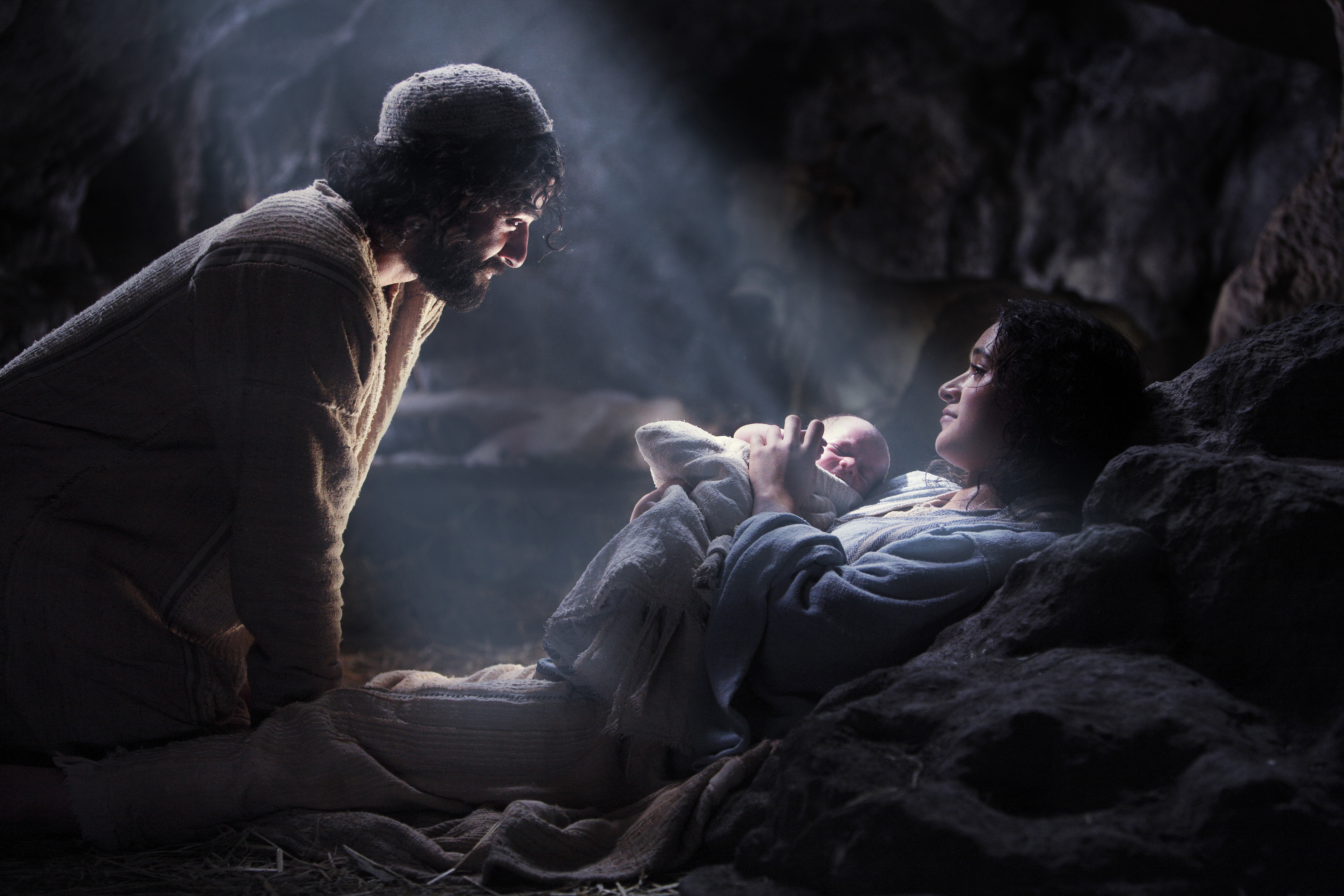
Obviously, Christmas, as we know it, started quite literally in the year dot.  Like it or don’t, the birth of Christ is the single most important event in the history of Western civilization.  Here in the 21st century, we continue to celebrate the day as a religious, secular or “hell of a good time” holiday.  It’s a tradition.  However, it’s a relatively new one.  Our celebration at Christmas started accidently, in the1840s, when these two events coincided.  First of all, an English author published a novel; secondly, Queen Victoria married a German.  Without these two isolated events happening at just the right time, we’d all be sitting around December 25th burping up turkey and looking for batteries — for no apparent reason.

When Queen Victoria ascended the throne in 1837, there was a feeling that this was the beginning of a new age in Britain.  The Napoleonic Wars were long over and mostly forgotten, and the world was enjoying a time of relative peace.  The industrial revolution was producing not only a new prosperity but also a new middle class who had both money and leisure.  They could enjoy things like travel, family life, and even hobbies such as reading for pleasure.  Also in 1837, a relatively unknown author named Charles Dickens published a newspaper serial called The Pickwick Papers.  Within about 5 chapters, he had suddenly become the J.K. Rowling of the 19th century.  The new English middle class fell in love with Pickwick.  Soon, people on both sides of the Atlantic were lining up to get the latest instalment of his adventures.  One of the most enchanting episodes in The Pickwick Papers was a fanciful description of a Christmas festival.  Christmas was undergoing a bit of a revival at the time, and Dickens’ highly fictional description gave people something to emulate.  It was very much the same as when people today talk and act like their electronic friends on TV.

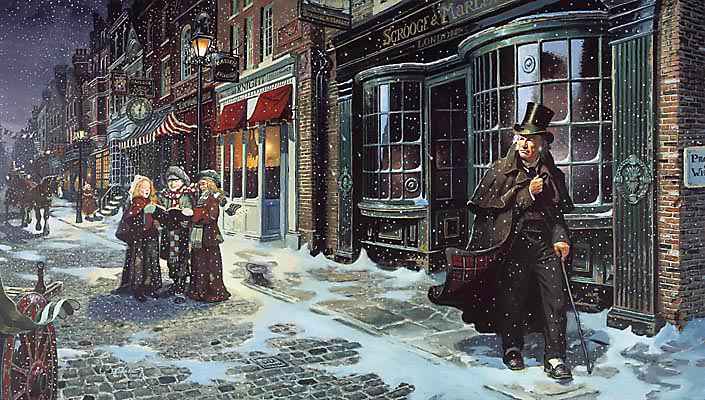
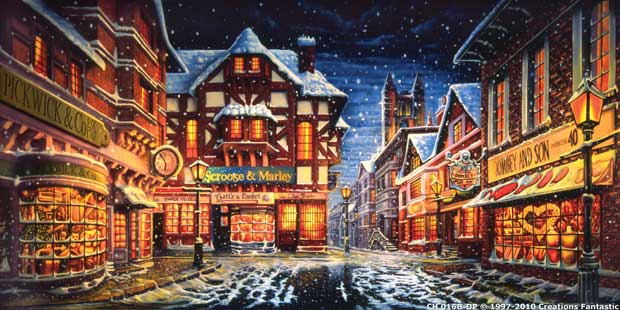
For the next couple of years, Charles Dickens kept himself busy.  He published some very successful novels — Oliver Twist and Nicholas Nickleby among others.  Then, like most successful authors, he decided to shoot his mouth off.  He run afoul of his American audience by advocating some rather radical ideas like universal copyright (so those damn Yankees couldn’t steal his stuff) and the abolition of that quaint American custom of slavery.  Suddenly, he was losing some pretty valuable customers on the other side of the Atlantic.   He wanted to get them back, so he began writing a series of books he described as, “… a whimsical sort of masque intended to awaken loving and forbearing thoughts.”  He succeeded.  In 1843, he published A Christmas Carol and the world changed dramatically.  Once again, both sides of the Atlantic went crazy for Charles Dickens.  Scrooge, Cratchit and Tiny Tim were more popular then, than Mikael Blomkvist and Lisbeth Salander are today.

Everybody wanted to celebrate a traditional Christmas the way Dickens described it because — before Dickens wrote it — nobody actually kept Christmas that way.  He made it all up.  He took several traditions that were already there and put them together in a stylized setting.  It was fiction.  Plus, Dickens didn’t just write A Christmas Carol; there were 5 books in the series.  Every time our Victorian ancestors turned around, there was Charles with another feel-good Christmas story.  It must have been like getting beaten over the head with a rainbow.  By the time Dickens was done, Christmas was everywhere.  You couldn’t get away from it.

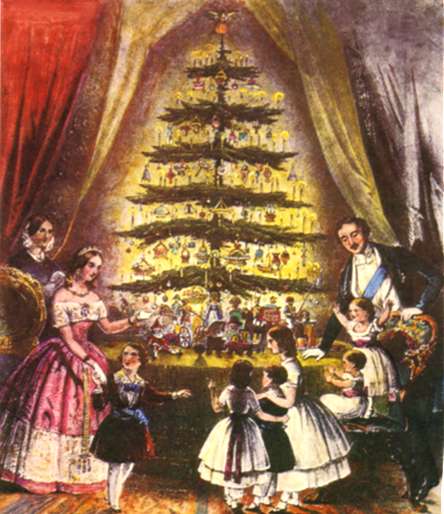
Meanwhile, in 1840, Queen Victoria married Prince Albert of Saxe-Coburg and Gotha, her German first cousin.  Albert showed up at Buckingham Palace with all his German sensibilities intact, including some very noticeable Christmas traditions — like decorations and the tannenbaum or Christmas tree.  Christmas trees had been around for some time, but it wasn’t a common practice in England to cut down a tree and haul it into your house.  Any trees that did get cut down around Christmas were normally thrown into the fire as Yule Logs.  However, the popularity of the young, good-looking monarchs was such that, when Victoria and Albert appeared with their children in front of a Christmas tree, in The London Illustrated News, Christmas celebrations became uber-fashionable.

The social ladder now had a new rung, and people all over England and America began decorating their houses at Christmas, just like they assumed their aristocratic betters were doing.  Thus, the height, breadth and weight of the Christmas table one set became society news and reason for gossip.  Everybody wanted to know what Jenny Churchill was wearing or what the Astors served for dinner — so they could do it, too.  It was Entertainment Tonight – only with bonnets and bustles.  Christmas was not only everywhere; it was trendy.  The result was that Christmas became the #1 holiday of the year — and has been, ever since.

Today, our Christmas celebration is surprisingly similar to that of our Victorian ancestors.  Of course, there have been a bunch of refinements along the way.  In 1843, Horsley and Cole, a couple of bored Englishmen, invented Christmas cards.  Saint Nicholas was turned into Santa Claus by Thomas Nast and Coca Cola.  At some point, religious hymns became I’m Dreaming of a White Christmas and Jingle Bell Rock.  And we’ve added Rudolph the extra reindeer and that stupid Little Drummer Boy (who was put on this earth just to annoy me.)  However, it’s basically the same Christmas they would have had a century and a half ago.  So, when you push your chair back from the table and look at the beauty of your own personal Christmas, take a nanosecond and thank Charles, Victoria and Albert, who invented it for you.