
What You Miss When You’re Cyber-blind

cyber-blind

I have a friend who is cyber-blind.  He doesn’t have a computer; he doesn’t have a tablet; he doesn’t have a cell phone.  In fact, he barely has cable TV (and no PVR!)  But he isn’t one of those pompous asses who’s constantly reminding the world that he lives on a higher plane of consciousness because he’s transcended technology.  No, he’s just a regular guy.  And as he tells it, “I missed the beginning of the digital revolution, and now the learning curve is too steep for me to catch up.”  He’s perfectly content, BTW, but the obvious question is: how does he function, on a daily basis, in a world that can’t go to the toilet without tweeting the results?

Here are just a few things my friend is missing:

1,612 Instagram Photos of Food — One of the requirements of an Instagram account is that you must eat at least 9 meals a day.  And I’m certain nobody under 30 knows what hot food tastes like because, by the time they’ve produced the photographic evidence, it’s cold.

16,120 Useless Email Messages — Aside from being cursed at birth, there is no earthly reason why my email account overflows every couple of days and I have to spend at least a half an hour, cleaning up the crap.  Who the hell even uses email anymore?

161,204 YouTube Videos — You start off, in the early evening, clicking on a 3-minute video about how to stuff a Cornish Hen and end up — somewhere south of midnight — watching “Best Of Drunk Girl Fails 2014,” posted by a Ukrainian named Nemski.  Don’t deny it!  You’ve done it, too!

1,612,047 Facebook Homilies — What is it about Facebook that attracts idiot clichés?  Facebook could be one of the greatest forums for intelligent discussion in history, but what do we get?  Cute kitten memes that tell us to “Value your friends, cuz true friendship is purrfect!”

16,120,479 Twitter Trolls — I don’t care how you slice the pie, Twitter is Lord of the Flies with Wifi!  It’s as if Jack the Ripper’s evil twin built a digital playground for all his nasty little friends and then turned them loose on the world.

But the very worst thing in the digital universe is:

161 Passwords — Every time you turn around in cyberspace, you need a new password.  I’m absolutely convinced that Websites demand that these weirdo afflictions have at least 8 characters, 2 prime numbers, 1 capital, 1 lower case, 3 symbols, an emoji, a hieroglyphic, a quadratic equation, a Greek letter, a Cyrillic letter and the first three letters of your great-aunt’s maiden name because they want to see just how obedient we are to our computer overlords!
Social Media Makes Us Tribal

neanderthals

Here at the shallow end of the 21st century, social evolution has stopped.  Having fallen short of Marshall McLuhan’s big idea of a Global Village (a long story for another time) we’ve unconsciously abandoned it, and now we’re reverting back to the comforts of our parochial tribal past.  This sounds preposterous (especially at a time when a guy in Indonesia can watch a YouTube girl in Belgium burp the alphabet in real time) but it’s absolutely true, and I can prove it.  First, the quick and dirty history lesson.

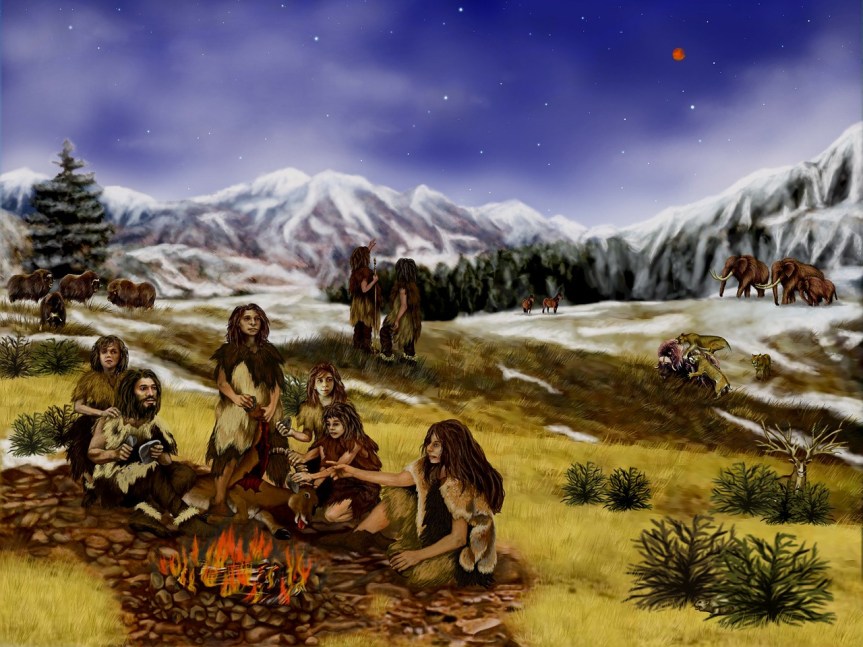
About five minutes after our ancestors dropped out of the trees, they made an interesting discovery.  Individually, humans are at the bottom of the food chain.  As animals go, we aren’t quiet enough, fast enough or strong enough to be anything more than dinner.  However, taken together, with these big brains of ours, we are the ultimate predator, capable of killing and eating everything in our path.  So, it made sense for humans to hang out in groups.  Originally these were 4 or 5 extended families who all knew each other and shared a common idea: let’s not get eaten, and let’s eat.  These early tribes, separated from each other by distance and geography, were naturally suspicious and even hostile to anybody outside the group.  As in: “This is my food chain.  Get your own!”

Now, throw in  half a million years of social evolution — agriculture, industry, art, religion, politics, etc. — and you end up here in 2017.  Our food chain stretches across the planet, and we don’t give a damn about distance and geography.

In our time, a billion people watched Pippa Middleton’s fine behind waltz into Westminster Abbey when her sister Kate married little Billy Windsor.  A year later, a chubby Korean pop star turned a silly dance called Gangham Style into a planetary phenom.  Half the world watches the Olympics, and more than that watch the World Cup.  Local disasters like hurricane Irma are heard around the world, and very few people on this planet don’t recognize Trump or Putin or Adele or Taylor Swift.  These are the shared ideas of an Internet-driven, One Click Universe.

However, the Internet also has an unexpected consequence — Social Media.  Social Media allows us to retreat behind our screens, surround ourselves with people who have similar ideas, and isolate ourselves from the people who don’t.  Sound familiar?  Take a look at your Facebook account.  I’ll bet (give or take some petty disagreements) everybody there basically shares your fundamental values.  This is your tribe (E-tribe?) and they’re only doing what tribes are supposed to do — keep the group cohesive and strong.  Instagram and Snapchat work the same way.  So do Tumblr, Pinterest and even the mighty Twitter.  Objectively, Twitter’s attacks on strangers are nothing more than a Cybertribe being very, very hostile to an outsider who doesn’t share their point of view.

Our Internet world may let us look far beyond the horizon to occasionally sneak a peek at Pippa’s bum or to cheer Götze’s World Cup winning goal, but on a daily basis, we’re using it to check Facebook (or Twitter etc.) ’cause that’s where our friends are.  And our friends, by definition, share our values and echo what we already know to be true.  The problem is that, as we spend more and more time in Cyberspace, we’re spending more and more time in the comfort and safety of our tribe.  Unfortunately, this means we have less and less time for ideas and attitudes we don’t agree with — and so they’re becoming more and more foreign to us.  As are the people who expound them.  Thus, the sophisticated ideal that there’s a universal core to human existence is slowly seeping away, and it’s being replaced by the more immediate and primitive “them and us” mentality.  Our ancestors gathered together in tribes for safety and as the nuances and complexities of our world threaten us we are doing the same.

This Computer Generation

generations

I have discovered the real reason that we have children and encourage our children to have children.

Last week, one of my lights went out.  A blue dot, it had glowed on a dusty, black molded plastic device on the corner of my desk.  Normally, since you can land airplanes from the various indicator lights shining around my house, I wouldn’t have cared or even noticed.  However, when this little bastard committed suicide, he took the Internet with him.

[Just so you know, I’m not a Luddite.  I love technology.  But I’m a Techno-dinosaur.  I don’t know a bit from a byte from a bot, and I don’t trust any of them because of my ignorance.  Techno-answers elude me because I don’t know the right techno-questions to ask.  In fact, I don’t even speak the language and — full disclosure — I don’t actually think in techno-terms.  Technology and I are like two pages of a closed book: we touch at every point of our existence, but we’re completely different.]

Anyway …  losing the Internet, without warning, was like suddenly being struck blind.  The panic was palpable.  I started thrashing around, waving my arms in the cyber darkness — propelling the mouse and hitting keys like a Rhesus monkey.  “Reboot!  Reboot!  They always tell you to reboot.”  I rebooted.  I swore.  I swore some more.  I started  randomly turning thing off and turning them back on again.  I unplugged.  I plugged.  I reversed cables.  I disconnected various wires and stuck them into a variety of other holes.  I realized I couldn’t remember what went where, anymore.  I unleashed a torrent of obscenities that is still hanging over the Pacific Ocean like a radioactive cloud.  I stopped.  I roared in frustration.  I wept.  I went for a walk.  I came back, sat down and looked at the dismantled mess on my desk.  This went on for three days and on the fourth day, I reached for the comfort of 2Oth century technology and telephoned my niece — my great-niece actually — on a land line.

Like Ground Control to Apollo 13, she methodically guided me through the reassembly process, calmly reconstructed the disaster, assessed the situation and isolated the problem.

“No, Uncle Bill!  The Internet doesn’t hate you; it’s your modem.”
“No, you can’t fix it.  You need to buy a new one.  Why don’t you get a good one this time?”
Then, she spoke gibberish for a minute and a half, and I dutifully wrote it all down.

The next day, I went to the retail techno-scoundrels with the note from my niece.  They pillaged my credit card and gave me a box large enough to hide their treachery.  Inside, there was a new black molded plastic device and a pamphlet of illustrated instruction.  I followed the instructions to the letter (picture?) plugged it in and — a miracle happened!  There was a little green light, shining bravely in the sun-drenched summer afternoon, and I knew I had been delivered.  I sank to my knees in praise of all that I know to be holy and thanked the Almighty that my sisters had indeed gone forth and multiplied.  Now I understand that, without a second, third and even a fourth generation to guide us through the labyrinth of technology, it would run amok.

And from there, it would only be a matter of time before we found ourselves up to our elbows in Terminators.