
The Lone Ranger Rides Again … Almost!

rangerI haven’t seen The Lone Ranger and I’m not going to see it any time soon.  Word around the campfire is it sucks.  So rather than waste my time — and pay Disney and Cineplex for the privilege — I’ll wait and let Movie Central do it to me for free.  At the end of the day, I’m not curious enough to rush into two hours of Johnny Depp with a dead bird on his head.  But I digress — and I haven’t even started yet.

Disney thought they had a guaranteed homerun with Lone when Bruckheimer, Verbinski and Depp (late of Pirates of the Caribbean) stepped up to the plate.  They even packed the movie with promises of a sequel (read “franchise.”)  Unfortunately, the dynamic trio hit into a disastrous double play.   (I’m assuming Bob Iger is still torturing people in the dungeons of the Magic Kingdom over the John Carter debacle.)  So instead of laughing all the way to the bank, Mickey Mouse is busy pointing fingers.  (Ironically, he only has three.)  However, the problem is not only Bruckheimer, Verbinski and Depp; the problem is the Lone Ranger himself and his buddy Tonto.

The legend of the Lone Ranger is not a story for the 21st century.  There are simply too many nuances for our unsophisticated tastes.

First of all, it’s a morality tale.  Lone is the good guy.  Those other fellows over there, in the black hats, are the bad guys.  They do nasty things (normally motivated by greed.)  Lone points himself in their direction and tries to thwart their evil schemes — full stop.  He is not an on-the-spot vigilante.  He leaves justice to the proper authorities.  Contemporary audiences don’t appreciate this subtlety.  However, because of it, Lone is not ambivalent about his purpose or his methods.  He knows he’s the good guy.  He’s not consumed with angst.  Our society doesn’t understand this interplay between good and evil.  We want our heroes to question it, mainly because we don’t really think it exists.

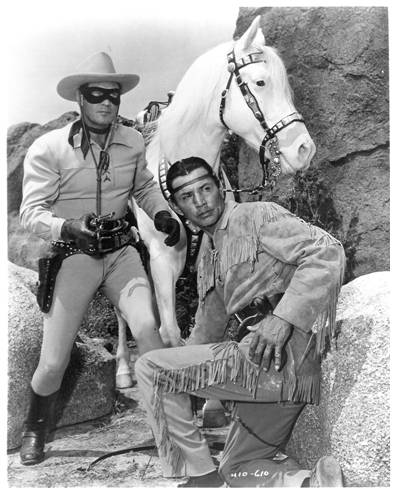
Secondly, the relationship between the Lone Ranger and Tonto is impossible for contemporary audiences to comprehend.THE LONE RANGER, Clayton Moore and Jay Silverheels  “Sidekick” just doesn’t translate into Oprahspeak.  In our relentless adherence to equality, anything less than a bromance between the two men is unacceptable.  We refuse to believe that Tonto has any dignity being the lower man on the scrotum pole, even though it’s clear he does.  (It’s too complicated to explain, but suffice it to say Tonto can hit the trail any time he wants to, but he doesn’t.)  Plus, our simplistic view is amplified by our aversion to actual ethnic diversity in film.  Minorities may be everywhere in the movies but, remarkably, for the most part, they dress, walk, look and talk stereotypically like the homogenized white guy standing beside them.

Finally, The Lone Ranger is a western.  This isn’t a bad problem until you try and tell the tale to kids.  In our world, there isn’t a Hovermom west, east, north or south of the Pecos who’s going to permit that.  Agrarian Workers and Native Americans (Cowboys and Indians) are personae non grata in today’s playgrounds.  Our children can zap aliens with death rays and mega-fry entire civilizations with video game warheads, but there is no way in hell little Bryce or Morgan will ever be allowed to strap on a toy pistol and go looking for bad guys.  It just isn’t done.  The demographics of The Lone Ranger’s first week in the theatre bear this out: ticket buyers were overwhelmingly white men over twenty-five.  This is not a bad group but clearly not the one Disney was aiming at.  Despite the advertising and the action figures, The Lone Ranger is not actually a kid movie — or at least not one parents are going to let their kids go see.

It’s too bad Disney missed the point and The Lone Ranger is a flop.  I grew up with Lone and Tonto, and I think, with a little creativity, they could have been retrofit into our brave new world.  In fact, their story is good enough that I still believe they should be.  After all, despite his being one of the deadliest pistolaros of the Old West-ern, in all the episodes of The Lone Ranger I saw, I don’t remember that he ever actually killed anybody.  That alone would be a welcome change from the carnage we see in most action/adventure films these days.  Unfortunately, now that Disney has bit the silver bullet, it’s going to be a long time before anyone else will return “to those thrilling days of yesteryear, when from out of the past came [sic] the thundering hoofbeats of the great horse Silver! [and] The Lone Ranger rides again!”


2013: Dull, If Not Boring!

new year3The year is less than two weeks old, but I’m willing to go out on a limb and say 2013 isn’t going to be a very good year.  It’s not going to suck or anything; it’s just going to be dull, boring, historically dismissive.  It’ll be one of those years which a hundred years from now nobody’s going care about.  Kinda like 1489, or 1843 or 1771.  Those were years that, I imagine, were perfectly cool at the time but simply couldn’t keep their lustre compared to 1492, 1848 and 1776.  They just didn’t have the star power.

First of all, 2013 doesn’t sound right.  It’s got too many syllables or something.   It trips on the tongue.  Nineteen eighteen has cadence.  Ten sixty six has rhythm.  Forty four B.C. has an authority about it.  These are all years when big stuff happened.   However, take a look at twelve fifty seven or seven thirty one.  These are years that so closely resemble every other year that even nerdy historians don’t worry about what happened then because guess what?  Nothing did.  That’s going to be the problem with 2013.

Yeah, we’re going to have all the regular stuff in 2013: Easter, Father’s Day, Labour Day, Christmas etc., but we’re not going to have any of the big stuff.  There are no Olympics this year, no World Cup and most importantly, no American elections.  American politics are going to be dominated by budget negotiations.  Big snooze!  Budgets aren’t sexy, and besides now that Obama’s been re-elected, there’s nothing much at stake.  The political shine is off the rose and all those oh-so-committed (informed? engaged?) voters are heading for the exits.  The last thing any of them wants to do is play Survivor with fiscal responsibility; a subject most people think is about as exciting as eating lukewarm Kraft Dinner.  No, Springsteen and Oprah have put away their microphones for the duration, and political entertainment has left the building.

Speaking of entertainment; don’t expect 2013 to be a banner year at the movies,new year2 either.  Film makers are doing so many storyline retrofits I fully expect to see Holmes on Homes listed as technical advisor in most of the credits.  First, there’s The Lone Ranger with Johnny Depp, who is going to outshine Armie Hammer by a long shot and probably end up riding off into the sunset with Red (Helena Bonham Carter) leaving Lone to fend for himself.  Then, there’s Gatsby who was great when Redford portrayed him in the ‘70s; something about Oz which has James Franco playing a prequel to Dorothy (remember him in drag at the Oscars, hmmm?) and two more additions to the Star Trek and Superman franchises – like we need those.  Eventually, Hollywood is going to get boiled down to just one single movie with various sequels, prequels and equals regurgitated every year.  Oh yeah, I almost forgot, there’s another Die Hard this year, which, with any luck at all will be Die Hard: Once and for all.  Unfortunately, I think John McClane is going to go on forever — like those “Call Me Maybe” parodies on YouTube.

Of course, in 2013, there won’t be that YouTube menace Psy kicking around.  2012’s answer to The Starlight Vocal Band is gone, if not already forgotten.  Last time I looked, he was hanging out in Times Square on New Year’s Eve with Jenny McCarthy and MC Hammer.  If that isn’t a triple whammy kiss of death, I don’t know what is?  And don’t expect a 2013 equivalent of “gangnam style;” there’s only so much a discerning public can stand in one decade.

That’s probably the problem with 2013.  This decade is relatively new, and there’s a whole pile of stuff out there just quietly waiting to hit the fan.  When it does, we’re going to have a lot more than reinvigorated “Hammer time” to contend with!  Actually, this might be the calm before the storm.  So, to that end, I suggest you just sit back and relax in the relative peace and quiet of the next eleven months or so.  Gather your wits about you, because after that it’s going to be “Buckle up, Pardner!  Here we go again!”

Ray Bradbury and Me

I’m not a big science fiction fan, but I stopped for a moment the other day when Ray Bradbury passed away — as we all do when we lose parts of our youth.  Honestly, I didn’t know he was still alive.  I thought he was like the rest of them — Heinlein, Asimov and Arthur Clarke — dead and gone.  These writers were the much-discussed trio of dire warnings from my high school and university days.  There isn’t a nerd over fifty who doesn’t know that HAL, the renegade computer from 2001: A Space Odyssey, is only one letter off IBM or Asimov’s Three Laws of Robotics – in order.  (They’re more than willing to remind you of both, at every opportunity.)  Oddly enough, though, it was Bradbury who made the biggest impression on me — even though Heinlein’s Glory Road is my favourite science fiction tale ever.

Like most non science fiction readers of my generation, I never actually read much Bradbury.  He was around, but most people didn’t take him that seriously.  Basically, the guy was considered all rayguns and rocket ships.  However, this all changed one evening in 1967 when, in a blast of utter irony, Francois Truffaut’s adaptation of Fahrenheit 451 hit the big screen.  The movie was almost universally panned at the time, but the cult film world and academia jumped all over the Bradbury bandwagon.  Forgotten 50s sci-fi rolled back into the independent movie houses, and people looked longingly over their shoulders at television’s Outer Limits and The Twilight Zone.  Practically overnight, Bradbury joined the big three futurecasters as another oracle warning us about our perilous ways.  In fact, some critics even spoke about the ABCs of science fiction (Asimov, BRADBURY and Clarke) leaving Heinlein out there to fend for himself.  As an author, Bradbury’s reputation was made — even though most people outside the science fiction community hadn’t actually read any of his stories.  Even today, many people are unaware that there are significant differences between the Fahrenheit 451 narrative they think they know; the movie they half remember and the novel they never read.  Regardless, Fahrenheit 451 is an astounding bit of fiction that is now part of our cultural fabric.  As with every other dystopian big hitter — Orwell’s 1984 or Huxley’s Brave New World, for example — everybody knows the basic tale, even though they may not have gone cover-to-cover with the author.

I’m very much a creature of my generation, so Bradbury’s influence on me started with Truffaut’s movie.  It was the first starkly serious film I ever saw; before that it was all James Bond and John Wayne.  I’ve got nothing against those guys, even now, but I realized with Fahrenheit 451 that sometimes it’s not just about cinemagraphic popcorn and soda pop.

In 1967, Montag’s futuristic world was not so physically different from my own.  (Truffaut filmed it at a British Housing Estate.)  It wasn’t Star Trek fantasy; just a glimpse into the future; the near future; perhaps even my future.   I could see the tentative thread that held Montag to his society and the embryonic rebellion against what for me (when you’re a teenager, it’s always about you) was the Wilderness of Lies the characterized the 60s-going-on-70s.  I remember the sad anger I felt that people could be so governed by their own ignorance.  And I remember leaving the theatre determined to keep that anger intact – and do something about it.  It sounds adolescent and maudlin now, over forty years later, but I was an adolescent then, much influenced by my surroundings.  It was physically painful to watch the “Firemen” burn books.  (Actually, it still is.)

Eventually, Bradbury’s influence with me and my generation waned.  His books sat on the shelves or went to the yard sales, when Kurt Vonnegut took centre stage.  However, in the mid 1980s, Bradbury re-introduced himself to another generation with The Ray Bradbury Theatre.  New people, who weren’t even born when Fahrenheit 451 was published in 1953, took note of Bradbury’s stories and his characters.  Of course, no one (probably not even Bradbury himself) can escape the one incredible irony.  Most of the people lauding his literary achievements — and praising Fahrenheit 451 as a pivotal work of fiction – are familiar with his written work only because it was adapted to the visual media of film and television.