Wit and Wisdom: Part II

Despite rumours to the contrary, the art of conversation hasn’t died.  It’s going on all around us — at 140 characters a second.  However, it’s ill; in fact, it’s in intensive care.  We don’t talk anymore because we don’t have to.  It’s a shame, but that’s the truth.  We communicate further, faster, to more people, more often, these days than at any other time in human history.  Unfortunately, it’s all without ever opening our mouths, although, sometimes the texting tongue is hard at work.  Wouldn’t it be the ultimate kick in the head to all the Fahrenheit 451 Doom Merchants (who’ve been predicting the end of books since the dawn of time) if we actually evolved beyond spoken language?  Could happen, but I doubt it.  We’d miss the sound, the cadence, the pause and that incredible nanosecond of recognition on the other person’s face.  Here are a few gems that might inspire you to help conversation get better.

Dorothy Parker (1893 – 1967)
Part of the famous Algonquin Round Table, Dorothy Parker had a wit that cut like a whip through warm butter and she didn’t care who got splashed.  She wrote for Vogue, The New Yorker and Vanity Fair, as well as writing a regular review column called “Constant Reader.”  Parker also wrote plays and worked in Hollywood as a screenwriter, but it is her ability to turn a phrase inside, outside and upside down that we remember today.

This novel is not to be tossed lightly aside, but to be hurled with great force.
The best way to keep children home is to make the home atmosphere pleasant — and let the air out of the tires.
Brevity is the soul of lingerie
The only “ism” Hollywood believes in is plagiarism.
That woman speaks eighteen languages, and she can’t say “No” in any of them.
Money cannot buy health, but I’ll settle for a diamond-studded wheelchair.
She runs the gamut of emotions from A to B. (reviewing Katherine Hepburn.
Men seldom make passes/At girls who wear glasses

Will Rogers (1879 – 1935)
Interestingly enough, the social commentary of humorist Will Rogers is as biting and relevant today as it was seventy years ago.  Rogers, whose “cowboy philosopher” made him famous, always credited his success to simple observation.  He appeared in movies and wrote a newspaper column, but it was his stage show that was the most popular.  It would be interesting to hear what Rogers had to say about how little things have changed since his time.

Income tax has made liars out of more Americans than golf.
Even if you’re on the right track, you’ll get run over if you just sit there.
Democracy is the form of government you have to keep for four years, no matter what it does.
I would rather be the man who bought the Brooklyn Bridge than the man who sold it.
Everybody is ignorant, only on different subjects.
The minute you read something you can’t understand, you can almost be sure it was drawn up by a lawyer.
I can remember way back when a liberal was one who was generous with his own money.
There’s no trick to being a humorist when you have the whole government working for you.

Mark Twain (1835 – 1910)
Although Samuel Langhorne Clemens is noted for his novels (which include two classics of American literature, Tom Sawyer and Huckleberry Finn)  he was also a popular public speaker.  In fact, after losing most of his money to bad investments in 1893, he literally talked his way out of debt by lecturing around the world.  Here are just a few examples of Mark Twain’s famous wit and some of his comic observations.

There is no distinctly American criminal class — except Congress.
Never put off until tomorrow what you can do the day after tomorrow.
Water, taken in moderation, cannot hurt anybody.
If you tell the truth, you don’t have to remember anything.
The man who does not read good books has no advantage over the man who can’t read them.
An ethical man is a Christian holding four aces.
Wagner’s music is better than it sounds.
Reports of my death have been greatly exaggerated. (reply to the New York Journal which reported him dead)

Anonymous
Greater than Mark Twain or Will Rogers, greater even than the great Will Shakespeare himself, the greatest wit of all time is, of course, Anonymous.  Throughout history, Anonymous has effortlessly plucked wisdom from what seems to be thin air and shared it with the world.  Brilliant and unselfish, “Anon” (as he and she are affectionately called by friends) is, a genius for all time.

Show me a good loser and I’ll show you a loser.
Under capitalism, man exploits man; under socialism, the reverse is true.
It’s easier to get forgiveness than permission.
The people who think they know everything are very irritating to those of us who do.
If it wasn’t for the last minute, nobody would get anything done.
When you talk to God, you’re praying.
When God talks to you, you’re crazy.
Whoever said money can’t buy happiness didn’t know where to shop.
Happiness is a child whose father dies rich.

Internet (1972 – Present)
No greater democracy exists than the Internet.  Anybody — and I mean anybody — can be as smart or as stupid as they please, across the entire planet!  The witless wisdom of common humanity is on display 24/7 and nobody can stop it.  But, as a wise website once said, “Just because you can communicate doesn’t mean you have to.

Life is uncertain; eat your dessert first
I’ll be glad when they finally save the environment so I can go back to styrofoam cups.
Nobody ever bets enough money on a winning horse.
It’s like taking a broom and a cauldron to a witch hunt.
If you die with all the toys, you’re still dead.
Life is short: summer is shorter.
He’s got all of his marbles but some of them are square.
“Nouveau riche” is better than no “riche” at all.
It’s Time to Judge Journalists

There’s been a tectonic shift in the cosmic balance on earth this week.  Less than a month ago, Rupert Murdoch was the name mothers used to frighten little politicians.  “Eat your vegetables, Tony, or Rupert Murdoch will get you!”  Today, British lawmakers are skipping through the halls of Parliament, singing “Who’s afraid of the big bad Murdoch?” and have actually invited the bogeyman to come and see them.  (Personally, I thought he’d tell them to go take a hike.)  The reason the Members of Parliament from all points north of Land’s End have found their cojones is that in the great game of sleaze, Murdoch blinked.  He admitted he had his fingers in the cookie jar when he shut down News of the World.  Had he brassed it out, I’m not so sure the honourable members of Her Majesty’s realm would be talking quite so tough this morning.  However, they are, and it’s a new world.  The King of Tittle-Tattle, whose very name used to scare the bejesus out of elected officials in Britain, is going to be judged.  And as sure as eggs is eggs, he’s about to get a thrashing – six of the best, trousers down.  Paybacks are… you get the idea.

However, this brings us to an interesting point.  For more than a century, journalists have been collecting, categorizing and rating everything they could get their grimy little mitts on.  Theatre critics pan plays at their leisure.  Food critics can make or break a chef’s Cordon bleu, and movies flare or fade depending on who gets invited to the Premiere After Party.  Plus, every media outlet has an Op-ed section where editors or anchors blow forth on everything from scientists to celebrities.  No one is safe from journalistic judgement.  If you happen to step into the spotlight, expect somebody with a laptop or a camera to peek into your underwear drawer and critique your selections.  They do this because, in general, the public – us — want somebody (in this case journalists) to sift through the crap of life – books, plays, politicians — and tell us what’s good enough to waste our time on.  It’s easier than hunting this stuff up for ourselves.  Unfortunately, as we’re finding out, things have gotten way out of hand.

Of course, journalistic judgement is all just a matter of opinion, but some critics actually start believing their reviews.  They write and speak as if theirs is the lost testament of the prophet Ezekiel, and wield power like a cut-rate Oprah on Book Club day.  In short, the audience goes to their head.  They expect respect, and when they don’t get it, they become savages.  Cross a journalist too many times and you’ll find yourself playing Lord of the Flies, The Home Game – and you’re Piggy.  Rupert Murdoch’s employees are just the major league version.  Believe me, it works the same with the Willow Bunch Shopper or the North Nowhere Weekly Bugle.  This is how Murdoch got so scary.

However, now that the mob has turned against him and his minions, maybe it’s time we quit relying on journalistic opinion.  Perhaps we should even come up with a rating system for journalists.   After all, they’ve been doing it to the rest of us for years.  Some celebrity gains five pounds and he’s over the hill.  Somebody else makes an unsubstantiated charge of sexual harassment (or worse) and the roof caves in.  And there hasn’t been a politician since 1945 who wasn’t compared to Adolf Hitler at least once.  (Currently, Barak Obama is rated two Hitlers wide and four Hitlers high.)  Maybe it’s time we turned the telescope the other way on these gasbags, cracked out the Sleaze Meter and did some comparison shopping.

The problem is how would you rate them?  Like fast food: sleazy, extra sleazy and super-sleaze-me?  Or maybe like movies, except instead of stars, we could use buckets of slime?  That way we could talk about three and four slime journalism.  Or perhaps we could just use an inverted triangle with Rupert Murdoch upside down at the bottom and the rest of them clawing their way down to get there.  Personally, I like a straight number system; International Murdoch Units.  For example, a newspaper that hacks the phone records of teenage murder victims could be assigned 100 International Murdochs.  A television network that convicts a lacrosse team of rape — without any evidence  – could be given 99.5 Murdochs.  Radio stations that blather on about President Obama’s birth certificate could be given 99 units and so on and so forth.  Journalists themselves could also be assigned numbers starting with Rebekah Brooks who could be 100 Murdochs, Nancy Grace could be 99.999 and guys like Glenn Beck 106.  Then a simple formula of accumulated International Murdoch Units divided by the journalist’s own Murdoch Number would reveal just how sleazy each media outlet is.  Eventually, we news consumers could get a pretty clear picture, and we could adjust our reading, viewing and listening habits accordingly.

This is a great idea whose time has come because, while I do NOT advocate censorship, some really despicable characters have been hiding behind freedom of the press for years.  And somebody better take a good, hard look at what journalists have been up to lately — and not just in Britain, either.

Harry Potter and the Last Space Shuttle

As any four-year-old (or Rupert Murdoch) will tell you, it’s easy to shut things down.  All you do is say, “It’s over!” and quit doing whatever it is you’re doing.  Fait accompli!  For example, last week we saw the end of a couple of things.

There was the end of the Harry Potter movie franchise.   After what seems like 35 years and 8 (or is it 10?) movies, Harry and the gang finally faded to black seriously.  For a while there, I thought they were doing Hogwarts on the instalment plan and were going to end up graduating with Archie and Veronica: Hermione pregnant and the Weasley boys all looking miserable.  Don’t get me wrong: I love Harry Potter, but in literature, he can remain a student forever; up on the big screen, he aged noticeably.  Once Harry and Ron started talking about liability insurance and mortgages, I lost interest.  Besides, unlike the original stories, the movies have a sameness that defies description.  The Goblet of Fire looks remarkably like The Half-Blood Prince, and, I assume, are both enlisted in The Order of the Phoenix.  I just got totally tired of the constant dickin’ around.  Unlike the books (which naturally follow each other) the movies run over the same ground, 8 (or is it 10?) times.  From the beginning, everybody and his muggle knows who the bad guy is, so why was it left to three rapidly aging adolescents to piece together the mystery?  And how come Dumbledore didn’t just round up Hagrid and the rest of the faculty, grab a few dragons on the way, and go kick Voldemort’s ass?  Luckily, 100% of the kids who watch the movies have already read the books because the franchise never bothers to explain these finer points.

J. K. Rowlings wrote some wonderful books that brought adventure back to children’s literature.  The books are fun for kids, and adults can read them, as well.  They aged along with their readers.  The movie franchise, however, disregarded what Rowlings was doing and struck out on their own.  They decided that — instead of adventure — they’d use some dark-and-stormy-night shenanigans to tell what is essentially a kids’ story.  I’m glad they’re over, and in a couple of years, when I get the bad taste out of my mouth I’m going to read the books again and enjoy them.

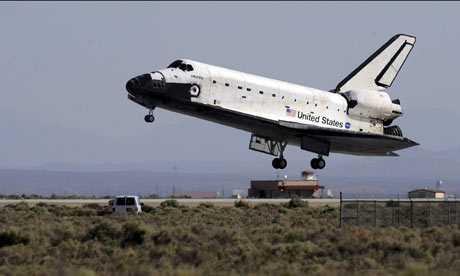
Last week we also saw the end of NASA’s Space Shuttle program.   After thirty years and 135 missions, when Atlantis touches down on Mother Earth next week, that’s it: no more shuttles.  I’m not really sure how this is going to work, given that they left a couple of folks sitting up in the International Space Station.  Honestly, if it was me up there I’d have my suitcase packed and be saying something like, “Hey, guys!  Where ya goin’?”  Apparently, it’s all good though.  The US is just going to pay Russia to haul their astronauts back and forth, at least until Richard Branson’s Virgin Galactic gets off the ground — literally.  Personally, I’m overwhelmed by the irony.  The nation that once shot billions of dollars into the air — just to make sure the first boot on the moon was Neil’s and not Nikita’s — is now asking Nicky to drive the bus!  The old comrades who worked on the original Soviet Soyuz program are probably having a couple of vodkas and a few high fives over this one.  “Who is doing the laughing now, running dog capitalists?”

The thing is some people are blowing this all out of proportion.  They’re saying things like this is the beginning of the end of the American Empire or it’s the high water mark of Western influence over history.  Although I fear for the end of the American Empire, I doubt if the death of the shuttle program marks anything.  In reality, NASA is finally getting out from under a huge mistake they made after they quit going to the moon in 1972.  At that point, they should have abandoned the process of putting people on top of a ballistic missile and gunning them into space.  Instead, they should have developed a vehicle that could both take off and land from the relative safety of terra firma, just like Branson is doing (even as we speak.)  If they had done that, today, ordinary billionaires would be taking their mistresses on vacations to the Sea of Tranquillity, and Moon Base One would probably have a Trump Hotel and casino.  Unfortunately, NASA was so locked in to rockets in the 70s they wasted billions of dollars and 40 years.  Now they have to play catch-up — just at a time when Obama and Congress have to start watching their pennies.  Oh, well!  Better late than never.

Finally, last week marked the end of the News of the World and although everyone applauded, it didn’t actually end; it just changed its name to protect the guilty.  You can read about it here.

Endings are easy.  It’s beginnings that are hard.  The people of South Sudan, the newest nation in the world, are about to find that out.

Wednesday: The nuts and bolts of nation-building in South Sudan.