I’m Scared Of The Mob (2018)

I’m a coward.  I’m scared of the mob.

Social Media
Carolyn Bourcier 

One of the problems with observing our modern world is you spend most of your life in fear.  This comes from having an opinion and voicing it outside the comfy confines of your own head.  It’s a truism in the 21st century that, whenever you say anything about anything, you’re going to piss off somebody.  Most people get all free-speech-macho about this, but when push comes to shove, everybody knows that our society is unforgiving around unguarded opinions.  More importantly, when the mob turns against you, you’re punished severely.  This is why we’ll never produce a contemporary Mark Twain: the consequences of unedited thoughts, in today’s world, are just too dangerous.  Far better to be momentarily safe than monumentally sorry.  Thus, people with pens tend to stick to the road most travelled.  Unfortunately, that road is crowded with dumbass clichés.  Future anthropologists who attempt to piece together our society from the mountain of evidence we’re going to leave behind will conclude we had an unholy obsession with heterosexual white men.  They are the nominated villains of our time, so naturally the record will read like a bad John Grisham novel.   It’s a sorry state, I suppose, but it beats the hell out of our world according to Suzanne Collins and E. L. James!

Actually, there’s no real problem with history recording our time as the shallow end of the intellectual swimming pool.  None of us are going to be around to be embarrassed by it anyway.  Nor do we have to worry about future chroniclers calling us cultural cowards.  They won’t be the slightest bit interested in our existence.  After all, you get historical ink from speaking up, not lying down.

The thing that burns the bacon, however, is that having set the table for a vigorous and dynamic dialogue, we’re now scared skinny of the food fight it might create.  Just look around: we have a mostly educated public with the information of the ages at their fingertips (literally.)  We’ve cracked open the Old Boys’ Club and now have instant access to all manner of ideas from everywhere and everyone.  Furthermore, we live in a free society, where (for the most part) the rule of law gives free range to these ideas.  Life is good, right?  Wrong!  The first thing we did with this intellectual banquet was set dietary restrictions.  Not to beat the metaphor to death, we’ve populated our world with so many sacred cows that, in the land of intellectual plenty, we’re starving to death.

It used to be that the only thing that governed public discourse was civility.  There was decorum in our discussion.  For example, we didn’t call each other names – like alt-right asshat and snowflake libtard.  Perhaps certain subjects were handled delicately, but there was never any thought that they should be avoided.  In fact, it was a matter of honour to shine light into the darker parts of our society – distasteful or not.

These days, those days are over.  We have more conversational taboos than a tribe of Borneo headhunters.  (No offence, headhunters!)  There are a ton of subjects in our world that are simply no longer open for discussion.  Some of them I can’t even name in these pages without hollering up a verbal lynch mob.  In the past few years, this list has expanded exponentially.  Soon the only subjects anyone will feel comfortable commenting on will be Donald Trump’s infidelities and the zombie apocalypse.

People like me, who know enough about history to understand what the mob is capable of, are cowards at heart.  It’s one thing to go Vaclav Havel on the powers that be and strike out against censorship and oppression.  After all, history shows us that eventually the pen is mightier than the sword.  However, it’s quite another to stand alone in front of a self-righteous mob of social media trolls who are gathering the torches for a good old-fashioned Twitter roast.

In these troubled times, I do not fear the endless apparatus of the omnipotent state.  It’s the Eagerly Offended anarchy of social media that scares the crap out of me.


Full Disclosure: I originally wrote this is 2013 but had to do some editing because things have gotten a lot worse in 5 years.

Facebook Sucks … Kinda/Maybe

OMG, the sky is falling!  Citizens, run for your lives!  SAVE YOURSELVES!

facebook1

This moment of panic was brought to you by Mark Zuckerberg and the good folks down at Facebook.  Apparently, those fun-loving scamps in Menlo Park, CA have been slackin’ off in the I’ve-Got-Your-Back department and allowed another company, Cambridge Analytica, to harvest personal data from a bunch of unsuspecting Facebook users.  Actually, “a bunch” is a bit of an understatement; the real numbers are north of 50 million.  Wow!  This is a serious no-no, and I have the feeling “my bad!” isn’t going to cover it.  (Although it looks like Zuckerberg is giving it the good ol’ Harvard try.)

I’ll grant you that this sordid bit of business looks remarkably like some faceless corporate somebody is peeking in the bedroom window, but let’s not get all lynch mob crazy just yet.  There are a few things we have to consider.

One — Unless you’ve been living on one of the moons of Uranus for the last 30 years, you know that the Internet is kinda like Santa Claus:
It sees you when you’re sleeping
It knows when you’re awake
It knows if you’ve been bad or good
So be good for goodness sake!
Cyberspace is not a vacuum, and every computer click that happens there is going somewhere.  Only children and the hopelessly uniformed believe the Internet is a private party.

Two — The people who are suddenly swimming in a sea of indignation over their invaded private parts are the same ones who’ve been posting their lives away on social media.  Honestly, if you’re telling the entire world everything about yourself — from your college Beer Pong championship to what you had for lunch at Olive Garden — you don’t have a lot of room to complain.  There’s such a thing as due diligence.

Three — Right now, Facebook might be the Big Bogeyman (Bogeyperson?) but they’re not the only ones collecting your private information.  Literally everything, in the 21st century, is selling you out to Cyberspace — from your Smart phone and its GPS tracker to that Rewards Card in your wallet that offers up your buying habits every time you swipe it.  At any given moment, some Internet minion somewhere can probably pull up a profile and tell you what size underwear you’re wearing and where and when you bought it.

But finally — So what?  Like it or not, we all know privacy has always been a movable feast.  Anybody who grew up in a small town will tell you that.  Personally, I’m not too pleased my preference in intimate apparel is getting harvested by 1,001 data management companies across the world, but my alternatives are limited.  I can a) sit around and bitch about it or b) pull the plug on my digital world and walk away.

So far, I’m not prepared to do either one.

Social Media Makes Us Tribal

neanderthals

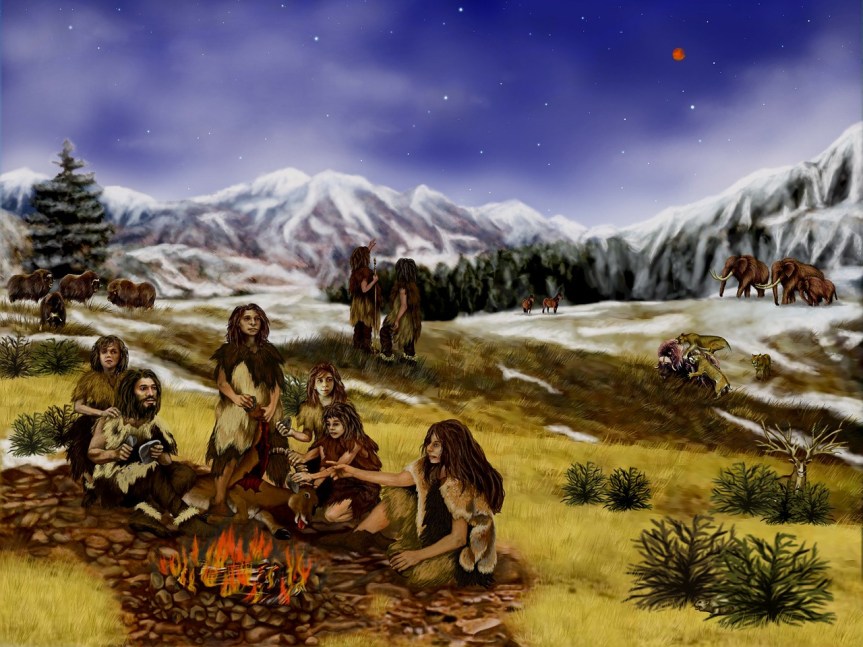
Here at the shallow end of the 21st century, social evolution has stopped.  Having fallen short of Marshall McLuhan’s big idea of a Global Village (a long story for another time) we’ve unconsciously abandoned it, and now we’re reverting back to the comforts of our parochial tribal past.  This sounds preposterous (especially at a time when a guy in Indonesia can watch a YouTube girl in Belgium burp the alphabet in real time) but it’s absolutely true, and I can prove it.  First, the quick and dirty history lesson.

About five minutes after our ancestors dropped out of the trees, they made an interesting discovery.  Individually, humans are at the bottom of the food chain.  As animals go, we aren’t quiet enough, fast enough or strong enough to be anything more than dinner.  However, taken together, with these big brains of ours, we are the ultimate predator, capable of killing and eating everything in our path.  So, it made sense for humans to hang out in groups.  Originally these were 4 or 5 extended families who all knew each other and shared a common idea: let’s not get eaten, and let’s eat.  These early tribes, separated from each other by distance and geography, were naturally suspicious and even hostile to anybody outside the group.  As in: “This is my food chain.  Get your own!”

Now, throw in  half a million years of social evolution — agriculture, industry, art, religion, politics, etc. — and you end up here in 2017.  Our food chain stretches across the planet, and we don’t give a damn about distance and geography.

In our time, a billion people watched Pippa Middleton’s fine behind waltz into Westminster Abbey when her sister Kate married little Billy Windsor.  A year later, a chubby Korean pop star turned a silly dance called Gangham Style into a planetary phenom.  Half the world watches the Olympics, and more than that watch the World Cup.  Local disasters like hurricane Irma are heard around the world, and very few people on this planet don’t recognize Trump or Putin or Adele or Taylor Swift.  These are the shared ideas of an Internet-driven, One Click Universe.

However, the Internet also has an unexpected consequence — Social Media.  Social Media allows us to retreat behind our screens, surround ourselves with people who have similar ideas, and isolate ourselves from the people who don’t.  Sound familiar?  Take a look at your Facebook account.  I’ll bet (give or take some petty disagreements) everybody there basically shares your fundamental values.  This is your tribe (E-tribe?) and they’re only doing what tribes are supposed to do — keep the group cohesive and strong.  Instagram and Snapchat work the same way.  So do Tumblr, Pinterest and even the mighty Twitter.  Objectively, Twitter’s attacks on strangers are nothing more than a Cybertribe being very, very hostile to an outsider who doesn’t share their point of view.

Our Internet world may let us look far beyond the horizon to occasionally sneak a peek at Pippa’s bum or to cheer Götze’s World Cup winning goal, but on a daily basis, we’re using it to check Facebook (or Twitter etc.) ’cause that’s where our friends are.  And our friends, by definition, share our values and echo what we already know to be true.  The problem is that, as we spend more and more time in Cyberspace, we’re spending more and more time in the comfort and safety of our tribe.  Unfortunately, this means we have less and less time for ideas and attitudes we don’t agree with — and so they’re becoming more and more foreign to us.  As are the people who expound them.  Thus, the sophisticated ideal that there’s a universal core to human existence is slowly seeping away, and it’s being replaced by the more immediate and primitive “them and us” mentality.  Our ancestors gathered together in tribes for safety and as the nuances and complexities of our world threaten us we are doing the same.