Election 2012: Obama’s Turn

The odd thing about elections is that they’re so easily sidetracked.  Major issues give way to pivotal moments that wouldn’t warrant a page five headline in normal times.  Michael Dukakis’ now infamous joyride on an M1 Abrams tank in 1988 comes to mind.  Few, if anybody, really remembers what Dukakis had to say in ’88 but the image is still there – slightly silly – definitely un-presidential.  It’s the simple things that define an election.  The thing is most concepts are just too complex to explain in a sound byte or a television ad.  Thus, candidates have to distill a broad spectrum of ideas into one overwhelming message and hope it sticks to the electorate.  Franklin Delano Roosevelt did it with The New Deal, John Kennedy with The New Frontier and in 2008, Hope and Change carried Barack Obama to the White House.  The problem is these encapsulated messages are fragile creatures, and like Humpty Dumpty, if they shatter, there’s no way to pick up the pieces.

There’s not a lot of talk about Hope and Change in the Obama camp these days.  The mood is more hunkered-down.  The Democratic National Convention still has the hoopla, but the party atmosphere of 2008 is gone.  People are serious.  This isn’t going to be a skate to November like it was last time.  There’s a broad admission that, “We’re not there yet.” and there’s a lot of work to do.

Tomorrow, the Democrats bring out the big guns – Bill Clinton and the president himself.  Barack Obama doesn’t need to convert the faithful anymore; he needs to reconvert the sceptics.  It’s a difficult situation.  In 2008, Obama’s message was one simple idea — I am the solution.  Here in 2012, it’s more complicated than that.   He’s got to tell the electorate that he is indeed still the solution, but he also has to convince them that he’s not actually the problem.  Meanwhile, the Republicans have branded their guy a matte finish Mr. Fix-it.  No gloss, no gleam, just a clear picture of a repairman who can spot-mend the immediate mess and hold the line until Christie and Ryan and Rubio are ready to take over.

So far, there has been no defining moment in this election, but there will be.  If Obama is smart — and I know he is — he will stay away from going toe to toe with the Republicans.  He needs to bring on the glitter, paint the Republicans as joyless suits and ties, and rekindle those personal flames that were burning election night four years ago.  If he does that, he’ll probably get four more years; if he doesn’t, he can get busy planning his library.

Labour Day

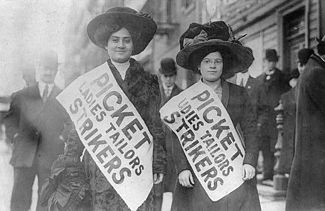
Today is Labour Day — a holiday that has fallen on hard times of late.  I have a long connection with Labour Day.  Despite outward appearances, I have actually laboured.  I was once a member of the now defunct AUCE (Association of University and College Employees) Union.  I have a Withdrawal Card from the International Meat Cutters Union and I belonged to the Rock and Tunnel something-or-other for two weeks one morning.

My father was a union man – a Teamster for most of his life.  He was nine years old during the Great Strike in Britain in 1926, and according to my grandmother, was enraged when he wasn’t allow to eat at the Union Soup Kitchen with his schoolmates.  My grandfather wasn’t a miner; he worked for an insurance company.  After the Great Strike was broken, he was fired.  Apparently, he’d been cooking the books so that the Scottish miners who couldn’t afford the premiums during the strike wouldn’t loss their insurance.  My grandparents emigrated soon after that.

When I was a union member, I went to all the meetings and once I even got to speak.  I don’t remember what I was for or against, but I was part of the process.  I have both walked picket lines and tried not to cross them but to me, as to most people, Labour Day in just an end-of-the-summer three-day-holiday.

It’s not supposed to be that way, you know.  Labour Day is supposed to honour the men and women who took the early bus, worked hard and stuck to their principles when the people they worked for had none.  It’s supposed to show us where we came from and how we got here.  Unfortunately, in 2012, Labour Day is more about barbeques than collective bargaining.

The problem is, since the 60s-going-on-70s, the trade union movement has been steadily losing the PR battle.  Even as far back as the 80s, when Reagan told the Air Traffic Controllers to take a hike, there was no general outcry of union-busting — even though that’s exactly what it was.  During the 90s and after the turn of the century each economic crisis pushed union membership further into the background even though it should have been taking centre stage.  So, for the most part, these days, if you don’t already belong to a union, you’re not all that enthusiastic to join one.  It’s more a condition of employment than a utopian vision of the future.  In fact, union membership in the private sector has been declining for half a century.  It’s only the big public sector unions that can boost an increase in membership.  It’s strange, but just as the need for unions is increasing, their appeal in dissolving away.

The unfortunate truth is that the trade union movement hasn’t kept up with the times.  They’re fighting 21st century labour battles with 19th century thinking.  Most union members in today’s economy make decent money.  They don’t toil in sweatshops like their grandparents did.  They have paid vacations and pensions and medical leave.  So when it comes to the public face of the union – the strike – it’s hard to convince anybody that union workers are downtrodden.  Likewise, the ridiculous rhetoric that all employers are closet robber barons, whipping the proletariat and pouncing on widows and orphans, lost its credibility years ago.  The antagonistic stance most unions still take was born in a day when some negotiations took place at the point of a gun.  The world has moved on since then.

The trade union movement needs to quit being production’s nasty little brother.  Back in the day, it was perfectly acceptable to shout its demands with a clenched fist.  But that adolescence is over.  With maturity comes greater responsibility.  Unions (especially in the public sector) have to become willing partners in the means of production, not cunning adversaries.  Most importantly, unions must demonstrate their relevance to the here and now.

Labour Day is a mostly forgotten holiday because–instead of reflecting on and honouring its turbulent past– the trade union movement wants to continue to live there.

The Retort: A Fading Art Form

Even though I spend most of my time running a losing race with technology, I love it.  I look at kids phone-thumbing their way across the virtual universe and think “What a wonderful time to be alive!”  However, like most people my age, I’m already nostalgic for some of the finer points of the old world that technology is destroying.  First among equals on that list is the retort, that verbal slap that says: “Throw down!  ‘Cause this conversation just got serious.”  It’s impossible to retort electronically.  First of all, there’s too much lag time.  The retort has to be on the fly, swift, offhanded and sharp as a rapier’s thrust.  Secondly, there’s way too much nicey-nice in the digital world; too many LOLs and those sucky little emoticons.  The best you’ve got to be demonstrative with is the cap lock key, and that’s just sorry.  Finally, the retort has to be face to face; half of its power is delivery, half is tone and the other half is the nanosecond of recognition in the other person’s eyes that says “Gotcha!”

It’s really too bad the retort is fading from our world; however, I’ve collected a few to save them for posterity (like memorized books a la Fahrenheit 451) in the hope that, one day, the retort will be resurrected for general use.

I’d agree with you if you were right.

We can’t have a battle of wits; you’re an unarmed man.

If you’re so smart, why aren’t you rich?

That argument is an encyclopedia of misinformation.

If you’re trying to be a smart ass you only got the second half right.

Obviously, the only thing on your mind is a hat.

I could drive a truck through that argument and never hit the truth.

You’re not the village idiot; you’re his apprentice.

There are only three things wrong with that argument: the beginning, the middle and the end.

If thought were a symphony orchestra, you’d be playing the bagpipes.

I could make a better argument out of Alphabet Soup.

What did you study in school?  Recess?

Ideas that are that stupid should be put in solitary confinement.

That isn’t a painting; it’s paint.

That idea is about as bright as Cassiopeia on a cloudy night.

If stupid was an Olympic event, you’d be in the medal round.