
Letter to the Passport Office

juneAlthough I just got this letter it’s been running around the Internet for some time now.  Normally, I don’t pass on e-mails but this one is too hilarious to miss.  It styles itself as real — it’s not (since I received it I’ve seen a couple of different versions.)  I’ve updated it a bit and cleaned up some of the language but aside from that it’s exactly as it came to me.  If you’ve ever filled out a government form you’ll love it.  Enjoy!

Dear Mr. Minister,
I’m in the process of renewing my passport, and still cannot believe this.
How is it that Radio Shack has my address and telephone number and knows that I bought a TV cable from them back in 1997, and yet, the Federal Government is still asking me where I was born and on what date.
For Christ sakes, do you guys do this by hand?
You have my birth date on my social insurance card, and it is on all the income tax forms I’ve filed for the past 30 years. It is on my health insurance card, my driver’s license, on the last eight goddamn passports I’ve had, on all those stupid customs declaration forms I’ve had to fill out before being allowed off the planes over the last 30 years, and all those insufferable census forms.
Would somebody please take note, once and for all, that my mother’s name is Maryanne, my father’s name is Robert and I’d be absolutely astounded if that ever changed between now and when I die!
I apologize, Mr. Minister. I’m really pissed off this morning. Between you an’ me, I’ve had enough of this bull! You send the application to my house, then you ask me for my freakin’ address. What is going on?  Do you have a gang of Neanderthals workin’ there?
Look at my damn picture. Do I look like Edward Snowden? I don’t want to destroy Western Civilization for God sakes. I just want to go and park my ass on a sandy beach in the sun.
And would someone please tell me, why would you care whether I plan on visiting a farm in the next 15 days? If I ever got the urge to do something weird to a chicken or a goat, believe you me, I’d sure as hell not want to tell anyone!
Well, I have to go now, ’cause I have to go to the other end of the city and get another copy of my birth certificate, to the tune of $60 !!!
Would it be so complicated to have all the services in the same spot to assist in the issuance of a new passport the same day??
Nooooo, that’d be too damn easy and maybe make sense. You’d rather have us running all over the place like chickens with our heads cut off, then find somebody to confirm that it’s really me on the goddamn picture – you know, the one where we’re not allowed to smile?!
Morons!
Hey, you know why we can’t smile? We’re totally pissed off!
Signed – An Irate Canadian Citizen.
P.S. Remember what I said above about the picture and getting someone to confirm that it’s me? Well, my family has been in this country since 1776 when one of my forefathers took up arms against the Americans. I have served in the military for something over 30 years and have had security clearances up the yingyang.
I was aide de camp to the lieutenant governor of our province for ten years and I have been doing volunteer work for the RCMP for about five years.
However, I have to get someone to verify who I am – you know, someone like my next door neighbour, Mr. Park, who was born and raised in the South Korea.
I’m An English Major

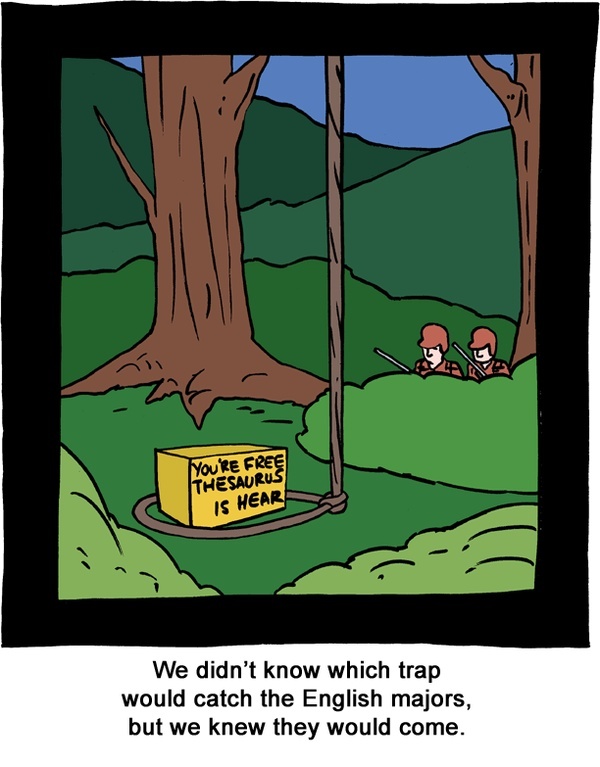
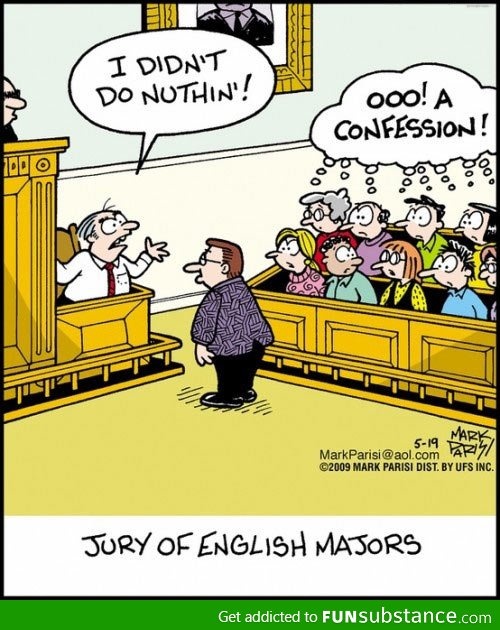
This week, I had another run-in with techies.  Honestly, I’m getting a little sick and tired of their superior attitude.  Look, you know-it-all nerds, I’m an English Major and I can do pompous ass better than you ever thought of.  (Yeah, that’s a preposition at the end of a sentence; what are you going to do about it?)  Just to set the record straight — English Majors were geeks, nerds and tweebs centuries before techies were ever even thought of, so don’t get all high and mighty with me.  And just remember, back in high school, while you were playing Space Invaders and dreaming about cheerleaders, I was in the only guy in the Poetry Club. (You do the math!)

english4

english5

english12

english7

english10

english11

english22

TV is Dead: Long Live TV!

tv ad2For a decade or so when I was young, I didn’t have a television machine.  It wasn’t because I have a philosophical argument with mass media – I don’t.  In fact, I’ve always been one of the cheerleaders – even back then.  Nor was it merely a sign of the times; despite popular mythology, even the most dedicated hippies of the Stoned Age watched television.  My situation was simple economics.  I couldn’t afford one in university, and it just got to be a habit.  As a result, I have no burning nostalgia for the days of Everybody Loves Friends TV.  To me, network television was just another brick in the media’s mind-numbing wall.  So, it’s with no emotion whatsoever that I can report the imminent death of television, and unlike Mark Twain’s premature demise, this is no exaggeration.

Let me clarify.  I’m not saying that those shiny screens we’ve got all over the place are going to follow the dinosaurs into extinction. Absolutely not.  Actually; I think we’re going to accumulate even more.  They’re going to get bigger.  They’re going to get smaller.  They’re going to be everywhere; and soon it’ll be impossible to escape their reflected glow.  But they’re not going to be the kind of television anybody born in the 20th century remembers.  Those times are gone and soon to be forgotten.

Way back in the day, when Milton Berle and Lucille Ball ruled the airwaves like media admirals, television was structured the same way as radio.  There were local programs of regional interest, but the national news and hardcore entertainment was provided by the networks.  We lived in a one-size-fits-all culture back then, and the whole family watched TV – together.  So when Lucy had “some ‘splaining to do” on Monday night, literally millions of people saw her do it and got the joke.  Network television built its power from those numbers and the massive advertising revenue they generated.  It was a lucrative arrangement, and TV to you and me was free.

Then along came cable.  Suddenly, media moguls discovered that the public would pay for television. What a novel idea!  Cable TV became the value-added medium that radio never had been.  People were willing to shell out substantial bucks for a few extra beyond-the-rabbit-ears channels and consistent sound and picture quality.  Within a couple of years, North America was wired up and life was good in media land.

Then along came Ted Turner, a guy who made a billion dollar career out of thinking outside the box.  In the early 70s, he figured out that the huge advertising dollars the big three networks were generating was simply a numbers game.  He knew that if he could broadcast his local station, WTCG, nationally, like the networks did through their affiliates, he could produce those numbers also and the ad revenue they generated.  Unfortunately, Ted didn’t have a network, or any affiliates or even very much money.  However, Ted realized he didn’t need any of those things because he could use the TV cables that local media companies had been stringing up all over the continent.  Those cables were hardwired into Ted’s potential national audience.  In 1976, the FCC approved Ted’s plan to broadcast WTCG nationally through hundreds of local cable networks, and the first Superstation was born.

From there, the floodgates were open.  Soon there were other superstations—notably, WGN Chicago and, of course, CNN.  By tv ad3the time Bill Clinton was in the White House, everybody and his friend had a specialty channel.  At the turn of the century, the 500 channel universe was alive and thriving and, ironically enough, already dying, as technology began to outrun the simple bit of coaxial cable that spawned it.  The Internet, once hardwired into your home or office was going wireless and when Stephen Jobs introduced the iPhone the revolution was on.

Today, as wireless communication grows, televisions are becoming empty receptacles – mere screens that host video games, iTunes, YouTube, Netflix etc. etc.  More and more people are choosing what they watch– and when they watch it– without reference to what television stations or networks are broadcasting.  Soon, that 60-inch big screen will be a slave to your smartphone, networks will produce pay as you play content only, and local stations, if they’re smart, will return to what they do best– local news and information.

By the time Lucy and Desi celebrate their 70th anniversary of reruns, nobody’s going to remember how we used to watch them, and television, as our generation knew it, will be dead as disco.