Christmas: A Victorian Invention

Obviously, Christmas, as we know it, started quite literally in the year dot.  Like it or don’t, the birth of Christ is the single most important event in the history of Western civilization.  Here in the 21st century, we continue to celebrate the day as a religious, secular or “hell of a good time” holiday.  It’s a tradition.  However, it’s a relatively new one.  Our celebration at Christmas started accidently, in the1840s, when these two events coincided.  First of all, an English author published a novel; secondly, Queen Victoria married a German.  Without these two isolated events happening at just the right time, we’d all be sitting around December 25th burping up turkey and looking for batteries — for no apparent reason.

When Queen Victoria ascended the throne in 1837, there was a feeling that this was the beginning of a new age in Britain.  The Napoleonic Wars were long over and mostly forgotten, and the world was enjoying a time of relative peace.  The industrial revolution was producing not only a new prosperity but also a new middle class who had both money and leisure.  They could enjoy things like travel, family life, and even hobbies such as reading for pleasure.  Also in 1837, a relatively unknown author named Charles Dickens published a newspaper serial called The Pickwick Papers.  Within about 5 chapters, he had suddenly become the J.K. Rowling of the 19th century.  The new English middle class fell in love with Pickwick.  Soon, people on both sides of the Atlantic were lining up to get the latest instalment of his adventures.  One of the most enchanting episodes in The Pickwick Papers was a fanciful description of a Christmas festival.  Christmas was undergoing a bit of a revival at the time, and Dickens’ highly fictional description gave people something to emulate.  It was very much the same as when people today talk and act like their electronic friends on TV.
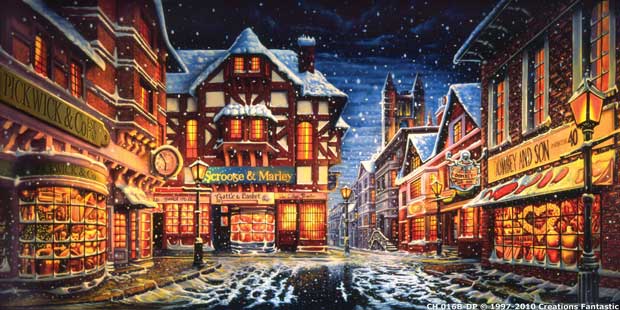
For the next couple of years, Charles Dickens kept himself busy.  He published some very successful novels — Oliver Twist and Nicholas Nickleby, among others.  Then, like most successful authors, he decided to shoot his mouth off.  He ran afoul of his American audience by advocating some rather radical ideas like universal copyright (so those damn Yankees couldn’t steal his stuff) and the abolition of that quaint American custom of slavery.  Suddenly, he was losing some pretty valuable customers on the other side of the Atlantic.   He wanted to get them back, so he began writing a series of books he described as, “… a whimsical sort of masque intended to awaken loving and forbearing thoughts.”  He succeeded.  In 1843, he published A Christmas Carol and the world changed dramatically.  Once again, both sides of the Atlantic went crazy for Charles Dickens.  Scrooge, Cratchit and Tiny Tim were more popular then, than Edward, Bella and whatever the kid’s name is are today.

Everybody wanted to celebrate a traditional Christmas the way Dickens described it because — before Dickens wrote it — nobody actually kept Christmas that way.  He made it all up.  He took several traditions that were already there and put them together in a stylized setting.  It was fiction.  Plus, Dickens didn’t just write A Christmas Carol; there were five books in the series.  Every time our Victorian ancestors turned around, there was Charles with another feel-good Christmas story.  It must have been like getting beaten over the head with a rainbow.  By the time Dickens was done, Christmas was everywhere.  You couldn’t get away from it.

Meanwhile, in 1840, Queen Victoria married Prince Albert of Saxe-Coburg and Gotha, her German first cousin.  Albert showed up at Buckingham Palace with all his German sensibilities intact, including some very noticeable Christmas traditions — like decorations and the tannenbaum or Christmas tree.  Christmas trees had been around for some time, but it wasn’t a common practice in England to cut down a tree and haul it into your house.  Any trees that did get cut down around Christmas were normally thrown into the fire as Yule Logs.  However, the popularity of the young, good-looking monarchs was such that, when Victoria and Albert appeared with their children in front of a Christmas tree, in The London Illustrated News, Christmas celebrations became uber-fashionable.

The social ladder now had a new rung, and people all over England and America began decorating their houses at Christmas, just like they assumed their aristocratic betters were doing.  Thus, the height, breadth and weight of the Christmas table one set became society news and reason for gossip.  Everybody wanted to know what Jenny Churchill was wearing or what the Astors served for dinner — so they could do it, too.  It was Entertainment Tonight – only with bonnets and bustles.  Christmas was not only everywhere; it was trendy.  The result was that Christmas became the #1 holiday of the year — and has been, ever since.

Today, our Christmas celebration is surprisingly similar to that of our Victorian ancestors.  Of course, there have been refinements along the way.  In 1843, Horsley and Cole, a couple of bored Englishmen, invented Christmas cards.  Saint Nicholas was turned into Santa Claus by Thomas Nast and Coca Cola.  At some point, religious hymns became “I’m Dreaming of a White Christmas” and “Jingle Bell Rock.”  Add we’ve added Rudolph the extra reindeer and that stupid Little Drummer Boy (who was put on this earth just to annoy me.)  However, it’s basically the same Christmas they would have had a century and a half ago.  So, when you push your chair back from the table and look at the beauty of your own personal Christmas, take a nanosecond and thank Charles, Victoria and Albert, who invented it for you.
Pearl Harbor: The Reason Why

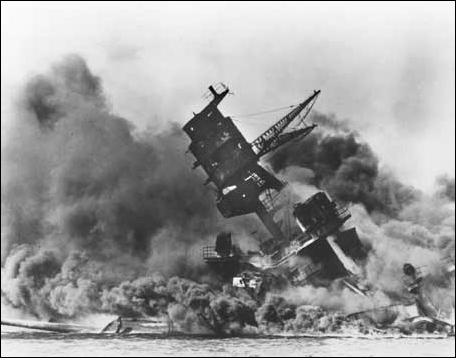
I love history.  It reads like a bad novel.  History has so many oddities, improbabilities and strange coincidences that, if you didn’t know it was true, you’d think it was all fake.  For example, today is the 70th anniversary of the Japanese attack on Pearl Harbor.  (FYI: you can’t just say “Pearl Harbor” anymore; nobody knows what you’re talking about.)  Whatever you call it though, aside from the American nuclear attack on Hiroshima three and a half years later, Pearl Harbor was the most important event in the 20th century.  It turned a European civil war into World War II, ended the worst economic depression in history and catapulted smalltown Americans onto the global stage – a role they’ve never been comfortable with.  That’s the thing about history though it’s full of unintended consequences that very few people see at the time.  I doubt very much if many Americans — even today — realize that the attack on Pearl Harbor was not the opening salvo in a carefully orchestrated Japanese plan to dominate the Pacific.  In fact, I think they’d be surprised to learn that, in general, the Japanese didn’t even want to go to war with the US (they were much more interested in Britain) and the devastating attack on Pearl Harbor was actually the direct result of a half-forgotten battle near the nowhere village of Nomonhan stuck somewhere on the Mongolian border.

Depending on how much time you’ve got, you can trace what Franklin Roosevelt called “December 7th, a day that will live in infamy” all the way back to a cold night in 1930, when a couple of Japanese colonels, stationed in Kwantung, China , got into the sake and hatched a plot to invade Manchuria.  Ishawara Kanji and Itagaki Seishiro, the particular colonels, knew what every person in Japan knows to this day.  Japan is a small bunch of islands that can hardly feed itself.  It has no natural resources, and unless it dominates international trade, it will always be at the mercy of every bullyboy with an attitude who happens to stroll by.  Remember, it was the American, Commodore Perry who dramatically pointed this out in 1853, when he sailed into Tokyo Bay, pointed his cannons  at anyone who poked their head up, and suggested the Japanese sign a treaty he just happened to have lying around the quarterdeck.  Anyway, Ishawara and Itagaki got to talking and decided that Japan needed a dependable source of raw materials (which, by coincidence, was going begging just across the border in Manchuria.)  They came up with a cunning plan, and on September 18th, 1931 manufactured an “incident” with China that sent Imperial Japanese troops across the border.  The Pacific Ocean, Pearl Harbor and America were never on the agenda.

In the 1930s, Japanese politics was so complicated it’s almost impossible to understand.  For example, the Japanese Emperor, Hirohito, who, as a living god, commanded absolute obedience from every Japanese citizen, never actually issued any orders just in case they weren’t obeyed.  However, in a nutshell, there were two political factions: the army (who saw the future intimately tied to mainland Asia) and the navy (who wanted a crack at the European imperial powers, Britain, France and the Netherlands.)  For most of the decade, the army dominated the government in Tokyo.  They saw China falling apart at the seams and figured with a few armoured divisions, some airplanes, and maybe a little poison gas here and there, they could take advantage of the situation.  China would become a Japanese province with a vast pool of subservient labour and a ready market for Japanese goods.  They also saw the resources of Manchuria dwarfed by the almost limitless expanse of Soviet Russia, which (once again) was now just across the border.  Remember, also, Japan, with Nazi Germany and Fascist Italy, was member of the Anti-Comintern (anti-communist) Pact.  They saw the Soviets as their natural enemies.  Besides, quite a few senior army officers had been young soldiers when Japan slapped the snot out of Russia back in 1905.  They didn’t see any problem with pointing their tanks north again.  It was quick and easy and handy to the homeland.

In 1932, Japanese troops reached the border between Manchuria and Soviet Mongolia.  The well trained victorious Kwantung army didn’t really see any need to slam on the brakes when their natural enemy, the Soviet Union was just an imaginary line away from getting its ass kicked a second time.  Over the next seven years, there were hundreds of very bloody “incidents” in the undeclared border war.  These “incidents” escalated over time until 1939, when a bunch of Japanese officers (without permission from Tokyo) decided to get serious and see just how tough these Soviets were.  They sent a couple of divisions to occupy the disputed territory.

The battle of Khalkhin Gol went back and forth for a couple of months.  However, times were changing for the Soviet Union.  They were in the middle of negotiating a non-aggression pact with Nazi Germany, which they signed in August, 1939.  This gave them the freedom to send a lot of soldiers and armour — that weren’t going to be needed against Germany in Europe — to the Far East to settle scores with Japan.  They were commanded by General Zhukov (the guy who would go on to defend Stalingrad in 1942 and take the Nazi surrender in Berlin in 1945.)  He massed over 50,000 Soviet troops, complete with tanks and airplanes, in an offensive assault in August.  He encircled the Japanese forces, at a village called Nomonhan, and when they wouldn’t surrender, destroyed them.  It was a humiliating defeat and it broke the back of the army’s independent power in Tokyo.  The way north was now blocked by a resurgent enemy, the Soviet Union and a back-stabbing ally, the Germans.  It was the navy’s turn to run the show.

Japan still needed raw materials, and the only other convenient place to get them was in southern Asia where the Europeans, preoccupied by their own war in Europe, were hanging on to their colonies by prestige alone.  There was rubber in British Malaysia and oil and gas in Indonesia (the Dutch East Indies.)   The problem was, in the ocean, directly between Japan and Jakarta, was The Philippines, an American colony.   Japan could not run the risk of having their military cut off from the homeland by a belligerent American navy, possibly based in the Philippines.  They needed to neutralize American sea power in the Pacific before they could go after the resources of the crumbling European empires.  And where was the America Pacific fleet based?  Pearl Harbor!

And the rest, as they say, is history.

History: Don’t be Afraid!

More than a few years ago, my niece asked me why we study history.  Actually, what she did was look up, in frustration, from a thick textbook that was mostly pictures and said, “Why do we have to learn about all these old _______s?  She used an expletive, inappropriate for a 15-year-old — even now.  I almost had a heart attack.  Not because of the expletive — I’d heard the word before – and used it a time or two.  No, I was astounded that there was someone on earth who wasn’t fascinated by old stories; especially when that somebody shared huge chunks of my DNA.  Up until that moment, I had thought everybody loved history.  I’ve since learned that large segments of our society are afraid of it.  My niece, by the way, has long since seen the error of her ways — or so she told me after several harangues on the subject.

These days, history is subject non grata in the halls of learning.  It’s kinda like farting.  Everybody is aware it exists, but it’s not acceptable in polite conversation.  People, in general, don’t talk about it and the ones who do aren’t really worth talking to.  It … makes people uncomfortable.  When the subject does come up, they tend to laugh nervously or give it the indignant scowl.  This is entirely understandable, by the way; most contemporaries don’t know enough about history to fill a mouse’s ear.  It hasn’t been taken seriously in Canadian schools for over a generation.  You see history is dangerous.  Not all those stupid dates and battles and crap – that’s just memory.  It’s the actual history itself – the wherefores and the whys – that’s what scares some people.  They’re frightened by the stuff that’s etched in stone – sometimes literally.

People who hate history do so for no other reason than that it exists.  It is the accumulation of our shared human experience.  It is a permanent collection of our ideas and ideals.  It not only tells us where we came from; it tells us how we got here.  It’s like having a bunch of really, really smart grandmas who know how to make cookies.  We don’t have to reinvent the chocolate chip wheel every time we want a snack ‘cause Grandma left us the recipe.  Pretty simple, actually, but it’s the way the entire world works.  For example, you might be reading this on your Smartphone because Grandpa Graham Bell wanted to talk to deaf people.  Or you’re commuting to work because great-grandpa Watt was fascinated by his mother’s tea kettle.  Or you see an emergency and call 911 because great-great grandpa Hammurabi figured out that the rule of law is better than every man for himself.  It’s all the same, and it goes on and on.  Every single one of our innovations and institutions is built on these little itty-bitty layers of knowledge, put together by our ancestors.  It’s a permanent record of what we are and we can’t change it.  That’s why a lot of people fear history so much.  It knows where the bodies are buried and it has all the evidence.

It’s very difficult to lie to people when they have all the evidence.  That’s why dictators take after history with such a vengeance.  They really don’t want people looking too closely at ideas that disagree with them.  Just look at Grandfather Hitler: he wanted to remake society into his vision of a fascist paradise.  So, one of the first things he did was gather up all the books that said anything different and burn them, in places like Heidelberg University.  He thought that if he destroyed the inconvenient parts of history (the ones that showed he was clearly a madman) he could rewrite the rest to justify his insanity.  He almost made it, too, but he was denied his demented social order because ordinary people all over the world knew better.

My point, of course, is if you want your vision of society to be the model for the future, it’s best to get rid of the past.  After all, the historical record of Hitler we’ve just seen shows us it’s impossible to convince people you hold the exclusive rights to utopian ideology when history says you’re a fraud.

These days, however, when you want to destroy the past, you don’t have to go all Fahrenheit 451 on it.  All you have to do is discredit it.  In my country, for the last couple of generations, history has gone from a serious study of events and ideas to a series of J’Accuse kangaroo court cases.  Historical people and events have been tried in absentia by a judge and jury of our temporary contemporary values and found guilty.  History is now considered to be nothing more than a set of misguided nefarious plots, perpetrated on the world by dead European men.  The quaint idea that our 2011 values are the be-all/end-all has closed the door on any serious discussion of history.  The irony is that every generation thinks history ends with them.

Obviously, history will continue, but with an entire generation historically illiterate, it’s difficult to realistically discuss either the present or the future.  We cannot talk about social, political or economic change when the only knowledge most people have is anecdotal living memory.  More importantly, without any background, many people cannot hope to understand our society’s serious problems.  It’s no wonder they seek wisp in the willows solutions or follow the simple demagoguery of sound bytes: their only point of reference is the here and now.

I’m certain that eventually, the pendulum of history will swing, but as our problems multiply exponentially by dint of overwhelming ignorance, it can’t come fast enough for me.  Fidel Castro once said, “History will absolve me.”  I’m not sure that’s going to work for us.